Japan is exciting, beautiful, and honestly… a tiny bit intimidating the first time, isn’t it!
You land after a long flight. Your phone battery is at 12%. You’re standing in a huge station. Your hotel looks “close” on the map, but somehow every exit leads to a different universe. And you’re thinking, “I don’t speak English… am I about to mess this up?”
Don’t worry, you’re not the only one. This guide is for you, dear nervous traveler friend (yes, you, you!). It’s a practical, calm list of what actually helps before you go, in your first 24 hours, and during your trip—without turning your planning into a second full-time job.
Quick note: Travel rules, entry requirements, train pass prices, luggage policies, mobile internet options, hotel services, ryokan policies, bath rules, tattoo policies, and local services can change over time. Use this guide as a calm starting point, and always check the latest official information before booking or buying anything important.
Quick Answer

If it’s your first time in Japan, focus on three things: stay connected (eSIM/SIM/pocket Wi-Fi), make transport easy (IC card + simple routes), and reduce friction (hotel location, luggage plan, a little cash, and basic manners).
Then add smart extras: reserve what sells out, don’t overpack your itinerary, and use maps/translation apps without shame.
Related guide: For a step-by-step landing plan (including entry prep and airport flow), read What to Do After Landing in Japan: A Simple Arrival Guide for First-Time Visitors.
Do This First: 7 Pre-Trip Actions That Prevent 80% of Stress
If planning feels overwhelming, use this as your simple priority list. You don’t need to do everything today—just start with the things that stop day-one panic.
- 1) Confirm entry requirements + passport validity using official sources (do this before non-refundable bookings).
- 2) Choose your internet plan (eSIM/SIM/pocket Wi-Fi) and set it up before you leave the airport.
- 3) Save your hotel info for offline backup: name, address, phone number, plus a map screenshot.
- 4) Decide your airport-to-hotel route (simplest > fastest for day one).
- 5) Plan your everyday transport: get an IC card (physical or mobile) and know how you’ll top up.
- 6) Make a small cash plan: know where you’ll withdraw, and carry a calm cushion amount.
- 7) Book only what truly sells out (special experiences, popular time slots, dream stays).
Stress-Free Tip: Put these into one note on your phone titled “Japan Day 1” and keep it pinned. When you’re tired, a short list is a superpower.
Best Time to Visit Japan (So You Don’t Accidentally Book the Most Intense Week)
Japan is worth visiting year-round, but your experience can change a lot depending on weather and crowds.
Spring and autumn: comfortable weather, bigger crowds
- These seasons are popular because walking around is easier (less heat, less humidity).
- Expect higher prices and fuller trains/hotels in many areas, especially during famous bloom and foliage periods.
Summer: lively, but plan for heat and humidity
- Summer can be fun for festivals and longer daylight.
- It can also be physically tiring if you’re doing lots of outdoor sightseeing. Build in breaks and indoor stops.
Winter: calmer in many cities (with some exceptions)
- Many areas feel less crowded, and you may find better availability.
- Some regions are very cold, and weather can affect travel, so keep your plans flexible and check forecasts.
Stress-Free Tip: If you can choose freely, pick the season that matches your energy level. Comfortable weather is nice, but slightly fewer crowds can feel even nicer.
Who This Guide Is For

This article is made for:
- First-time visitors to Japan who want a simple “what to know” list
- Travelers who do not speak Japanese and feel nervous about it
- People worried about getting lost at airports and big train stations
- Anyone choosing hotels, ryokan, or onsen stays for the first time
- Families with kids, or travelers with large suitcases
- Visitors who want to avoid crowds, avoid mistakes, and avoid wasting money
1) Check entry rules early (because boring paperwork loves surprises)
Let’s be honest. Entry rules are the least fun part of Japan travel planning.
But they’re the part that can ruin your day if you ignore them. Visa requirements depend on your nationality, and policies can change. So check your country’s official guidance and Japan’s official sources before you book non-refundable things.
Tiny warning: Don’t rely on a random blog post from 3 years ago. Even good blogs get outdated.
Stress-Free Tip: Put a calendar reminder for “passport validity + entry requirements check” the day you start planning. Future-you will feel smug.
2) Don’t try to do “Tokyo + Kyoto + Osaka + Hiroshima + Mt. Fuji + everything” in 7 days
A common first-timer mistake is planning Japan like it’s a small country where every city is “just an hour away.” Sometimes it is. Sometimes it is not.
What makes Japan tiring isn’t only distance. It’s the constant switching: packing, check-outs, station navigation, luggage, and new neighborhoods.
A calmer first-timer pacing idea
- 7 days: Tokyo as a base + 1–2 day trips, or Tokyo + Kyoto with one transfer
- 10 days: Tokyo + Kyoto/Osaka + one extra region like Hakone, Nikko, or Hiroshima
- 14 days: Two bases + a third region is possible without sprinting every morning
Stress-Free Tip: If you remember one thing, remember this: less moving hotels = more energy for fun.
Related guide: If you are still deciding where to stay, read Where to Stay in Tokyo for Your First Trip to Japan (Stress-Free Areas). Hotel area can make your first trip feel much easier or much harder.
3) Plan your first 24 hours (it’s the most stressful part)
This is where many first-time visitors get stuck. Not because Japan is unfriendly. Because your brain is jet-lagged and everything is new.
A simple “first 24 hours” flow
- Land → immigration/customs
- Get internet working: eSIM, SIM, or pocket Wi-Fi
- Get cash from an ATM and set up your IC card if needed
- Go to your hotel using the simplest route, not necessarily the fastest
- Do a convenience store stop for water, snacks, breakfast, and basics
A realistic moment to plan for
You may arrive at a large station, exit from the “wrong” side, and realize the hotel that looked 3 minutes away is actually a 15-minute loop with crossings and overpasses.
That’s normal. Stations are like small cities. You’re not failing. You’re just learning the map.
Stress-Free Tip: Save your hotel name and address in your notes app, and also save a screenshot of the map pin. When your signal is weak, screenshots feel heroic.
Related guide: For a calm, detailed arrival walkthrough, read What to Do After Landing in Japan: A Simple Arrival Guide for First-Time Visitors.
4) Internet in Japan: choose one main option before you land
Yes, there is free Wi-Fi in some places. No, it’s not something you want to depend on when you’re trying to find the right train platform.
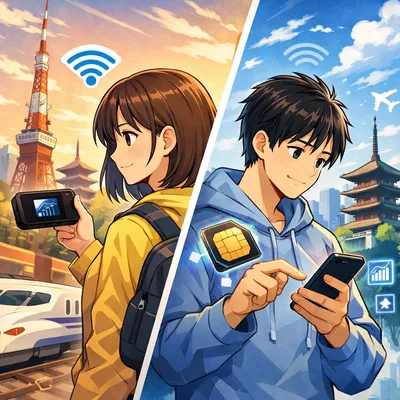
Your main choices
- eSIM: convenient if your phone supports it, with no physical swapping
- Physical SIM: good if your phone is unlocked and you’re comfortable swapping SIMs
- Pocket Wi-Fi: useful for groups sharing one connection, but it’s another device to charge
Stress-Free Tip: Whatever you choose, do one test: open maps, search a route, and load a translation app before you leave the airport.
Related guide: If you want a simple breakdown before choosing, read Pocket Wi-Fi vs eSIM in Japan: Which One Should You Choose?.
Related guide: For a practical first-timer pick (including setup), read Best eSIM for Japan: What First-Time Visitors Should Know (2026).
5) Money: Japan is not “cash-only,” but cash still saves you
Many first-timers hear “Japan is cash-based” and panic. Here’s the thing: cashless payment has grown a lot, especially in cities. But you will still run into moments where cash is the easiest option.
Common cash moments include smaller restaurants, local buses, tiny attractions, temple and shrine offerings, rural areas, and some older shops.
Stress-Free Tip: Keep a “calm cushion” amount of cash. Many travelers like having enough for one day of small purchases so they’re not hunting an ATM while hungry.
Related guide: If you are worried about payments, read Do You Need Cash in Japan? Simple Cash, Card & ATM Tips for First-Time Visitors.
Related guide: If you want to plan your total trip budget, not just daily cash, read Japan Travel Budget: How Much Money Do You Really Need?
6) No tipping (your wallet can relax)
Tipping is generally not expected in Japan. In many situations, it can even feel confusing.
Just pay the bill. Be polite. Say thank you. That’s the winning combo.
Stress-Free Tip: If you want to show appreciation, a sincere thank-you and being easy to serve, such as being ready to order and not blocking space, goes a long way.
7) Trains: get an IC card and you’ve already won
Japan’s transport system is amazing. It’s also… a lot the first time.
An IC card, such as Suica, Pasmo, ICOCA, and similar cards, makes daily travel smoother. You tap in, tap out. You can usually use it for convenience stores and vending machines too.
Tiny warning: Availability and purchase methods can vary by region and time. Check current options at the airport, station, or official transport sites.
Stress-Free Tip: When you’re tired, choose the route with fewer transfers, even if it’s 7 minutes longer. Transfers are where stress hides.
Related guide: For a simple explanation of cards, mobile options, and top-ups, read How to Use IC Cards in Japan: Suica, PASMO, and Other Travel Cards Explained (Stress-Free Guide).
8) Japan Rail Pass: don’t buy it “just because it’s famous”
You may see people online asking whether the Japan Rail Pass is “a must.” The real issue is not “is it popular,” but does it match your route?
If you’re doing multiple long-distance trips in a short window, it might help. If you’re mostly staying in Tokyo with a couple of day trips, it often doesn’t.
Because prices and rules can change, check the latest official information and compare your major trips before buying.
Stress-Free Tip: Write your big intercity trips on one line, such as Tokyo → Kyoto → Tokyo. If the list is short, you probably don’t need a big nationwide pass.
9) Big stations are confusing on purpose (okay, not on purpose, but still)
Tokyo Station. Shinjuku. Umeda. These places are legendary for a reason.
Many first-time visitors think, “If my hotel is near a major station, it will be easy.” Sometimes yes. Sometimes you just booked yourself into a daily maze with extra crowds.
What “easy station access” actually means
- A short walk from the specific line you’ll use most
- Few stairs, or reliable elevators
- Simple exits, not 40 exits with similar names
- A calm route at night, especially if you arrive late
Stress-Free Tip: Before booking, open the map and check: “hotel → station entrance” and also “station entrance → hotel.” The return walk is where people get lost.
10) Luggage in Japan: you don’t need to suffer
If you’re imagining dragging a big suitcase up stairs in a crowded station… yes, that can happen. But you can plan around it.
Simple ways to reduce luggage stress
- Pack lighter than you think. Laundry exists!
- Use station lockers when sightseeing between hotels
- Consider luggage delivery between hotels for multi-city trips
- Avoid rush hour trains with suitcases when you can
Stress-Free Tip: The “secret upgrade” for first-timers is sending the big suitcase and traveling with a small overnight bag for 1 night. It can make your transfer day feel 50% easier.
Related guide: If you want the practical steps (lockers + delivery), read How to Use Coin Lockers and Luggage Delivery in Japan (Stress-Free Guide).
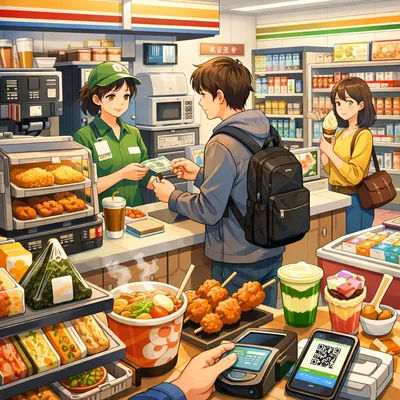
11) Convenience stores are your emergency support team
Convenience stores are not just for snacks. They can rescue you when you’re jet-lagged, underpacked, or just too tired to think.
You can often find decent meals, drinks, umbrellas, basic toiletries, simple medicine items, and sometimes ATMs.
Stress-Free Tip: On your first night, do a quick convenience store run. Water, breakfast, and one comfort snack. Sounds small? Maybe. But it helps.
12) Trash cans are rare (so carry a tiny bag)
Japan is clean, but public trash cans can be surprisingly hard to find.
So you may end up holding a coffee cup like it’s your new travel companion.
Stress-Free Tip: Carry a small plastic bag for your own trash. Drop it at your hotel or when you find a proper bin, often near vending machines, convenience stores, or stations.
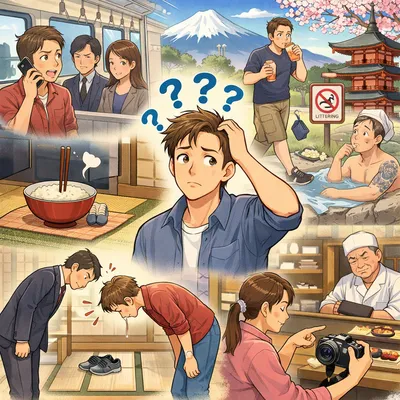
13) Basic manners: you don’t need to be perfect
Many visitors worry about “breaking etiquette.” Good news: you don’t need to memorize a rulebook.
In many situations, Japan’s manners boil down to: be considerate, be quiet in shared spaces, and follow the room.
A quick “do / avoid” cheat sheet
- Do: speak softly on trains, line up, keep bags out of the way
- Avoid: loud phone calls on public transport, playing audio out loud, blocking walkways
- Do: remove shoes where you see shoe racks, slippers, or a step-up entrance
- Avoid: eating messy food while walking in crowded areas (in calmer areas, use your judgment)
- Do: pause and look around when unsure
Stress-Free Tip: When you’re unsure, a small pause + looking around solves 80% of etiquette confusion.
Related guide: For simple, clear examples (trains, restaurants, temples, photos, shoes, and baths), read Japanese Etiquette for Tourists: What Foreign Visitors Should Know (Stress-Free Guide).
14) Food worries: allergies and dietary needs take planning (but it’s doable)
If you have allergies, vegetarian/vegan needs, or halal requirements, Japan can be wonderful… and occasionally tricky.
Labels and support vary by place, and smaller restaurants may not be able to customize.
What helps in real life
- Use translation apps for menus and labels (camera translation is especially helpful)
- Choose restaurants that clearly state options, especially in big cities
- Carry a simple note on your phone stating what you cannot eat
- Book ahead for special meals when possible
Stress-Free Tip: If your needs are strict, stay somewhere with easy food access nearby, such as station areas or big shopping streets. Convenience beats “cute but remote” on low-energy days.
15) Reservations: know what to book early vs. what you can wing
Japan has many things you can do spontaneously. But certain experiences sell out, especially in peak seasons.
Often worth booking ahead
- Popular museums with timed entry
- Theme parks and special exhibitions
- Highly sought-after restaurants
- Ryokan stays, especially with dinner or private bath options
Often okay without booking, with timing awareness
- Many temples, shrines, and parks
- Neighborhood exploring and shopping
- Casual restaurants, though you may need to wait at peak times
Stress-Free Tip: Book the “hard to replace” items first, such as special events, dream ryokan stays, or timed-entry attractions. Leave the flexible sightseeing for later.
Accommodation terms: ryokan and onsen without the confusion
If your first trip includes a ryokan or onsen stay, be careful with booking terms like private bath, family bath, and open-air bath. They do not always mean the same thing.
A ryokan is a traditional-style Japanese inn. An onsen is a hot spring bath using natural hot spring water. A private bath might be inside your room, or it might be a reservable shared facility used by one group at a time.
Tiny warning: Do not assume every “private bath” means a bath inside your room. Room descriptions can be surprisingly easy to misunderstand.
Stress-Free Tip: If a private bath matters to you, or tattoos are a concern, confirm directly with the ryokan or hotel before booking. Policies vary widely.
Related guide: Before booking a ryokan or hot spring hotel, read Private Onsen, Family Bath, and Open-Air Bath Rooms in Japan so you do not accidentally choose the wrong bath type.
Must-Have Apps and Tools (So You Don’t Feel Lost)
You don’t need 25 apps. You need a few that work reliably when you’re tired and surrounded by signs you can’t read yet.
- Maps: Google Maps (routes, platforms, exits, walking navigation)
- Translation: Google Translate (camera translation, conversation mode, offline packs)
- Train planning backup: a Japan train app for route checks when you want a second opinion
Stress-Free Tip: Before you fly, do a 2-minute test: open Maps, search your hotel, and download offline map areas if you like having a safety net.
Related guide: For a simple first-timer list (maps, trains, translation, entry prep, payments, and safety), read Japan Travel Apps You Should Download Before Your Trip (First-Timer List).
Related guide: If you want to feel confident using Google Maps for exits, platforms, and transfers, read How to Use Google Maps in Japan: Simple Tips for First-Time Visitors.
Common Mistakes (Totally Understandable, But Try to Avoid These)
- Booking a hotel “near the station” without checking which side or exits you’ll actually use
- Arriving without internet and trying to figure everything out on weak airport Wi-Fi
- Overplanning day 1 when your body may still be on a different time zone
- Assuming every “private bath” is in your room when sometimes it is reservable, time-limited, or paid
- Not carrying any cash and discovering your cute ramen shop is cash-only
- Dragging big luggage at rush hour when luggage delivery or a locker would have saved your shoulders
- Buying a big rail pass first and only later realizing your route doesn’t justify it
- Standing in the middle of a busy walkway to check your phone (step aside first—it instantly feels more polite and more relaxed)
Recommended Options (Choose What Fits Your Trip)
eSIM
Best for: Solo travelers who want simple setup and reliable maps/translation right away.
Not ideal for: Phones that don’t support eSIM, or travelers who dislike phone setup steps.
My honest take: It’s often the smoothest “first hour in Japan” solution if your device supports it. Just set it up before your flight or at the airport while you’re still calm.
Pocket Wi-Fi
Best for: Families or friends sharing one connection across multiple devices.
Not ideal for: People who forget to charge gadgets. It’s one more thing to keep alive.
My honest take: Great value for groups, but the extra device can become annoying on long sightseeing days.
IC card
Best for: Basically everyone using trains and buses in cities.
Not ideal for: Travelers doing almost no public transport, which is rare in Japan but possible.
My honest take: This is one of the biggest stress reducers. Tapping through gates feels like unlocking “Japan travel on easy mode.”
Luggage delivery
Best for: Multi-city trips, travelers with large suitcases, and families with kids.
Not ideal for: One-night-only hops where you need your suitcase immediately.
My honest take: It can cost extra, yes. But the comfort payoff can be huge. Confirm timing with your hotel so you know when your bag will arrive.
Stress-Free Checklist
- Check entry requirements and passport validity using official sources
- Decide your internet plan, such as eSIM, SIM, or pocket Wi-Fi, before flying
- Download key apps (maps + translation) and test them once
- Save hotel details and a map screenshot for offline backup
- Plan the simplest airport-to-hotel route, not only the fastest one
- Get an IC card or mobile IC option and load some balance
- Keep some cash for small shops, buses, and surprise cash-only moments
- Pack a tiny trash bag and a small day bag
- Make a luggage plan for transfer days, such as locker use or luggage delivery
- Book only the things that truly sell out; leave breathing room elsewhere
- Save your hotel emergency information and check basic disaster guidance for your travel season
What to Prepare Next
You don’t need to plan everything at once. Start with the parts that reduce the most stress first.
- Choose your hotel area based on ease, not just famous neighborhoods
- Sketch a simple route plan; two bases is often plenty
- List any must-do bookings, such as ryokan dinner plans, museums, or special events
- Decide how you’ll handle luggage on travel days
- Make a tiny first-day note: internet, cash, IC card, and hotel route
Related guide: If you want a calm, practical overview of hotel types, room sizes, and booking gotchas, read Japan Hotel Guide for First-Time Visitors: What to Know Before Booking.
Helpful Guides to Read Next
If this is your first trip to Japan, you do not need to learn everything at once. Start with the basics, then prepare the parts that feel most stressful for your trip.
- If you are worried about paying for things, read: Do You Need Cash in Japan? Simple Cash, Card & ATM Tips for First-Time Visitors.
- If you want your phone to work smoothly after arrival, read: Best eSIM for Japan: What First-Time Visitors Should Know (2026).
- If you want useful apps before you land, read: Japan Travel Apps You Should Download Before Your Trip (First-Timer List).
- If you are nervous about local manners, read: Japanese Etiquette for Tourists: What Foreign Visitors Should Know (Stress-Free Guide).
- If you are still choosing a place to stay, read: Where to Stay in Tokyo for Your First Trip to Japan (Stress-Free Areas).
- If you are worried about suitcases and station transfers, read: How to Use Coin Lockers and Luggage Delivery in Japan (Stress-Free Guide).
- If you are planning a ryokan or hot spring stay, read: Private Onsen, Family Bath, and Open-Air Bath Rooms in Japan.
Stress-Free Tip: Do not try to master Japan before you arrive. Prepare the parts that reduce the biggest stress first: internet, money, transport, hotel location, luggage, and your first day.
FAQ
Is Japan hard for first-time visitors?
It can feel intense at first, especially in big stations. But with internet access, an IC card, and a simple plan, Japan becomes surprisingly easy to travel.
Do I need to speak Japanese to travel in Japan?
No. You can do a lot with apps, signs, and polite gestures. Learning a few basic words helps, but you don’t need to be fluent to have a great trip.
Should I carry cash in Japan?
Yes, it’s smart to carry some. Cards and cashless payments are common in cities, but cash is still useful in smaller places and for certain transport and attractions.
Is the Japan Rail Pass worth it?
Sometimes, but not automatically. It depends on your route and number of long-distance trips. Check official prices and compare before buying.
How do I know if a ryokan bath is actually private?
Don’t guess. Read the room and bath details carefully, and confirm directly with the ryokan or hotel before booking, especially for tattoo rules and reservation systems.
Final Thoughts
Your first trip to Japan doesn’t need perfect planning. It just needs a few smart “stress blockers.” Internet that works, transport that’s simple, a luggage plan, and a first-day plan that assumes you’ll be tired.
And if you make a small mistake—wrong station exit, cash-only surprise, mild etiquette confusion—don’t panic. That’s not failure. That’s just Japan being Japan, and you learning fast.
You don’t need to be perfect. You just need to be prepared. You’ve got this, travel buddy!