You land in Japan. You’re tired. Your suitcase feels heavier than it did at home (mystery). And now you’re standing at a hotel front desk thinking, “Okay… what do I say?”
Don’t worry. This is where many first-time visitors get stuck. Not because Japan is “hard,” but because hotel check-in feels like a test when you don’t speak the language.
Here’s the good news: in many cases, hotel check-in in Japan is almost a “show and nod” situation. If you prepare a few things in advance—passport, booking proof, payment, and a tiny language backup plan—you can check in smoothly, even with zero Japanese.
Quick note: Hotel policies (check-in cutoffs, payment timing, deposits, taxes, English support, and whether a property is cash-only) can vary. Use this guide as a calm starting point, and always check the latest official information on your hotel’s website or your booking page before you go.
Related guide: What to Do After Landing in Japan: A Simple Arrival Guide for First-Time Visitors.
Quick answer: what to prepare for a smooth check-in
- Passport (original) for each guest (best to assume everyone needs theirs)
- Booking confirmation (screenshot + reservation number)
- Payment backup (card + a little yen cash)
- Your address written out (home address is fine) + basic details in a phone note
- Hotel contact link saved (for late arrival messages)
Japan hotel check-in: the standard flow at the front desk
If you like knowing what happens step-by-step, this is the usual rhythm. Not every hotel does it in exactly this order, but it’s a good mental map:
- Name confirmation (you show your booking / reservation number)
- Passport check (they confirm details and may take a copy)
- Registration card (you fill a short form)
- Payment step (pay now, or they register/authorize your card)
- Key + basics (room number, Wi‑Fi info, breakfast, checkout time, elevator)
Small move that helps: Before you walk up to the desk, open your booking confirmation on your phone and hold your passport in your hand. It speeds everything up and makes you feel instantly more “ready.”
The 4 things to prepare (so you don’t need Japanese)
1) Your passport (original, not a photo)
This is the big one. For travelers who don’t have a Japanese address, hotels commonly need to confirm your passport and take a copy. That’s why they ask, even if you already paid online.
A common surprise: they may ask for each guest’s passport, not just the person who booked. This can vary, but it’s smart to assume everyone needs theirs.
Tiny warning: If your passport is buried at the bottom of a suitcase, check-in becomes a mini workout. Keep it easy to reach.
Stress-Free Tip: Put passports in one small pouch. When the staff asks, you can hand them over calmly instead of doing the “pocket panic dance.”
2) Your booking confirmation (phone is fine)
You don’t need to speak Japanese if you can show the essentials: hotel name, your name, dates, and reservation number.
Many booking sites also show the hotel name and address in Japanese alongside English. That can make it easier for the front desk to match your reservation quickly.
Practical example: you just navigated a huge station, your battery is lower than expected, and you’re trying to find the right entrance. That’s when a simple backup saves your mood.
Stress-Free Tip: Take a screenshot of your booking confirmation (and save it offline). Screenshots don’t care about Wi‑Fi or weak signal.
3) A payment plan (plus a little yen cash)
In many cases, hotels in Japan take payment at check-in (or they register your card at check-in even if you pay later). This can feel “early” if you’re used to paying at checkout.
Payment methods vary by property, but commonly include credit card, debit card, and cash in Japanese yen.
Some budget properties (and some capsule hotels) may be cash-only or may require full prepayment at check-in. It depends on the place.
Stress-Free Tip: Carry enough yen cash for at least one night + a little extra. Not because Japan is “cash only,” but because the one time you don’t have cash is the one time you’ll need it.
4) A note with your address and basic details
At check-in, you’ll often fill out a guest card with details like:
- Name
- Home address (your country’s address is fine)
- Nationality
- Signature
You can usually write in the alphabet. No Japanese required.
But if you’re jet-lagged (or you’ve been carrying bags all day), writing your full address neatly can feel weirdly hard. (Why do you suddenly forget your own postal code? It happens.)
Stress-Free Tip: Save your home address in a phone note you can copy from, or bring it written on paper. Simple wins.
What to write on the hotel registration form (with examples)
The registration card is usually quick. Think of it as: “Who are you, where can we contact you, and who is staying in the room?”
| Common field | What to write (simple answer) |
| Name | Your name as on your passport |
| Nationality | Your nationality |
| Address | Your home address (street/city/country is fine) |
| Phone number | Your phone number (or the number you can be reached at during the trip) |
| Passport number | Your passport number (if the form asks) |
| Signature | Sign as usual |
If you have no Japanese address: That’s normal for visitors. Write your home address. If the form has a separate field that seems to ask for an address in Japan, staff will usually guide you. When in doubt, politely point to the field and wait—this is a very common situation.
Stress-Free Tip: Keep a single phone note with: your home address, your phone number, and your hotel name. Copying from your own note is faster than trying to remember details while standing at a counter.
Related guide: Japan Travel Apps You Should Download Before Your Trip (First-Timer List).
Payment, deposits, and extra taxes (what surprises people)
Most check-in stress comes from payment expectations, not language. Here are the common “wait, what?” moments to be ready for.
Pay at check-in vs. pay at checkout
Many hotels collect payment at check-in, especially business hotels and budget stays. Some collect at checkout. Some bookings are prepaid online. The only reliable answer is: check your booking conditions and the hotel’s current policy.
Deposit or card authorization (a temporary hold)
Some hotels may take a deposit or place a temporary authorization on your card for incidentals. This isn’t always an extra charge, but it can reduce your available credit until it drops off (timing depends on your bank/card).
Stress-Free Tip: If you’re using a tight-limit travel card, keep a backup card or enough yen cash so you don’t get stuck over a temporary hold.
Accommodation tax / hot spring tax (if applicable)
Depending on the city/area and the type of property, you may see an extra local tax added (for example, an accommodation tax). Hot spring areas may also have a separate bathing-related tax. These are usually not huge, but they can be pay-on-site even when the room is prepaid.
Stress-Free Tip: If your booking page says something like “taxes may be collected at the property,” assume you’ll need a little extra at check-in or checkout.
How to “talk” at check-in without talking much
If you’re worried about conversation, aim for a simple goal: communicate your name + reservation + dates. That’s it.
Most check-ins can be done with:
- A smile
- Your passport
- Your booking screen
- Pointing at dates and names
If you want one easy English line, this is enough:
- “Check-in, please.”
- “I have a reservation under (your name).”
If the staff asks something you don’t understand, these two lines are genuinely useful:
- “Sorry—could you speak slowly?”
- “Could you write it down?”
Stress-Free Tip: If you freeze, just place your passport and booking confirmation on the counter together. It quietly tells the staff what you need, without any speech.
Useful copy-paste messages (no Japanese needed)
Message template: late arrival
Send this through your booking site chat or email (edit the time and details):
Subject: Late check-in today
Message:
Hello. I have a reservation under [FULL NAME], check-in on [DATE]. My arrival is delayed and I expect to arrive around [TIME]. Please keep my reservation. Thank you.
Message template: I don’t speak Japanese
Message:
Hello. I will check in on [DATE]. I do not speak Japanese. If possible, could we communicate in simple English or by written notes? Thank you.
Check-in time: the part that can actually cause problems
Many hotels in Japan start check-in around 3:00 pm (and some, like certain business hotels or ryokan, may start earlier, such as around 2:00 pm). It varies, so check your booking details.
If you arrive early
Early check-in is sometimes possible, but it often depends on availability and may cost extra.
The easy, common solution: store your luggage until check-in time. Many hotels can do this, but it’s always best to confirm with your specific property.
Stress-Free Tip: If you arrive early, ask for luggage storage first. Then go find a konbini snack and pretend you planned it that way.
Related guide: Luggage Delivery in Japan: A Stress-Free Guide for Families.
If you arrive late
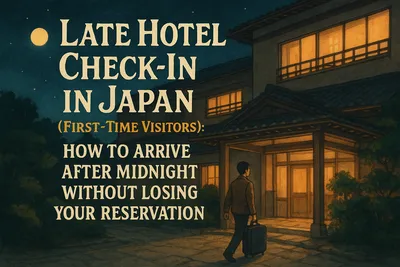
This is the one that can get stressful. Some hotels may treat very late arrivals without notice as a no-show, and your reservation could be cancelled. Policies vary by hotel and booking type.
If you think you’ll be late (flight delay, missed train, you got lost in a mega-station), message the property as soon as you can through your booking site or email and say you are arriving late.
When should you contact the hotel? If you know you will arrive after the hotel’s stated check-in window (or you’re unsure you’ll make it), message them immediately. If your booking shows a latest check-in time, treat it as real.
Tiny warning: “Late check-in allowed” does not always mean “arrive anytime with no message.” Always check the latest rules for your specific booking.
Stress-Free Tip: Save your hotel’s phone number and your booking message link before your trip. When you’re tired, you don’t want to search for it from scratch.
If your hotel uses a machine check-in (business hotels + budget stays)
Some hotels use self-service kiosks or semi-automated check-in. This can be great (less talking!), but it can also feel intimidating if you’re exhausted.
What you’ll usually need at a kiosk
- Your passport (some machines scan it)
- Your reservation number or a QR code (if your booking provides one)
- A payment card or cash (depending on the property)
If the kiosk can’t find your booking (easy fixes)
- Try searching by reservation number instead of name (or the other way around)
- Check if the booking name matches your passport name (spacing and middle names can matter)
- Confirm you’re at the right property (some chains have multiple locations nearby)
- Look for a staff button or desk—it’s normal to ask for help
Stress-Free Tip: If you see a kiosk and freeze for a second, look for a staff member first. A quick gesture like “help?” is totally fine.
Accommodation terms explained (so you don’t get surprised)
Check-in is easier when you know what kind of place you booked. A “hotel” and a “ryokan” can have very different rhythms, especially if meals are involved.
Hotel vs. business hotel
A business hotel is usually a simple, efficient hotel—often smaller rooms, fast check-in, practical location, and fewer “extras.” Great for first-timers who want predictability.
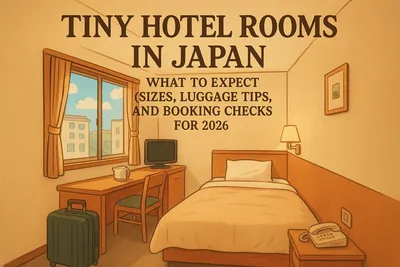
Related guide: Tiny Hotel Rooms in Japan: What to Expect (Sizes, Luggage Tips, and Booking Checks for 2026).
Ryokan
A ryokan is a traditional-style inn. Check-in may include extra explanation (meals, bath times, rules). Some ryokan have earlier dinner times or set schedules, so arriving late without notice can be more complicated.
Related guide: How to Book a Ryokan in Japan Without Getting Confused: A Calm, Step-by-Step Guide for First-Timers.
Onsen
An onsen is a hot spring bath using natural hot spring water. Some ryokan have onsen facilities on-site, but not all baths are onsen.
Private onsen / family bath / reserved bath
These labels can be confusing because they’re not always used the same way at every property.
- Private onsen: could mean a bath attached to your room, or a bath you reserve for a time slot
- Family bath: often means a private bath you can use together (couples and friends too), not necessarily “kid-focused”
- Reserved bath: a private bath you book for a set time; rules and fees vary
Open-air bath / room with private open-air bath
An open-air bath is outdoors (or semi-outdoors). A room with a private open-air bath is usually the most private and convenient option, but it’s often more expensive.
Dinner included vs. room-only
Many ryokan bookings come with meal plans. Some are dinner + breakfast, some are breakfast only, and some are room-only.
Stress-Free Tip: If you’re booking a ryokan, confirm meal times and the latest check-in time before you pay. This avoids the classic “we arrived after dinner service” problem.
Common mistakes (totally understandable, but easy to avoid)
- Not having passports ready and then holding up the line while you dig through luggage
- Assuming you can arrive anytime without messaging the hotel (late arrivals can become no-shows depending on policy)
- Forgetting yen cash and discovering your budget stay is cash-only
- Not expecting a deposit or card hold and worrying you were charged twice
- Booking “near the station” without realizing the station is huge and confusing with luggage
- Booking a ryokan with dinner but not checking the meal time or check-in cutoff
- Assuming “private bath” means “in your room” (sometimes it means reservable time slots instead)
Stress-Free Tip: When you book, take 2 minutes to re-check: check-in window, payment method, meal plan, and bath type. Those four prevent most surprises.
Related guide: Where to Stay in Tokyo for Your First Trip to Japan (Stress-Free Areas).
Simple prep that makes check-in calmer
Screenshot pack (booking + address + map pin)
Best for: Everyone, especially if your phone battery drops fast or you’ll be offline.
Not ideal for: People who never take screenshots and then regret it later (you know who you are!).
My honest take: This is the lowest-effort, highest-reward prep. Screenshot your booking, hotel address, and a map pin before you fly.
Small yen cash buffer
Best for: Budget travelers, late arrivals, capsule hotels, rural areas, and anyone who hates payment surprises.
Not ideal for: Carrying huge amounts of cash. Keep it reasonable and safe.
My honest take: You don’t need to go full “cash-only lifestyle,” but having a buffer makes check-in calmer.
Message the hotel in advance (only if you have a special situation)
Best for: Late arrival, separate bookings, dietary restrictions for ryokan meals, accessibility needs, or traveling with kids.
Not ideal for: Overthinking every tiny detail. You don’t need to email them your life story.
My honest take: One clear message can prevent 10 minutes of confusion at the front desk. Keep it short and polite.
What to prepare next
You don’t need to plan everything at once. If you’re arriving tired, focus on the pieces that make the first night smoother—getting connected, getting to the hotel, and not having to hunt for information while standing in a lobby.
- Decide how you’ll stay connected (SIM, eSIM, pocket Wi‑Fi, or roaming)
- Plan your first route from the airport to your hotel (and save it offline)
- Think about luggage: will you carry it through stations, or use luggage delivery (takkyubin)?
- Choose your first-night hotel for ease, not perfection (easy access beats “most central” when you’re tired)
Related guide: Best eSIM for Japan: What First-Time Visitors Should Know (2026).
Related guide: Pocket Wi-Fi vs eSIM in Japan: Which One Should You Choose?.
FAQ
Do I really need my passport to check into hotels in Japan?
In many cases, yes. Hotels commonly need to confirm and copy passports for foreign guests who don’t have a Japanese address. Bring the original passport, not just a photo. If your situation is unusual, check your hotel’s current instructions.
Will hotel staff speak English?
Often in big cities and major chains, yes—at least basic English. Smaller properties vary. The good news is check-in is routine, so gestures + your booking screen usually work well.
Do I pay at check-in or check-out?
Many hotels commonly take payment at check-in (or register your card then). Others charge at checkout, and some bookings are prepaid. Check your booking details and the hotel’s latest policy.
What if I arrive before check-in time?
Early check-in may be possible depending on availability and may cost extra. Many hotels can store your luggage until check-in, but confirm with your property to be safe.
What if my flight is delayed and I’ll arrive late?
Message the hotel as soon as you can (booking chat is often easiest). Some places may cancel reservations as a no-show if you arrive very late without notice. Policies vary, so check your booking conditions too.