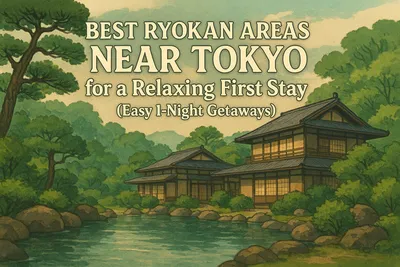
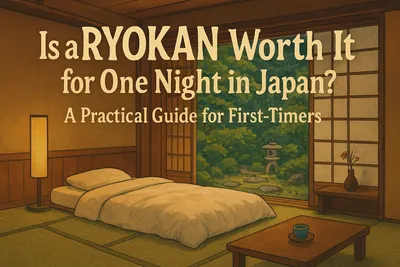
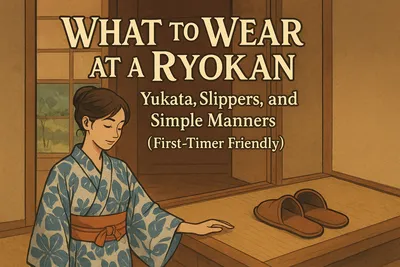
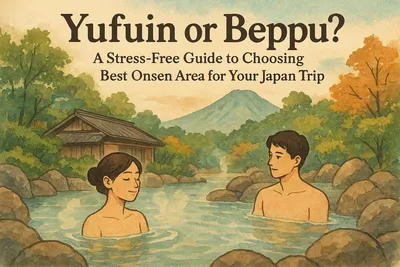
You want an onsen near Tokyo. You want it to be beautiful. Relaxing. Not a complicated “transport puzzle” that makes you question all your life choices at a giant station with a suitcase.
What this guide covers: This article compares onsen areas near Tokyo, such as Hakone and Kawaguchiko. For bath-type differences, read Private Onsen, Family Bath, and Open-Air Bath Rooms. For ryokan selection, read How to Choose a Ryokan with a Private Onsen.
Totally fair, isn’t it!
This guide is for first-time visitors who want the classic Japan hot spring experience without the stress. We’ll cover the best onsen areas near Tokyo, how to choose between Hakone vs Kawaguchiko (yes, this is the big one!), and a few other easy, popular options like Atami, Kusatsu, Ikaho, and Minakami.
And don’t worry. You don’t need perfect Japanese or perfect planning. You just need a few smart decisions upfront. That’s the whole vibe here at Stress-Free Japan Travel.
Quick note: Transport schedules, ticket options, hotel/ryokan services, bath rules, tattoo policies, and shuttle availability can change. Use this as a calm starting point, and check the latest official information before you go. For private baths, meals, tattoos, and kid rules, confirm directly with the ryokan or hotel before booking.
Quick Answer (So You Can Stop Overthinking)

If you want the easiest “first onsen trip” from Tokyo, Hakone is usually the most balanced choice (onsen + sightseeing + lots of transport options).
If your top priority is big Mount Fuji views with a lakeside resort feel, Kawaguchiko is often the better match—just remember Fuji visibility depends on weather.
Want the fastest escape? Atami is a classic “Tokyo to onsen” quick win. Want a more “real onsen town” vibe? Kusatsu is famous, but it’s a longer trip.
Related guide: If you’re still deciding where to base yourself in Tokyo before your onsen side trip, see Where to Stay in Tokyo for Your First Trip to Japan (Stress-Free Areas).
Who This Guide Is For
This guide is for you if any of these sound familiar:
- You are visiting Japan for the first time and want an onsen trip that feels doable.
- You don’t speak Japanese and you’re nervous about “what if I mess up the rules?”
- You want to try a ryokan but don’t fully understand meal plans or bath types yet.
- You want a private bath (or at least a reservable one) because shared bathing feels intimidating.
- You want to avoid long travel days, confusing transfers, and dragging luggage through crowds.
Related guide: For a calm overview of basic manners (including onsen basics), see Japanese Etiquette for Tourists: What Foreign Visitors Should Know (Stress-Free Guide).
First, What Counts as an “Onsen Near Tokyo”?
When people say “onsen near Tokyo,” they often mean a hot spring area you can reach in about around 2 hours, give or take, and enjoy as a day trip or a 1-night stay.
Here’s the thing. “Near” on a map and “easy” in real life are not the same thing.
A common first-timer moment: you arrive at a station, your phone battery is low, you’re holding a suitcase, and suddenly you realize the “10-minute walk” to the hotel is uphill… in the rain. Surprise!
Stress-Free Tip: For your first onsen trip, prioritize simple access and fewer transfers over “the most famous place on Instagram.” You’ll enjoy it more.
Access + Cost Snapshot (Time, Transfers, and Budget Reality)
Below are rough, first-timer-friendly ranges for time and transport cost. Prices vary by route, seat type, and season, so use these as a planning baseline and check current fares when you book.
| Onsen area | Typical one-way time from Tokyo | Transfers | Typical one-way transport cost | Best for |
|---|---|---|---|---|
| Hakone | About 1.5–2 hours | Low to moderate | Roughly ¥2,000–¥4,500 | Variety + flexibility |
| Kawaguchiko | About 2 hours (can be longer in traffic) | Low to moderate | Roughly ¥2,000–¥4,500 | Fuji views (weather-dependent) |
| Atami | About 45–90 minutes | Often none | Roughly ¥2,000–¥5,500 | Fast escape + seaside vibe |
| Kusatsu | About 3–4 hours | Moderate | Roughly ¥4,000–¥7,500 | Classic onsen-town atmosphere |
| Ikaho | About 2.5–3.5 hours | Moderate | Roughly ¥4,000–¥7,000 | Nostalgic streets + calm pace |
| Minakami | About 1.5–2.5 hours | Low to moderate | Roughly ¥3,000–¥6,000 | Nature + onsen + seasonal activities |
Stress-Free Tip: If you’re traveling on a weekend or holiday, assume extra time for buses and check whether you need to reserve seats. “Easy on paper” can get crowded fast.
Related guide: For the best official sources and practical planning tools, bookmark Best Japan Travel Websites to Bookmark Before Your Trip (Stress-Free List).
Hakone: The Classic, Balanced Onsen Area (Great First Choice)
Hakone is often described as the “safe choice” for first-time visitors—and honestly, that’s not an insult. It’s a compliment!
Many travelers like Hakone because it’s not only about soaking. You can mix onsen time with museums, scenic rides, and lake views, so it feels like a full mini-trip.
Why Hakone feels easier for first-timers
- Multiple transport options from Tokyo (train and bus choices), so you can pick what feels simplest.
- Lots of accommodation styles, from traditional ryokan to more casual hotels.
- Plenty of sightseeing, which helps if your travel partner is thinking, “Wait… are we really traveling just to sit in hot water?”
What surprises first-time visitors in Hakone
Hakone is a region, not one tiny onsen street. So where you stay matters.
Some areas are more “station convenient,” and others are more “quiet mountain hideaway.” Both can be great. But they feel very different when you’re tired.
Tiny warning: Some hotels look “close” to a station on a map, but the route may involve hills, stairs, or limited sidewalks. If you have large luggage, check the exact access details before booking.
Hakone for Fuji views: yes, but…
Some Hakone spots and some baths are known for Mount Fuji views. But it’s not guaranteed. Visibility depends on weather and also which part of Hakone you’re in.
If your heart is set on “Fuji right in front of me,” Hakone can work, but it’s not as straightforward as Kawaguchiko.
Stress-Free Tip: If you choose Hakone, think “onsen + variety.” If you happen to see Fuji, it’s a bonus, not the only reason to go.
Easy, low-stress things to do in Hakone (besides soaking)
- Scenic rides and viewpoints: Plan one “big scenic loop” activity, then stop. Over-planning Hakone is the #1 way to make it feel rushed.
- Lake time: A short lakeside walk and a café break can be more relaxing than trying to do every attraction.
- Museums: Hakone is great for “rainy day travel” because you can pivot to indoor stops.
Kawaguchiko: Fuji-View Onsen Heaven (When the Weather Cooperates)
Kawaguchiko (in the Fuji Five Lakes area) is famous for one thing: that big, postcard-style Mount Fuji view, often across the lake.
Many first-time visitors love it because it feels like “Yes, I’m really in Japan now!”
Why Kawaguchiko is so popular
- Mount Fuji + onsen is a dream combo for photos and memories.
- You can often reach it from Tokyo in around 2 hours (many travelers use highway buses from Shinjuku, or trains with a transfer).
- It pairs well with low-stress activities: lakeside walks, viewpoints, seasonal flowers, and theme-park style fun nearby.
The honest trade-offs (because yes, there are some)
Fuji is shy sometimes. Clouds happen. Rain happens. And in some seasons, visibility can be hit or miss.
Also, compared with Hakone, Kawaguchiko can feel more “spread out,” so you may rely more on buses, taxis, or careful hotel location choices.
Stress-Free Tip: If you’re going mainly for Mount Fuji, book a place that clearly states the view direction and room/bath type. And keep your expectations flexible. Fuji doesn’t take requests.
A famous day-use onsen example (for Fuji views)
Some guides often mention day-use baths with Fuji views, such as Benifuji-no-Yu. Details like hours, tattoo policy, shuttle options, and fees can change, so check the latest official information before you go.
Easy, low-stress things to do in Kawaguchiko (when you want more than “just onsen”)
- Lakeside walk: Perfect for a gentle morning before check-in or after breakfast.
- Viewpoints: Pick one viewpoint and build your day around it (instead of chasing five).
- Cafés and slow time: This is one of the best areas near Tokyo to simply do less.
Hakone vs Kawaguchiko: Which One Should You Choose?
I know, it sounds confusing. They’re both easy-ish from Tokyo. They both have onsen. They both can have Fuji views.
So here’s the simplest way to choose, first-timer style.
Choose Hakone if you want “easy variety”
- You want onsen plus sightseeing options close together.
- You like having multiple transport routes as a backup.
- You want a “resort area” feel with lots to do.
Choose Kawaguchiko if you want “Fuji first”
- Your top goal is a big Mount Fuji view, especially the classic lake + Fuji composition.
- You want a calmer, scenic vibe and you’re okay with a bit less “attraction density.”
- You’re happy to plan around weather risk (because the view is the star).
Quick Q&A
Q: I only have one night. Which is less stressful?
A: Many first-time visitors find Hakone easier for a one-night trip because there are so many transport and sightseeing options. But if Fuji views are your “must,” Kawaguchiko can still be a great one-night choice with the right hotel location.
Stress-Free Tip: For a 1-night stay, avoid a plan with too many transfers. Fewer steps = more soaking.
More Great Onsen Areas Near Tokyo (Also First-Timer Friendly)
Hakone and Kawaguchiko get most of the attention. But they’re not your only options, and that’s good news!
Atami: The Fastest “I Need Onsen Now” Escape
Atami is often mentioned as one of the easiest onsen resort areas from Tokyo, with access that can be surprisingly quick (many travelers use the Shinkansen, and it’s often described as around 1 hour).
It’s a seaside onsen town, so the vibe is different from mountain onsen. Think ocean views, seafood, and a relaxed resort mood.
Best for: short trips, nervous planners, and anyone who wants the simplest “Tokyo to onsen” win.
Not ideal for: travelers who want a deep mountain ryokan atmosphere.
Stress-Free Tip: If you’re arriving in Japan and feel jet-lagged, Atami can be a smart choice because you spend less time in transit.
Kusatsu: Famous Onsen Town Energy (But Farther)
Kusatsu is often introduced as one of Japan’s top onsen towns, known for its iconic hot spring center area and strong “onsen town” atmosphere.
The trade-off is time. It’s commonly described as taking around 3 hours from Tokyo by bus or train + bus, so it’s better when you have more breathing room in your itinerary.
Best for: travelers who want the “this is what an onsen town looks like” feeling.
Not ideal for: a rushed day trip, or your first night in Japan after a long flight.
Stress-Free Tip: If you pick Kusatsu, consider staying overnight. Day trips can feel like speed-running relaxation (which is… a bit silly, right?).
Ikaho: Nostalgic Streets and a Calm Pace
Ikaho is often described as a smaller, nostalgic onsen town with a famous stepped street and a relaxed atmosphere.
It’s a nice match if you want something charming and traditional-feeling, without the “big resort sprawl” vibe.
Stress-Free Tip: If stairs are tough for your group (or you’re traveling with heavy luggage), check whether your accommodation is near the main street or requires extra walking.
Minakami: Nature + Onsen + Outdoor Fun
Minakami is often listed as a good choice for travelers who want onsen plus outdoor activities, like rafting in warmer months or snow activities in winter.
This is a great “active trip” option—just remember that your schedule may be shaped by seasonal conditions and activity availability.
Stress-Free Tip: If you’re doing activities, plan your onsen time like an appointment. It’s easy to get tired and accidentally skip the relaxing part.
Season + Weather Reality (So You Don’t Get Surprised)
Onsen is great year-round, but the experience changes a lot with season and weather. Here’s the calm version of what to expect.
Winter: the “this is why people love onsen” season
- Cold air + hot water is an unbeatable combo.
- Mountain areas can get icy or snowy—wear shoes with grip and allow extra time for walking.
- Popular weekends book out early, especially for ryokan with private baths.
Summer: still worth it, just plan smarter
- Hot days can make midday soaking feel intense—many travelers prefer early morning or evening baths.
- Mountain areas can feel pleasantly cooler at night, but cities-to-onsen transit can be humid and tiring.
Rainy days (and cloudy Fuji days): build in a “Plan B”
- If Fuji is hidden, aim for a great bath, a great meal, and one cozy activity (museum, café, slow shopping).
- Choose accommodations where you’ll still be happy even if the view is a blank white cloud.
How to Choose the Right Onsen Style (Day Trip vs Ryokan Night)
Let’s be honest. Many first-time visitors think “onsen trip” automatically means “expensive ryokan with a fancy dinner.”
It can. But it doesn’t have to.
Option 1: Day-use onsen (no overnight stay)
This can be a great low-commitment first step. You soak, you relax, you go back to Tokyo.
Good for: nervous travelers, tight itineraries, people unsure about shared bathing rules.
Watch for: last entry times, towel rental fees, and whether tattoos are allowed (rules vary by facility).
Stress-Free Tip: Bring a small coin pouch or some cash. Some day-use places are cash-friendly, and you don’t want to be that person counting coins at the locker machine with a line behind you.
Option 2: One-night ryokan stay (the “full experience”)
This is where you get the cozy room, the slower pace, and often a set dinner and breakfast.
It’s also where misunderstandings happen most often—mainly around meals, check-in times, and what “private bath” really means.
Stress-Free Tip: If you book a ryokan, treat check-in time as important. Dinner service often has a schedule, and late arrivals can get complicated.
Related guide: If you want help choosing the least stressful bath setup, see Private Onsen vs Public Onsen: Which Is Better for Foreign Visitors?.
Accommodation Terms Explained (So Booking Pages Make Sense)
These terms show up everywhere. And yes, they can feel like a secret code at first!
Ryokan
A traditional Japanese-style inn. Rooms may have tatami-style flooring, and meals are often served as set courses. Some ryokan feel luxurious, others are simple and homey.
Onsen
A bath that uses natural hot spring water. Not every big bath is an onsen, so if this matters to you, check the property description carefully.
Public onsen (shared bath)
A gender-separated shared bathing area. You bathe nude (no swimsuits). This is normal in Japan, but it can feel intimidating the first time.
Private onsen
This phrase can mean different things depending on the property. It might mean a bath attached to your room, or it might mean a reservable private bath you book for a time slot.
Family bath / reservable private bath
Often a private bath that a couple, family, or small group can use together. It does not always mean the property is designed for families with kids. The key point is privacy, not child-focused services.
Open-air bath
A bath outdoors (or semi-outdoors). These are popular, but the “outdoor” feeling varies a lot by property.
Room with private open-air bath
A guest room that includes its own open-air bath. It’s usually the most private and convenient option, but it’s often more expensive.
Dinner included vs room-only
Many ryokan offer plans with dinner and breakfast included. Room-only plans exist too. If you’re arriving late or you have dietary needs, this choice matters a lot.
Shuttle service
Some properties offer a shuttle from a station or bus stop. Times and reservation rules vary, so check the latest details before you rely on it.
Stress-Free Tip: If you remember one thing, remember this: “private bath” does not automatically mean “in your room.” Read the details carefully.
Related guide: If booking pages stress you out in general, this helps: Japan Hotel Guide for First-Time Visitors: What to Know Before Booking.
Common Mistakes (Totally Understandable, But Let’s Avoid Them)
Booking “near the station” without checking the real walking route
A hotel can be 700 meters away and still be stressful with luggage if it’s uphill, confusing, or has stairs.
Choosing Hakone or Kawaguchiko only for Fuji views
Fuji views depend on weather. If the view is your only goal, you might feel disappointed on a cloudy day.
Assuming every ryokan dinner is flexible
Many ryokan dinners have serving times. Arriving late can create awkward situations. Not your fault—just how it works sometimes.
Assuming every “family bath” is free and always available
Some are free, some cost extra, some require reservations, and some are first-come-first-served. Policies vary widely.
Not checking tattoo rules until the last minute
This is a big one. Tattoo policies vary by facility and can change. If it matters for your group, confirm directly before booking.
Trying to do an onsen overnight with “full-size Tokyo luggage”
Onsen areas often involve buses, slopes, stairs, or short taxi rides. A huge suitcase can turn a relaxing trip into a workout.
Stress-Free Tip: Pack a small overnight bag and send the big suitcase ahead when possible.
Related guide: For step-by-step help, see Luggage Delivery in Japan: A Stress-Free Guide for Families.
Recommended Options (Not for Everyone, But Great in the Right Situation)
Option: Room with a private open-air bath
Best for: couples, honeymooners, tattooed travelers worried about rules, and anyone who wants maximum privacy and minimum etiquette stress.
Not ideal for: tight budgets or travelers who plan to spend most of the day sightseeing outside the ryokan.
My honest take: This is often the easiest “first onsen” experience because you can relax without worrying about shared-bath nerves. But it can cost more, so it’s a “comfort upgrade,” not a requirement.
Option: Reservable private bath (family bath)
Best for: travelers who want privacy but want a more affordable middle option than a private-bath room.
Not ideal for: travelers who hate schedules or don’t want to plan time slots.
My honest take: A great compromise. Just check whether it’s free or paid, how long the slot is, and how reservations work. Then you’re golden.
Option: Day-use onsen facility
Best for: people who want a low-pressure introduction to Japanese bathing culture.
Not ideal for: travelers who want the full ryokan meal + slow evening experience.
My honest take: If you’re nervous, start here. You can always “level up” to a ryokan on your next trip (or later in the same trip!).
Option: Luggage delivery (takkyubin)
Best for: anyone doing an onsen overnight with big suitcases, especially if you’ll use buses or walk from a station.
Not ideal for: last-minute planners who need their bag immediately (delivery timing depends on distance and cut-off times).
My honest take: This is one of the most stress-reducing services in Japan. If you hate dragging luggage through stations, it can be worth it. Confirm timing and fees at your hotel or service counter.
Booking Checklist (Ryokan and Onsen Stays Near Tokyo)
- Check whether the bath is public, private, reservable, or attached to your room.
- Confirm whether the bath is real hot spring water (onsen) or a regular bath, if that matters to you.
- Check if your plan includes dinner and breakfast, or if it is room-only.
- Confirm the latest check-in time (especially if dinner is included).
- Check access from the station: walking time, hills, stairs, and bus/taxi needs.
- Confirm shuttle service details if offered (times, reservation needs, pick-up point).
- If tattoos matter for your group, confirm directly with the ryokan or hotel before booking.
- If traveling with kids, confirm child policies, meal options, and whether private bath use is allowed.
- Re-check cancellation rules before paying (they can be strict).
Stress-Free Checklist (Do This Before Your Onsen Side Trip)
- Pick your area based on your priority: Hakone for variety, Kawaguchiko for Fuji views, Atami for speed, Kusatsu for onsen-town vibes.
- Save your accommodation name, address, and check-in time in your notes app.
- Plan your route while your Wi-Fi is stable (not when your phone is at 7%).
- Pack a small “onsen pouch”: cash, hair tie, skincare, and a small towel if you prefer.
- Avoid rush hour with large luggage when possible.
- If you want a private bath, book it clearly (room bath or reservable bath) instead of assuming.
- Keep expectations flexible for Mount Fuji visibility. Weather happens.
Related guide: For the calm “what to download and set up before you leave your hotel,” see Japan Travel Apps You Should Download Before Your Trip (First-Timer List).
What to Prepare Next
You don’t need to plan everything at once. Start with the pieces that remove the most stress first.
- Decide whether you’ll do a day trip or a 1-night ryokan stay.
- Choose your “bath comfort level”: public bath, reservable private bath, or private bath in-room.
- Plan how you’ll handle luggage (carry it, store it, or deliver it).
- Make a simple payment plan: keep some cash and a card ready.
- Screenshot or save your key transport steps in case your signal drops.
Related guide: If internet setup is one of your stress points, see Best eSIM for Japan: What First-Time Visitors Should Know (2026).
FAQ
Do I need to speak Japanese to visit an onsen area near Tokyo?
No. In popular areas like Hakone, Kawaguchiko, and Atami, many travelers get by with basic English, signs, and translation apps. A little preparation (saved addresses and routes) helps a lot.
Is Hakone or Kawaguchiko better for a first onsen trip?
Hakone is often easier for first-timers who want variety and flexible transport options. Kawaguchiko is often better if Mount Fuji views are your top priority.
Can couples bathe together in Japan?
In most public onsen, baths are separated by gender. Couples can bathe together in a reservable private bath or a room with a private bath, depending on the property’s rules.
Are tattoos allowed at onsen near Tokyo?
It varies by facility and can change over time. Some allow tattoos, some restrict them, and some allow them with coverage. If tattoos are important for your group, confirm directly before booking.
Is a day trip onsen or an overnight ryokan stay better?
A day trip is simpler and cheaper for many travelers. An overnight ryokan stay is more immersive and relaxing, but requires more planning (check-in time, meals, and bath type).
Final Thoughts
Choosing an onsen near Tokyo doesn’t have to feel like a high-stakes exam.
Pick Hakone if you want balance. Pick Kawaguchiko if you want that iconic Fuji view. Choose Atami for speed, or Kusatsu when you want a deeper onsen-town experience.
And remember: you don’t need to be perfect. You just need to be prepared. A little planning means you’ll spend less time staring at station signs… and more time doing the whole point of this trip: relaxing in hot water, like a genius.