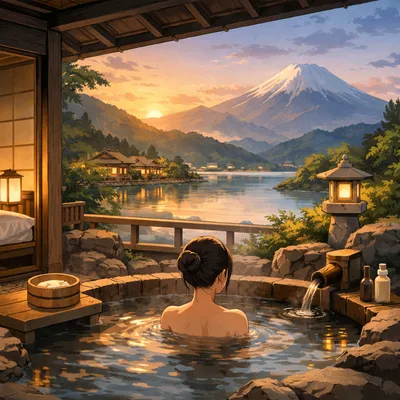
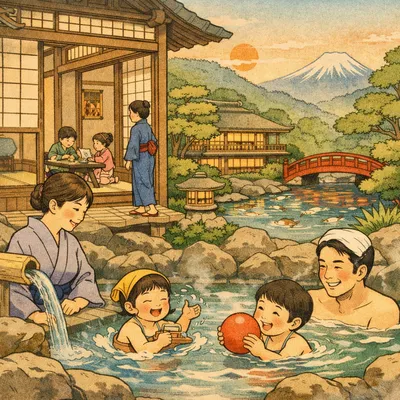
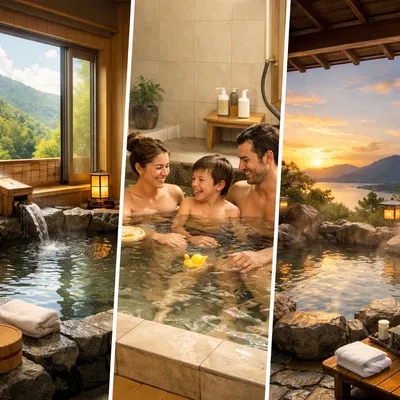
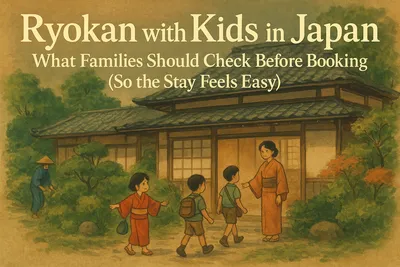
You want the dreamy Japan ryokan night. The yukata. The beautiful dinner. The hot spring bath.
What this guide covers: This article helps you choose a ryokan with a private onsen. For bath-type terminology, start with Private Onsen, Family Bath, and Open-Air Bath Rooms. For area comparison near Tokyo, read Best Onsen Areas Near Tokyo.
And then you hit the booking pages and… suddenly everything looks the same. “Private bath.” “Hot spring bath.” “Open-air bath.” “Family bath.” Wait, are those the same thing? Also, is it actually an onsen… or just a normal bathtub with fancy wording?
Don’t worry. You’re not the only one. This is where many first-time visitors get stuck. Especially when you’re planning in English, you don’t speak Japanese, and you really don’t want to book the “wrong” kind of bath by accident.
In this guide, you’ll learn how to choose a ryokan with a private onsen that matches your comfort level, budget, and travel style. Calm, practical, and no weird surprises at check-in.
Quick note: Ryokan policies, bath rules, tattoo policies, meal plans, shuttle times, and booking windows can change. Use this as a calm starting point, and always check the latest official information (or confirm directly with the ryokan) before you book.
Quick Answer: The Calm Way to Choose

Pick your private bath style first: in-room private onsen (most convenient), reserved private bath (often cheaper), or annex/villa with its own bath (maximum privacy).
Then confirm it’s a real onsen: look for “onsen ryokan” or clear “hot spring” wording, and check if the property shows hot spring details (many do). A normal bathtub is not an onsen, even if the photos are pretty.
Finally, reduce stress: choose a location with easy access, check the meal rules and check-in time, and don’t assume “near the station” automatically means easy with luggage.
Related guide: Want a simpler side-by-side decision? Private Onsen vs Public Onsen: Which Is Better for Foreign Visitors?
Related guide: Still confused by the labels? Private Onsen, Family Bath, and Open-Air Bath Rooms in Japan: What’s the Difference?
Who This Guide Is For
This guide is for you if you’re:
- A first-time visitor to Japan who wants a ryokan stay without feeling overwhelmed
- Nervous about public onsen etiquette, nudity rules, or bathing separately by gender
- Traveling as a couple, with friends, with kids, or with a tattoo (and you want fewer awkward moments)
- Trying to avoid expensive mistakes like booking “room only” when you expected dinner
- Planning in English and worried you’ll misunderstand the bath type
Step 1: Decide What “Private Onsen” Means to You (Because It Can Mean Different Things)
Here’s the thing. “Private onsen” is a catch-all phrase. On booking sites, it can describe very different setups.
If you remember one thing, remember this: private can mean “in your room” or “booked for a time slot.” Those feel very different on the actual trip.
Type A: In-room private onsen (best for maximum comfort)
This is the “your bath is part of your room” style. It might be open-air (outside) or indoor.
Why first-timers love it: You can bathe when you want. No schedule. No walking through hallways. No worrying about etiquette signs when you’re tired.
Trade-offs: It’s often more expensive. And if it’s open-air, weather matters (yes, winter can be cold… and also kind of magical).
Stress-Free Tip: If you’re anxious about doing things “wrong,” an in-room bath is the easiest way to enjoy onsen vibes with almost zero social pressure.
Type B: Reserved private bath (often called a “family bath”)
This is a private bath inside the ryokan that you book for a time slot. Often 40 to 60 minutes, but it varies.
Why it’s popular: It can be a middle option. You still get privacy, but it may cost less than a room with its own bath.
What surprises people: You might need to reserve it at check-in. Or it may be first-come-first-served. And the best times (early evening) can fill up fast.
Tiny warning: A “family bath” in Japan usually means “a private bath you can use together.” It does not automatically mean the ryokan is designed for families with kids.
Stress-Free Tip: If private bath time matters to you, email the ryokan before booking and ask how reservations work (advance, at check-in, or first-come-first-served).
Type C: Annex/villa-style room with its own bath (maximum privacy, often higher-end)
Some ryokan offer separate buildings or villa-style rooms with a private bath.
Why people choose it: Quiet. Private. Fewer shared spaces. Great if you want a “hideaway” feeling.
Trade-offs: Often pricier, and sometimes a longer walk on the property (which can matter if it’s raining, or you’re carrying a toddler who refuses to walk).
Stress-Free Tip: If mobility or stairs are a concern, confirm the walking distance and whether there are slopes or steps.
Step 2: Make Sure It’s a Real Onsen (Not Just a Nice Bathtub)
Let’s be honest. Photos can be… persuasive.
But a private bath is not automatically a hot spring. Some “private baths” are simply heated tap water in a beautiful tub.
How to tell if it’s likely a real hot spring
Look for these signs (the more you see, the more confident you can feel):
- The property describes itself as an onsen ryokan or uses clear “hot spring” wording
- They list hot spring details such as the source, mineral type, or properties (many onsen ryokan display this)
- You see mention of an onsen tax (a small hot spring tax, often a few hundred yen per person, in many areas)
Stress-Free Tip: If the listing is vague, message the property with one simple question: “Is the bath filled with natural hot spring water?” Clear question, clear answer. (And yes, you can ask in English.)
Watch out for confusing wording on booking sites
You might see labels like “hot spring bath,” “open-air bath,” or “spa bath.” These can be used differently depending on the site and property.
Don’t rely on one badge or filter. Read the room description carefully and confirm if it matters to you.
Step 3: Choose the Right Location for Your First Ryokan Night
A common first-timer situation: you land after a long flight, you’re carrying a suitcase, your phone battery is low, and you’re trying to find the “right” train platform while your brain quietly melts.
That is not the best moment to start a complicated journey to a remote hot spring town with three transfers.
Beginner-friendly onsen areas (often chosen for first trips)
These areas are often considered easier for first-time visitors because access from major cities is generally straightforward, and English-friendly options are common. (Exact ease depends on the specific ryokan location, so check transport details.)
Hakone
Often chosen as a first onsen area from Tokyo. There are many ryokan with private bath options, and it’s a well-known onsen region for international visitors.
Stress-Free Tip: “Hakone” is a region, not one tiny town. A ryokan can be “in Hakone” and still be far from the station. Check the exact nearest stop and the last bus time.
Related guide: Not sure if Hakone is the right call? Hakone vs Kawaguchiko: Which Is Better for a Private Onsen Stay?
Related guide: Want more easy options near Tokyo? Best Onsen Areas Near Tokyo for First-Time Visitors: Hakone, Kawaguchiko, and More
Izu and Atami
These areas are often picked for ocean views, relaxing scenery, and resort-style onsen vibes.
Stress-Free Tip: If you’re traveling with big luggage, consider choosing a ryokan that offers a shuttle from the nearest station (if available) or is a short taxi ride away.
My honest take on “near the station”
Many people search for “5 minutes from the station” and feel safe. Totally understandable.
But in Japan, a station can be huge, busy, and confusing. Sometimes a hotel that is “10 minutes away” on a simple route feels easier than a “3 minute” route through crowds, stairs, and the wrong exit.
Stress-Free Tip: Before booking, do a quick map check: is the route flat, simple, and sidewalk-friendly? Or does it look like a maze of overpasses and stairs?
Step 4: Understand the Price Structure (So You Don’t Panic at Checkout)
Ryokan pricing can feel surprising if you’re used to “price per room.”
Many ryokan list prices per person, per night. And many plans include dinner and breakfast.
Typical price patterns (very general)
Ryokan can range widely by season, day of week, room type, and how fancy the meals are:
- Budget options may start from around 5,000–12,000 yen per person (often simpler, sometimes room-only)
- Mid-range often falls around 15,000–30,000 yen per person (commonly with meals)
- High-end can be 50,000 yen+ per person
Rooms with a private onsen tend to sit in the mid to higher ranges, especially on weekends and during peak seasons.
Tiny warning: The “cheapest plan” on a booking site is often room-only. If you expected the famous ryokan dinner, double-check before you pay.
Why this matters on your actual trip
Imagine arriving hungry, thinking dinner is included… and then realizing your plan is room-only and the nearest restaurant closes early. Not fun.
Stress-Free Tip: If you want the full ryokan experience, look for plans that clearly say dinner and breakfast included, and confirm the dinner start time (some ryokan have a latest dinner check-in time).
Step 5: Meals, Check-in Times, and “Wait, We Missed Dinner” Problems
Ryokan meals are often a big part of the experience. But they come with rules.
Many ryokan serve dinner at a set time window. If you arrive too late, they may not be able to serve it. This varies by property, so don’t guess.
Questions to check before booking
- Is dinner included, or is it a room-only plan?
- What is the latest check-in time for dinner?
- Where is dinner served: in your room, a dining room, or a restaurant space?
- Do they accommodate dietary restrictions? (Some do, some can’t, and it may require advance notice.)
Stress-Free Tip: If your travel day is long, choose a ryokan with a later dinner window or stay at a simple hotel the first night and do the ryokan on night two.
Step 6: Tattoos, Kids, and Mixed-Gender Bathing (The Awkward Questions)
These are very normal concerns. And yes, it can feel a bit personal to ask. But it’s better than showing up and feeling stuck.
If you have tattoos
Tattoo rules vary a lot by property and by bath type. Some places allow tattoos in private baths but not public baths. Some allow small cover stickers. Some don’t allow tattoos at all.
Stress-Free Tip: If tattoos are relevant, confirm directly with the ryokan before booking.
Related guide: If tattoos are part of your planning, this will save you time: Tattoo-Friendly Onsen in Japan: Why Private Baths May Be the Easiest Option
If you’re traveling with kids
Private baths can be a great option for families, especially if you don’t want to manage public bath etiquette with a sleepy child.
But child policies vary: age limits, meal options, bedding fees, and whether children can use certain baths.
Stress-Free Tip: Check whether your plan includes kids’ meals and bedding, and confirm if the private bath is suitable for children (temperature and safety features can differ).
Related guide: Going as a family? Family-Friendly Ryokan in Japan: What to Check Before Booking (Without Regrets)
If you’re traveling as a couple or with friends
Public onsen are usually separated by gender. Private baths can be used together, which is often the whole point for couples and mixed-gender friend groups.
Stress-Free Tip: If bathing together matters, make sure the private bath is truly private (not just “semi-private”) and confirm the reservation rules.
Step 7: Booking Methods and Timing (Beginner-Friendly)
Once you know the bath type you want, booking gets much easier. The main decision is where to book and how early.
Where to book (and what each option is best for)
- International booking sites: Usually the easiest for English menus, credit cards, and cancellations. Great for first-timers who want a smooth process.
- Japan-focused booking sites: Often have more ryokan inventory and plan details, but English support varies by property and by page. Still very usable if you read carefully.
- Direct booking on the ryokan’s official site: Sometimes gives the best plan options (or small perks), but the site may be partly translated and emails may take time.
How early to book (so you don’t get stuck with leftovers)
For private onsen rooms, supply is limited. If your dates are not flexible, earlier is calmer.
- Weekends and holidays: Book as early as you reasonably can.
- Peak seasons: Prices rise and the best rooms go first. If you’re traveling during popular sightseeing seasons, plan ahead.
- Last-minute bookings: Possible, but you may have fewer private-bath choices (or only the most expensive room categories left).
Stress-Free Tip: If you’re deciding between two properties, don’t compare 20 tabs. Compare these 5 things only: bath type, real onsen confirmation, dinner included, latest check-in for dinner, and access from the nearest station.
A simple message template (copy/paste) before you book
If anything is unclear, send one short message. Keep it simple:
- Is the private bath filled with natural hot spring water?
- Is the private bath in the room, or is it reservable by time slot?
- If reservable: how do we reserve, how long is each slot, and is there a fee?
- What is the latest check-in time if dinner is included?
Step 8: Price Breakdown and Extra Fees (What to Expect)
Most ryokan stays are straightforward once you know what’s included. The stress usually comes from small extras you didn’t expect.
Common line items (varies by property and area)
| Item | What it means (in plain English) |
|---|---|
| Per-person rate | The displayed price may be per person, not per room. Always check the total for your group. |
| Meal plan | Dinner + breakfast plans cost more, but they’re often the “full ryokan experience.” |
| Hot spring tax | A small local tax in many onsen areas (often charged per person, per night). If it applies, it’s usually listed in the fine print. |
| Private bath fee | Some reservable private baths are free, some are paid per slot. The room’s own bath is usually included in the room rate. |
| Child pricing | Kids may be charged differently depending on age, meals, and bedding. Always check the child policy page. |
| Payment rules | Some properties take cards easily, others have limits or prefer a card on file + pay on site. Confirm at booking. |
Private bath pricing patterns (very general)
- In-room private bath: Usually “included” because you’re paying for the room category.
- Reservable private bath: Could be free, included in some plans, or charged per time slot.
- Multiple soaks: If you want to bathe more than once, an in-room bath (or a property with free reservable baths) tends to feel more relaxed.
Stress-Free Tip: Before you book, scroll until you find the section that says what’s included and what’s excluded. If it’s not clear, message the ryokan.
Step 9: How Private Baths Usually Work (And the Basic Manners)
You don’t need to memorize a rulebook. You just need a simple flow so you feel confident when you arrive.
If it’s an in-room private bath
- You can usually use it anytime (some properties may ask for quiet hours late at night).
- Water temperature controls vary. If there’s a faucet system, follow the room instructions.
- Rooms often include towels, but some properties ask you to bring towels from your room to any shared bath areas.
If it’s a reservable private bath (time slots)
- Reservation method: It might be booked at check-in, via a sign-up board, by phone from your room, or (less commonly) in advance.
- Time limit: Many are around 40–60 minutes. Treat it like a dinner reservation—arrive on time and finish on time.
- Keys and entry: Some baths use a physical key; others use a sign that shows “in use.” Staff will explain.
- Cleaning/next guest: Leave it neat, take your belongings, and don’t linger after your slot ends.
Stress-Free Tip: If you want a prime-time slot (early evening), reserve it as soon as you check in—before you relax too hard.
The “no stress” bathing basics (private or public)
- Rinse your body first before soaking.
- Keep towels out of the bathwater.
- Take your time, but be mindful of time limits if it’s a reservable bath.
- If you’re unsure about anything, ask at check-in. Staff questions are normal.
Related guide: If you want a quick etiquette refresher for Japan in general, Japanese Etiquette for Tourists: What Foreign Visitors Should Know (Stress-Free Guide)
Step 10: Search Words and Filters That Actually Help
Booking sites are powerful, but the labels can be messy. Use a mix of filters and keyword checks.
Useful English search terms to try
- “Room with private open-air bath” (often the clearest for in-room outdoor tubs)
- “In-room onsen” or “private onsen in room” (wording varies)
- “Private bath” or “reservable private bath” (for time-slot baths)
- “Hot spring” + the onsen town name (to surface onsen properties)
Filters to use (and how to avoid the common trap)
- Start with budget + guest rating to keep your options manageable.
- Then check the room category for the bath type. Don’t assume the property-level “private bath” badge means your room has one.
- Read 5–10 recent reviews focusing on bath reservations, dinner timing, and access from the station (not just “beautiful!”).
Stress-Free Tip: If a listing says “private bath available,” open the details and look for whether it’s in-room or reservable. That one detail changes your whole experience.
Accommodation Terms Explained (So Booking Pages Make Sense)
Ryokan
A traditional Japanese inn. Often includes tatami rooms, futon bedding, yukata robes, and meal plans. Comfort levels vary widely, from simple to luxury.
Onsen
A hot spring using natural spring water. An “onsen ryokan” typically supplies hot spring water to baths on the property, but the exact setup depends on the ryokan.
Private onsen
A general term meaning you can bathe without sharing with other guests. It can mean an in-room bath or a reservable private bath.
Family bath / reserved private bath
A private bath you book for a time slot. Couples and friend groups use these too. It’s not automatically a “kid-focused” facility.
Public onsen
A shared bath area, usually separated by gender. Etiquette is important, but it can be a wonderful experience if you feel comfortable with it.
Open-air bath
A bath outdoors (or semi-outdoors). It can be public or private. Always check which one it is.
Room with private open-air bath
A room category where your room includes its own open-air bath. Convenient and private, often more expensive.
Dinner included / breakfast included / room-only plan
Meal plans matter a lot at ryokan. “Room-only” usually means no meals. Always confirm what your plan includes.
Shuttle service
Some ryokan offer a shuttle from the station at set times. Rules vary, and you may need to reserve it.
Yukata
A casual robe provided by many ryokan. Often worn around the property. If you’re unsure where it’s okay to wear it, just ask at check-in.
Common Mistakes (Totally Understandable, But Let’s Avoid Them)
- Assuming “private bath” means it’s in your room. It might be a reservable bath with time slots.
- Booking the cheapest plan and accidentally skipping meals. Ryokan dinners are often the highlight, so check the plan details.
- Choosing a remote ryokan for your first night in Japan. After a long flight, simple wins.
- Not checking the latest dinner check-in time. Some ryokan can’t serve dinner if you arrive late.
- Forgetting about luggage reality. A “short” walk can feel long with a suitcase on a narrow street.
- Not checking private bath rules. Some are free, some are paid, and many have time limits.
- Assuming tattoo rules are the same everywhere. They’re not. Confirm directly with the property.
Stress-Free Tip: When in doubt, choose fewer “unknowns”: easier access, clearer meal plan, and a bath type you fully understand.
Recommended Options (Choose What Fits You)
Option 1: Room with an in-room private onsen
Best for: Couples, honeymoon travelers, families with kids, and anyone nervous about public baths.
Not ideal for: Tight budgets, or travelers who don’t care whether the bath is private.
My honest take: This is the simplest, lowest-stress choice if you can afford it. You’re paying for convenience and privacy more than anything.
Option 2: Ryokan with reservable private baths (family baths)
Best for: Travelers who want privacy but want to keep costs more reasonable.
Not ideal for: People who hate schedules, or travelers who want to soak multiple times without planning.
My honest take: A great compromise. Just treat the reservation system like a “popular attraction.” Ask how it works, and book your slot early.
Option 3: Do a ryokan stay for 1 night (not your whole trip)
Best for: First-timers who want the experience without over-committing.
Not ideal for: Travelers who strongly dislike packing and unpacking.
My honest take: One night is often enough to enjoy dinner, breakfast, and a relaxing soak. It also keeps your itinerary flexible.
Option 4: Use luggage delivery (takkyubin) before your onsen town night
Best for: Anyone traveling with big suitcases, kids, or multiple train transfers.
Not ideal for: People who need all their belongings immediately (delivery takes time).
My honest take: This can be a surprisingly powerful stress-reducer. Travel to the ryokan with a small overnight bag, and let your suitcase meet you later.
Booking Checklist (Private Onsen Ryokan)
- Confirm the bath type: in-room private onsen, reservable private bath, or public bath only
- Confirm whether it is a real onsen (natural hot spring water) or a regular bath
- Check if the bath is open-air or indoor (and whether weather affects it)
- Confirm private bath reservation rules: advance booking, at check-in, or first-come-first-served
- Check time limits for reserved baths (for example, 40–60 minutes is common, but varies)
- Confirm whether the private bath is free or has a fee per slot (if reservable)
- Confirm meal plan details: dinner and breakfast included, or room-only
- Check latest check-in time, especially if dinner is included
- Confirm access: nearest station, shuttle availability, and how hard the walk is with luggage
- Check child policies if traveling with kids (meals, bedding, bath rules)
- Confirm tattoo rules directly with the ryokan if needed
- Check payment details (some properties may prefer card, some may have limits; policies vary)
Stress-Free Checklist (Do This and Your Ryokan Night Gets Easier)
- Choose your bath style first (in-room vs reservable) before you fall in love with photos
- Save the ryokan name, address, and access notes on your phone (and screenshot them)
- Plan your arrival time with a buffer so you don’t miss dinner
- Reserve your private bath slot early (if it’s a time-slot system)
- Travel lighter to the onsen town (use luggage delivery if it fits your trip)
- Keep some cash available for small taxes or local transport (amounts vary)
- Charge your phone before travel to rural areas (navigation is your best friend)
- Confirm anything sensitive (tattoos, kids, bath rules) directly with the property
What to Prepare Next
You don’t need to plan everything at once. Start with the parts that reduce the most stress first.
- Decide how you will handle internet access in Japan (so you can navigate calmly)
- Plan your “big luggage” strategy (carry, store, or deliver)
- Make a simple arrival-day schedule that avoids late check-in panic
- Prepare a short message template in English to confirm bath and meal details with a ryokan
Related guide: For internet planning, Pocket Wi-Fi vs eSIM in Japan: Which One Should You Choose?
Related guide: For a calm “before you fly” checklist, How to Plan a Stress-Free Trip to Japan for the First Time (Without Overthinking)
FAQ
Is a “private bath” always a private onsen in my room?
No. It can mean an in-room bath, or a reservable private bath that you book for a time slot. Always check the room type and bath description carefully.
How can I tell if it’s a real hot spring and not just heated water?
Look for “onsen ryokan” or clear hot spring wording, and check whether they list hot spring details. If it’s important to you, confirm directly with the ryokan before booking.
Can couples use a private bath together?
In many cases, yes—especially with reservable private baths or in-room baths. Public baths are usually separated by gender.
Are private onsen rooms worth the extra cost?
Many first-time visitors find they are worth it for comfort and privacy, especially if you’re nervous about public baths. But if you’re okay with a schedule, a reservable private bath can be a great middle option.
Do I need to speak Japanese to stay at a ryokan?
Not necessarily. Many ryokan welcome international guests, and booking sites often support English. Still, English support varies, so check the listing details and don’t hesitate to message the property with simple questions.
Related guide: If language worries are on your mind, Can You Travel Japan Without Speaking Japanese? A Practical Guide
Final Thoughts
Choosing a ryokan with a private onsen for your first trip can feel confusing at first. But it gets much easier once you separate the decision into small steps: bath type, real onsen check, meal plan, access, and booking rules.
You don’t need perfect planning. You just need a few smart confirmations. And then you can focus on the good part: warm water, quiet time, and that “wow, I’m really in Japan” feeling.
You’ve got this.