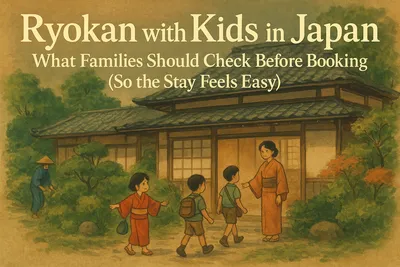
You’re trying to plan a calm family trip to Japan. And then you open a ryokan booking page… and suddenly it feels like you need a translation degree, a logistics degree, and a spare brain just for “room type.” Totally normal!
A common first-time situation is this: you land after a long flight, your kids are running on pure chaos energy, your suitcase feels heavier than it did at home (how?), and you just want a place that’s warm, easy, and doesn’t make you whisper-apologize to strangers all night.
This guide is here to help you choose a family-friendly ryokan without stress. Not by giving you a “best ryokan” list. But by showing you what to check before you book—so the stay matches your family’s real life.
Quick note: Ryokan policies (kids’ rates, meal options, private bath reservations, tattoo rules, shuttle times, check-in limits) can vary a lot by property and can change. Use this as a calm starting point, and always check the latest official information—or confirm directly with the ryokan—before booking.
Quick Answer

To book a truly family-friendly ryokan in Japan, focus on seven checks: room layout, kids’ gear, bath type (private vs public), meal style and allergy support, access with luggage, house rules (check-in, noise, curfews), and what “family-friendly” actually means on that listing.
If you remember one thing, remember this: don’t book based on the word “private” alone. “Private bath” can mean several different setups.
Who This Guide Is For
This is for you if you’re:
- A first-time visitor to Japan traveling with kids (baby to teens)
- Nervous about not speaking Japanese and missing important rules
- Trying to avoid awkward meal situations or bath confusion
- Planning a multi-generational trip (grandparents included)
- Looking for an onsen experience but want it to feel simple and comfortable
First, What Does “Family-Friendly Ryokan” Really Mean?
Here’s the thing. In Japan, “family-friendly ryokan” often means the property is welcoming to families—not necessarily that it’s a kids’ resort with slides and cartoon dinners.
Many family-friendly ryokan focus on practical comfort: tatami rooms where toddlers can crawl, larger rooms for 5–6 people, helpful staff, and (the big one) private bathing options so you’re not stressed about disturbing others.
Stress-Free Tip: When you see “family-friendly,” treat it like a clue—not proof. Your job is to confirm what your family actually needs before you pay.
7 Things to Check Before Booking a Family-Friendly Ryokan
1) Room Type, Capacity, and Layout (This Is Where Many People Get Stuck)
Ryokan room names can feel mysterious. And the biggest stress comes from a simple mismatch: you thought you booked “a room for four,” but it’s actually two beds plus floor bedding… or it’s technically for four but feels tight once luggage enters the chat.
What to check
- Maximum occupancy (especially for 5–6 people or three generations)
- Tatami vs Western beds (or a mixed “Japanese-Western” room)
- Where everyone sleeps: beds, futon on the floor, or both
- Can beds be pushed together? (helpful for small kids)
- Kitchen/microwave/fridge if you need to warm baby food or do longer stays
Tiny warning: “Family room” on an international booking site may just mean “bigger.” It doesn’t always mean baby-proofed, quiet, or designed for children.
Stress-Free Tip: Before booking, imagine your real night: one parent unpacking, one kid melting down, one suitcase open. If the room photos don’t show floor space clearly, look for a floor plan—or message the property to confirm.
2) Kids’ Amenities and Baby Gear (Don’t Assume Anything)
Some ryokan are brilliantly prepared for families. Others are more like: “Yes, children are allowed.” That’s… not the same thing.
If you’re traveling with a baby or toddler, the right gear can turn a stressful stay into a smooth one.
What to check
- Baby bed or crib availability (and whether it must be reserved)
- High chairs or booster seats in the dining area
- Diaper disposal options (diaper bins are a small miracle)
- Kids’ amenities (toothbrush, small slippers, kid-size yukata)
- Playroom, game corner, table tennis, pool, or indoor activities (great for rainy days)
Practical example: If your child goes to bed early, a playroom or lounge area can help you avoid the “everyone must whisper in the room at 7:30 pm” problem.
Stress-Free Tip: If the ryokan doesn’t clearly list baby items, assume they don’t have them. Message and ask. Simple question, big stress reduction.
3) Baths: Private Onsen, Family Bath, Reserved Bath, or In-Room Open-Air Bath?
This is the big one, isn’t it? You want the onsen experience. But you may also want privacy. Or you’re traveling as a mixed-gender family with young kids and you’re not sure how public baths work.
Let’s make it simple: “private” can mean different things.
What to check
- Is there a private bath you can reserve (often called a “family bath”)?
- Is the private bath free or paid?
- Is it first-come-first-served or booked in advance?
- Is there a time limit (common for reservable baths)?
- Is the bath attached to your room (in-room bath) or elsewhere in the building?
- If you plan to use the public bath: are there baby chairs, baby baths, or non-slip mats?
My honest take: For many first-time families, a reservable private bath is the sweet spot. It’s usually cheaper than an in-room open-air bath, but still gives you privacy. The trade-off is scheduling and availability.
Tiny warning: A “room with bath” does not automatically mean “room with private onsen.” It may be a regular hot-water bath, not hot spring water. If hot spring water matters to you, confirm on the official site.
Stress-Free Tip: If privacy is your top priority, search specifically for in-room open-air bath or reservable private bath, then confirm the details before booking. Don’t rely on one label.
4) Meals: Room Dining, Private Dining, Buffet… and “What If My Kid Hates Everything?”
Ryokan meals are often a highlight. They can also be a stress point if you’re picturing your toddler launching rice across a quiet dining room.
Meal style matters more than many first-time visitors expect.
What to check
- Is dinner served in your room, in a private dining room, or in a shared restaurant space?
- Is there a buffet option (often easier with picky eaters)?
- Are there kids’ meals or smaller portions?
- Do they provide kids’ plates/cutlery and high chairs?
- Allergy support: can they adjust meals if you contact them in advance?
Practical example: If your child has allergies, you don’t want to explain it at check-in while jet-lagged, with low phone battery, and no translation ready. It’s much easier to message before booking and confirm what’s possible.
Stress-Free Tip: If you’re nervous about manners or noise, choose room dining or private dining when possible. It’s not “extra.” It’s a sanity upgrade.
5) Access: Station Size, Luggage, and Shuttle Reality
Let’s be honest. “Only 10 minutes from the station” can mean a calm sidewalk stroll… or a steep hill… or a confusing exit… or 10 minutes that feels like 30 with a stroller and two suitcases.
Ryokan are often in scenic areas. Scenic sometimes means “not right next to the train station.”
What to check
- Is there a shuttle service from the nearest station? What are the times?
- Is the route walkable with a stroller, or are there stairs/slopes?
- What’s the latest check-in time if you’re arriving from Tokyo/Kyoto by train?
- Is luggage delivery (takkyubin) practical for this location?
My honest take: For families, access is not a “nice-to-have.” It’s part of the room. If the trip from station to ryokan is stressful, the whole stay starts on hard mode.
Stress-Free Tip: If you’re doing an onsen trip, consider not making it your first night in Japan. The first night is better in a simple, convenient hotel—then ryokan when you’re rested.
6) Child Policies and Extra Fees (The Sneaky Budget Stress)
This is where many travelers get surprised. A child may be “free” in one ryokan and “counts as an adult” in another—depending on age, bedding, and meals.
And “co-sleeping” rules can vary a lot.
What to check
- Age rules for children (and how each age is charged)
- Whether co-sleeping is allowed, and up to what age
- Whether kids’ meals are included, optional, or required
- Fees for extra bedding (futon) or extra guests
Tiny warning: Booking platforms may show a total price that changes after you add children’s ages and meal/bedding options. Always do a final review before payment.
Stress-Free Tip: If anything looks unclear, send one short message: “We are X adults and Y children (ages __). What is the total cost including meals and bedding?” Clear question, clear answer.
7) House Rules: Check-In, Quiet Hours, Tattoos, and Onsen Etiquette
Ryokan are relaxing… partly because they have structure. That structure is lovely when you know it. Stressful when you don’t.
What to check
- Check-in window (some ryokan need you in by a certain time for dinner)
- Any quiet-hour expectations (especially in traditional properties)
- Tattoo policy for public baths (varies widely—confirm directly)
- Whether the public baths are separated by gender (common)
Practical example: If dinner starts at a fixed time and your train is delayed, that’s a stressful phone call—especially without Japanese. This is why confirming check-in and dinner timing matters.
Stress-Free Tip: Save the ryokan’s phone number and address in your notes. If you’re running late, contacting them early is usually the best move.
Accommodation Terms Explained (So Booking Pages Make Sense)
These terms pop up everywhere. Here’s what they usually mean in plain English.
Ryokan
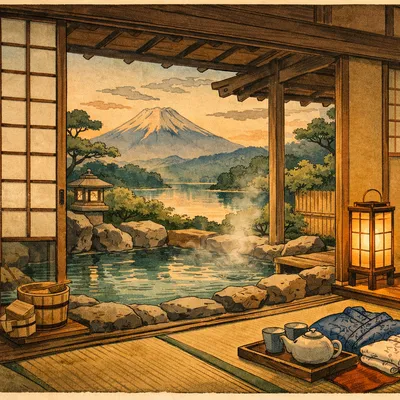
A traditional Japanese-style inn. Often includes tatami rooms, futon bedding, and set meals. Some are very traditional, others feel like modern hotels with a Japanese vibe.
Onsen
A hot spring bath using natural hot spring water. Some properties also have regular heated baths. If you care that it’s “real hot spring water,” confirm on the official site.
Private onsen / Family bath / Reserved bath
Often a bath you can use as one group (couple or family) without strangers. It may require a reservation, may have a time limit, and may cost extra. A “family bath” does not automatically mean the whole ryokan is kid-focused.
Public onsen
A shared bath area used by multiple guests. Usually separated by gender. Nudity is standard. This can feel intimidating at first, but many visitors love it once they understand the basics.
Open-air bath
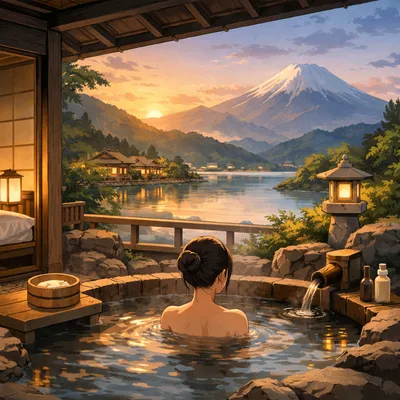
A bath outdoors (or partially outdoors). If it’s in your room, it’s typically the most private option—but often more expensive.
Dinner included vs room-only
Many ryokan stays are sold as packages. “Dinner included” can be wonderful, but it often comes with a fixed schedule. “Room-only” gives you flexibility, but nearby dining may be limited in onsen towns.
Yukata
A casual robe provided by many ryokan. Guests often wear it around the property. Kid sizes may or may not be available—check if it matters to you.
Shuttle service
A pick-up/drop-off service to the nearest station. Times and reservation rules vary, so confirm before arrival.
Common Mistakes (Totally Understandable, But Avoid These If You Can)
- Booking “private bath” without checking if it’s attached to the room (it may be a shared facility you reserve)
- Choosing a ryokan for the photos and forgetting to check access with luggage and kids
- Not checking dinner time rules, then arriving late and panicking
- Assuming “family bath” means kid amenities (it often just means “private bath for a group”)
- Forgetting to confirm allergy support in advance (last-minute requests may be difficult)
- Booking a remote onsen town for night one after a long flight (tired + transfers + kids = hard mode)
Recommended Options (Practical Choices That Reduce Stress)
Room with a private open-air bath
Best for: Families who want maximum privacy and flexibility (especially with babies or shy kids).
Not ideal for: Tight budgets, or families who plan to be out sightseeing all day.
My honest take: It’s often the easiest “no-thinking-required” option. Expensive, yes. But it can remove a lot of anxiety in one move.
Reservable private bath (family bath)
Best for: Families who want privacy without paying for an in-room bath.
Not ideal for: Families who hate schedules (time slots and rules vary).
My honest take: A great middle option. Just confirm how reservations work before you arrive.
Buffet-style dinner plan
Best for: Picky eaters, kids who need familiar choices, families who want less pressure.
Not ideal for: Families who prefer quiet, slow, course-style dining.
My honest take: Not “more authentic,” but often more relaxing. And relaxing is the point, right?
Luggage delivery (takkyubin) to your ryokan
Best for: Families moving between cities with big suitcases.
Not ideal for: One-night stays if timing doesn’t work, or travelers who need their luggage immediately.
My honest take: When it works, it’s one of the most stress-reducing tools in Japan. Confirm delivery timing and whether the ryokan can receive luggage before you send it.
Booking Checklist (Use This Before You Hit “Pay”)
- Confirm the exact room type, layout, and maximum occupancy
- Check whether your room is tatami, beds, or mixed (and where kids will sleep)
- Confirm child policies: ages, co-sleeping rules, bedding fees, meal fees
- Check bath setup: public vs private, reservation method, time limits, and fees
- If you need it, confirm tattoo policy directly with the property
- Confirm meal style: in-room, private dining, or buffet and kids’ meal availability
- Ask about allergy support before booking (don’t leave it to check-in)
- Check access: nearest station, shuttle service, and latest check-in time
- Look for family gear: crib, high chair, diaper bin (reserve if needed)
- Re-read the final booking screen for extra charges and conditions
Stress-Free Checklist (What to Do This Week)
- Decide your “must-haves” (private bath, room dining, crib, easy access) before browsing listings
- Make a short list of 3 ryokan and compare them using the same checklist
- Message the ryokan with your key questions (kids’ fees, meals, bath reservations)
- Plan your arrival route and timing (especially if dinner has a fixed schedule)
- Consider using luggage delivery if you’re changing cities with kids and suitcases
- Save the property details offline (address, phone number, check-in time)
What to Prepare Next
You don’t need to plan everything at once. Start with the parts that remove the biggest stress first.
- Set up your mobile internet plan (so you can message properties and navigate easily)
- Plan how you’ll handle luggage on travel days (stroller + suitcase is a lot)
- Decide your “easy first night” strategy (hotel first, ryokan later—often calmer)
- Make a simple list of food needs (allergies, picky eater backups)
FAQ
Do family-friendly ryokan usually allow children in the public onsen?
Often yes, but it varies by property and by the child’s age. If this matters for your plan, confirm directly with the ryokan before booking.
Is a “family bath” the same as an in-room private onsen?
Not usually. A family bath is often a private bath you reserve for a time slot, located somewhere in the building. An in-room private onsen is attached to your room and is more flexible.
Do I need to speak Japanese to stay at a ryokan with kids?
Not necessarily. Many ryokan handle international guests, but English support varies. The easiest approach is to message simple questions before booking and save key info (check-in time, dinner time, shuttle details) in your notes.
What’s the easiest meal setup for families?
Many families find in-room dining or private dining less stressful with small kids. Buffets can also be easier for picky eaters. The “best” choice depends on your child’s age and your noise-stress level.
Can a ryokan handle food allergies?
Some can, especially with advance notice, but not all requests are possible. Contact the property before booking and confirm what they can do.
Final Thoughts
Booking a family-friendly ryokan in Japan can feel confusing at first. But you’re not missing something—ryokan just have their own system, and booking sites don’t always explain it clearly.
You don’t need perfect planning. You just need a few smart checks: room layout, meals, bath type, access, and child policies. Do that, and your ryokan stay is much more likely to feel like the relaxing highlight you’re hoping for.
And if you’re still unsure? That’s okay. Pick your top two “non-negotiables,” confirm them with the property, and book with confidence. Calm trips are built from small, practical decisions—one at a time!