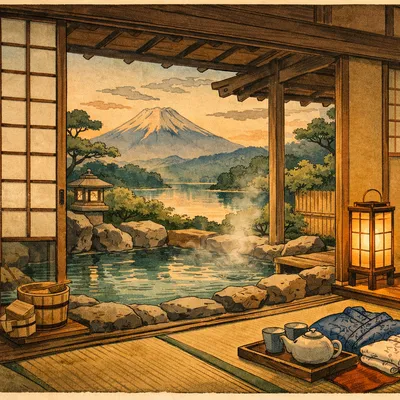
Private onsen are one of the easiest ways for couples to enjoy Japan’s hot springs without worrying about public bath rules, shyness, or separate changing areas. The key is choosing the right “type” of private bath and confirming a few details before you book—because what counts as “private” varies by property.
This guide walks you through the decision points first, then the on-the-day flow, then the common booking mistakes to avoid.
Quick answer: the simplest couples’ private onsen option
- Most private and most straightforward: a room with an in-room open-air bath (often called “private bath in the room”).
- Best value at a ryokan: a reservable private bath (a private bath you book for a time slot).
- Best for a short experience: a day-use facility that offers private rooms or private baths by the hour (availability depends on the area).
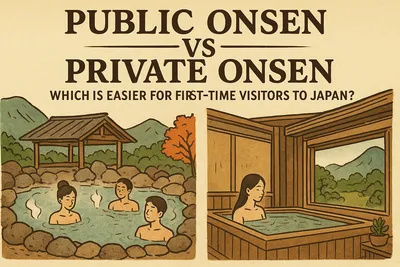
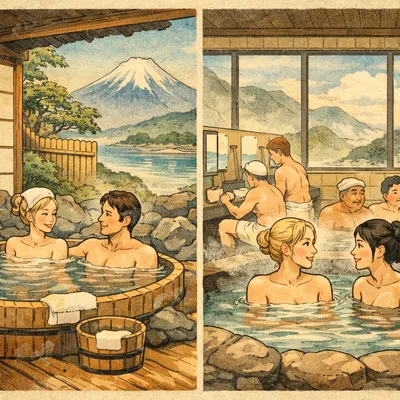
If you only remember one rule: couples can usually bathe together only in a private bath. Public onsen are typically separated by gender.
Related guide: Private Onsen vs Public Onsen: Which Is Better for Foreign Visitors?
Private onsen basics for couples (so you book the right thing)
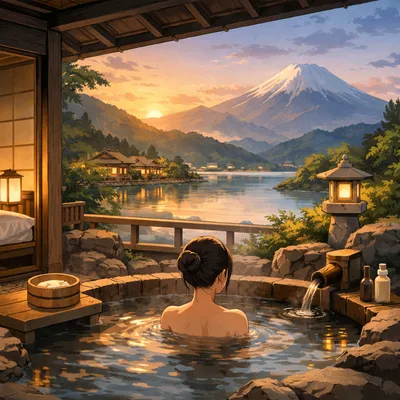
Option A: In-room bath (highest privacy, easiest for first-timers)
You have a bath attached to your room—often on a balcony or small terrace. You can usually use it whenever you like (some properties limit hours or ask you to avoid late-night noise).
- Pros: maximum privacy, no scheduling, easiest if you’re nervous about etiquette.
- Cons: higher price, bath size varies (some are compact), views vary by room.
- Best for: anniversaries, short stays, couples who want zero logistics.
Option B: Reservable private bath (good value, a “time slot” system)
This is a private bath on the property that you book for your exclusive use for a set time (commonly 40–60 minutes). Some places let you reserve in advance; others do it at check-in.
- Pros: more affordable than in-room baths, still private for couples.
- Cons: time limits, popular slots sell out, may require walking from your room.
- Best for: couples who want privacy but also want a more typical ryokan stay.
Option C: “Family bath” (usually similar to a reservable private bath)
Many places use “family bath” to mean a private bath intended for couples or families. The setup is typically the same as a reservable private bath: you book a time and use it privately.
Option D: Mixed-gender public baths (not the same as “private”)
Some destinations have mixed-gender bathing, but this is not private and comes with its own rules and comfort level. If your goal is privacy, focus on in-room baths or reservable private baths.
Who can use each option?
| Bath type | Couples together? | Typical privacy level | Usually needs reservation? |
|---|---|---|---|
| In-room bath | Yes | Very high | No (but room must be booked) |
| Reservable private bath | Yes | High | Often yes (advance or at check-in) |
| Family bath | Yes | High | Often yes |
| Public onsen | Usually no (gender-separated) | Low | No |
Related guide: Private Onsen or Ryokan? How to Choose the Right Stay in Japan (Without Booking Regrets)
How to choose the right stay (the booking checklist that prevents regrets)
Before you hit “reserve,” scan the listing for these specific points. Most disappointment comes from assuming “private” means the same thing everywhere.
1) Confirm the exact bath type (don’t rely on photos alone)
- Look for wording that clearly matches: “bath in the room,” “private bath reservation,” or “family bath.”
- Check if it’s: indoor vs outdoor, stone/wood/tile, and whether it’s truly hot spring water (some baths are heated water, depending on the property).
- Check bath size: some “two-person” baths are cozy rather than spacious.
2) Understand the reservation method (advance vs at check-in)
- Advance reservation: best for couples with a tight schedule or a specific preferred time.
- Reserve at check-in: flexible, but you may not get sunset slots on busy days.
- No reservations (first-come system): can be fine, but ask how you queue (sign-up board, key tag, or front desk).
3) Check fees, time limits, and “included vs extra”
Private baths may be:
- Included in your room rate
- Charged per session (per 40–60 minutes)
- Charged per person (less common, but it happens)
Also confirm whether towels are provided at the private bath area or only in your room.
4) Tattoo, language, and accessibility checks (ask early)
- Tattoos: private baths are often more flexible, but policies still vary. If tattoos are a concern, confirm directly before booking.
- Language support: look for clear English instructions or responsive messaging. It makes private-bath scheduling much easier.
- Accessibility: many baths involve steps, slippery stone, and narrow entrances. If you need step-free access, ask what’s available.
5) Check the stay “rhythm”: check-in time, dinner time, and last bath slot
Ryokan stays often run on a schedule, especially if dinner is included. Make sure your arrival time leaves room for a bath without rushing.
Related guide: Japan Hotel Guide for First-Time Visitors: What to Know Before Booking
Budget reality: what couples’ private onsen typically cost
Prices change by season, day of week, and location, so treat these as rough planning ranges and confirm current rates when you book.
| Style | What you’re paying for | Typical range (rough) |
|---|---|---|
| Day-use private bath | Private bath room for a set time | Often a few thousand to around 10,000+ yen per session |
| Ryokan with reservable private bath | Overnight stay + private bath time slot(s) | Mid-range to high, depending on meals and room |
| Ryokan with in-room open-air bath | Overnight stay + private bath anytime | High to luxury (especially weekends/peak seasons) |
Money-saving tip: if you want a private bath experience without a luxury room, look for a ryokan where the private bath is reservable and reasonably priced, then prioritize a weekday stay.
What to expect on the day (a calm, step-by-step flow)
From arrival to bath time
- Check in and confirm your bath plan: “Do we need to reserve the private bath? What times are available?”
- Choose a time slot (if required). If you have dinner included, ask which bath times fit around dinner.
- Go to your room and locate towels, a small towel, and any bath basket provided.
- Head to the private bath area a few minutes early (some places give you a key or tag).
- Lock the door or flip the sign to “occupied” so you won’t be disturbed.
- Wash before soaking (this is the most important etiquette point).
- Soak, relax, and hydrate. Many people keep the first soak short and take breaks.
- Rinse lightly if you want (rules vary; if the water is mineral-rich, some people prefer not to fully soap up again).
- Dry off well before leaving so you don’t drip in hallways.
What to bring (and what not to bring)
- Bring: towels (unless provided at the bath), hair tie, water, and your room key.
- Optional: a small pouch for toiletries if you prefer your own shampoo/conditioner (many places provide them).
- Avoid: phones/cameras in the bath area unless the property explicitly allows it. Even in private spaces, facilities often discourage photography to protect everyone’s privacy.
Simple etiquette that keeps everything stress-free
- Wash first: always clean your body before entering the bath.
- Keep towels out of the water: set them aside (or on your head) rather than soaking them.
- Tie up long hair: keep it out of the water and away from drains.
- Be mindful of time limits: if you booked a slot, leave on time for the next guests.
- Keep it quiet: sound carries in ryokan hallways, especially at night.
Related guide: Japanese Etiquette for Tourists: What Foreign Visitors Should Know (Stress-Free Guide)
Common booking mistakes to avoid (and how to spot them)
Mistake 1: Booking a “nice hotel” and assuming it has a private onsen
Many hotels have a bathhouse, but not a private bath. If privacy is the priority, confirm “in-room bath” or “reservable private bath” in the room plan details.
Mistake 2: Reserving the wrong room plan
Some properties have only a few rooms with private baths. Double-check the room name and inclusions before paying.
Mistake 3: Not noticing extra fees or short time limits
A listing may show “private bath available,” but the fee, time limit, and reservation method may be in the fine print. Look specifically for:
- Session length (40/50/60 minutes)
- Price per session vs included
- How to reserve (online, phone, at check-in)
- Last reservable time
Mistake 4: Confusing private-bath rules with public-bath rules
Even in a private bath, you still wash first and keep towels out of the water. But you don’t need to worry about gender-separated spaces if the bath is truly private and lockable.
Mistake 5: Ignoring cancellation rules and check-in deadlines
Ryokan can have strict cancellation policies, and some dinner-included plans have a latest check-in time. Confirm both before booking, especially if you’re arriving from another city.
Related guide: How to Book a Ryokan in Japan Without Getting Confused: A Calm, Step-by-Step Guide for First-Timers
Area planning: how to choose an onsen town as a couple
Japan has great private onsen options across the country. Rather than chasing a “best” town, choose based on your route and the kind of trip you want.
Easy add-on from Tokyo: Hakone-style trips
- Why couples like it: convenient, lots of ryokan choices, good for 1 night.
- Watch for: weekend crowds and higher prices; book earlier for in-room baths.
Classic hot spring vibe: Kusatsu-style trips
- Why couples like it: strong onsen town atmosphere and cooler-weather appeal.
- Watch for: travel time and winter conditions depending on your route.
Hot spring capital feel: Beppu-style trips
- Why couples like it: lots of bathing culture and variety, including private options.
- Watch for: picking the right neighborhood for your pace and transport.
Scenic and relaxed: Yufuin-style trips
- Why couples like it: calm scenery, slower pace, many ryokan with beautiful baths.
- Watch for: popular seasons selling out early.
If you’re building your whole Japan itinerary right now, it can help to choose an onsen stop after a busy city segment, when you’ll appreciate a slower day.
Related guide: How to Choose the Best Area to Stay in Japan Without Regret (First-Timer Friendly)
Best trip planning tips for couples (simple but effective)
- Book one night, not zero: a single overnight ryokan stay is often the easiest way to enjoy a private bath without rushing.
- Pick a weekday if you can: better availability for private bath slots and often better pricing.
- Plan your “bath timing” around meals: many couples enjoy a soak before dinner and a short soak after.
- Pack for comfort: easy slip-on shoes, minimal valuables, and hair ties make the experience smoother.
Related guide: First Time in Japan? 15 Things to Know Before You Go (Stress-Free Tips)
Private onsen checklist (save this before you book)
- Is it in-room or reservable private bath?
- Do we need to reserve in advance or at check-in?
- What are the hours and time limit?
- Is there an extra fee per session or is it included?
- Are tattoos allowed (especially if using shared areas to reach the bath)?
- Are towels provided at the bath area, or only in the room?
- What is the latest check-in time (especially with dinner plans)?
- What is the cancellation policy?
FAQ: Couples’ private onsen in Japan
Can couples bathe together in Japan?
Yes—in a private bath (in-room bath, reservable private bath, or family bath). In most places, public onsen are gender-separated, so couples typically bathe separately unless you choose a private option.
Are tattoos allowed in private onsen?
Often, private baths are more flexible, but policies vary by property. If tattoos matter for your trip, confirm before booking and follow the property’s guidance.
Do we need to stay overnight to use a private onsen?
Not always. Some areas offer day-use private baths, but availability depends on the destination and the facility. Overnight stays generally give you more choices and less time pressure.
What should we wear in a private onsen?
In a private bath, you typically bathe without clothing. The difference is that you’re not sharing the space with strangers. If you’re unsure, check the property’s instructions—private bath rooms are designed for privacy.
Can we take photos in a private onsen?
Even if the bath is private, many properties discourage or restrict photography in bathing areas. If you want a photo, ask staff about the rules and keep privacy and safety in mind.
What if one of us is on our period?
Policies and comfort levels vary. Some people choose to skip bathing during that time, while others prefer a private bath for privacy. If you’re unsure, check the property’s guidance and do what feels comfortable for you.
How long should we soak?
There’s no single rule, but many people start with a short soak and take breaks. Drink water, listen to your body, and be mindful of the time limit if you reserved a slot.