Finding a menu you cannot read can feel awkward when you are hungry and standing at the door. The good news is that an English menu is helpful, but it is not essential for having a good meal in Japan.
Many small restaurants use photos, food displays, tablets, set meals, or simple pointing. With a calm plan, you can usually work out whether the restaurant is a comfortable fit before ordering anything.
Quick answer: First, ask whether an English menu is available. If not, look for photos or a touchscreen, use a translation app as a guide, point to a dish, or ask for the restaurant’s recommendation. If you cannot understand the food, price, or allergy information well enough to feel comfortable, it is completely fine to leave before ordering.
First, Ask Whether an English Menu Is Available
Start with a simple, friendly question. Staff may have an English menu, a picture menu, or an English version on a tablet even if it is not visible outside.
You can say, “Do you have an English menu?” slowly and politely. Showing the question on your phone can also help.
If the answer is no, do not assume you need to leave immediately. A menu without English often still has useful clues, including photos, prices, popular-item markings, and familiar food shapes.
An English menu is also not a measure of how welcoming or how good a restaurant is. Some small local places simply serve mostly regular customers and keep their menu simple.
Your 5-Step Plan When There Is No English Menu
-
Pause and look around. Check the menu, walls, counter, display case, and ordering screen for photos. Look at what other diners are eating, too.
-
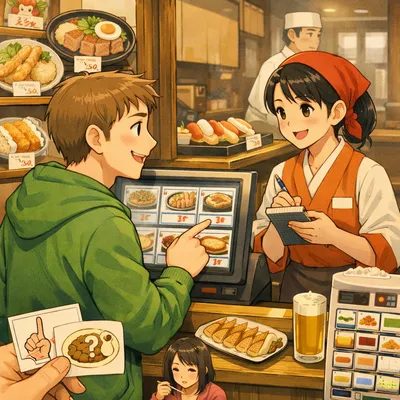
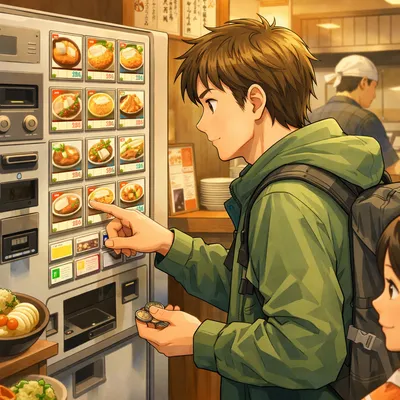
Find the easiest ordering method. A picture menu, plastic food display, touchscreen, or meal ticket machine may make ordering much easier than a printed menu.
-
Use your phone for a quick translation. Camera translation can help you identify broad categories and prices. Treat unusual dish names and ingredient lists with caution, since automatic translations can be unclear.
-
Choose a visible dish or ask for a recommendation. Pointing is normal and practical. You can point to a photo and say, “This one, please.” If you have no food restrictions, asking what the restaurant recommends can also work well.
-
Leave politely if you still do not feel sure. You do not need to force an order just because you have sat down. It is better to choose another place than order something you cannot identify or afford comfortably.
Useful fallback sentence: “Sorry, I need a little more time to decide.” This gives you a graceful moment to review the menu or decide whether to leave.
Look for These Easy Ordering Clues
Before trying to translate every line on a menu, look for the simplest visual route. In many restaurants, this is enough to place an order confidently.
Photos on the Menu or Wall
Photo menus are common in casual restaurants. Match the photo to the price and point directly. If there are several sizes or set options, use your fingers to show the number of portions you want and confirm the price on the menu.
Food Displays Outside
Some restaurants show realistic plastic models of their dishes in a window. Take a photo of the item you want before entering, then show it to the staff. This is especially useful when the indoor menu has no pictures.
Set Meals
A set meal usually combines a main dish with rice, soup, and small side dishes. It can be an easy choice because you are ordering one complete meal rather than several separate items.
However, do not choose a set meal based only on its photo if you have an allergy, follow a strict diet, or need to avoid a particular ingredient. Side dishes and soup may contain ingredients that are not obvious.
Touchscreens and Meal Ticket Machines
Some ramen shops, curry restaurants, and fast-casual places use a machine before you sit down. The screen may have photos or an English-language option hidden in the settings.
If the machine is difficult to understand, it is fine to step aside and watch how it works, ask staff for help, or choose another restaurant.
Related guide: How to Use Restaurant Ticket Machines in Japan Without Feeling Confused.
What Other Diners Are Eating
If a restaurant is busy, you may notice that many people have the same bowl, plate, or tray. You can point to that dish and say, “The same as that, please.” This can be useful at restaurants that specialize in one or two main dishes.
The Safest Choices for First-Time Visitors
There is no single “safe” dish for every traveler, because tastes and dietary needs vary. But these choices are often easier to understand and order when there is no English menu:
- A dish with a clear photo and visible ingredients
- A dish shown in the window display
- The restaurant’s signature item, if you have no relevant food restrictions
- A simple set meal with a clearly pictured main dish
- Grilled or fried items where the main ingredient is easy to see
- The same dish being ordered by several nearby diners
Try not to rely only on a translated dish name. A short menu label may not explain the broth, sauce, garnish, seasoning, or side dishes included with the meal.
How to Use Translation Apps Without Relying on Them Too Much
Camera translation is useful for getting the general idea of a menu. It may help you spot words such as rice, noodles, chicken, fish, spicy, or dessert. But it is less reliable for regional dishes, handwritten specials, and ingredients with multiple meanings.
Use a translation app as a starting point, then confirm the important details by pointing, showing a short question on your phone, or asking staff for help.
A Better Way to Translate a Menu
- Translate the heading first to understand the menu section.
- Translate the full dish name and price together.
- Check the photo, if there is one.
- Look for small notes beside the dish, which may describe portion size or ingredients.
- For anything important to your health or diet, ask staff to confirm rather than guessing.
It is also helpful to keep your question short. “Does this contain pork?” is easier to translate and answer than a long, detailed sentence.
Simple Phrases You Can Use at the Table
You do not need to memorize a long list of phrases. These plain English sentences are useful to say, show on your phone, or enter into a translation app.
| Situation | Simple English to Say or Show |
|---|---|
| Asking for a menu | Do you have an English menu? |
| Asking for help | What do you recommend? |
| Ordering by pointing | This one, please. |
| Copying another order | The same as that, please. |
| Checking spice level | Is this spicy? |
| Checking an ingredient | Does this contain pork? |
| Asking staff to verify | Could you please check with the kitchen? |
| Asking to pay | Check, please. |
Pointing while using a short sentence is often more effective than trying to explain a long request. A smile, a calm pace, and a clear gesture go a long way.
Related guide: How to Order Food in Japan When You Don’t Speak Japanese (No-Stress Guide).
If You Have Allergies or Dietary Restrictions
This is the situation where it is most important not to guess. A photo, translated name, or visible ingredient does not always tell you what is in a broth, sauce, seasoning, or cooking oil.
If you have an allergy, tell the staff before ordering. Use a clear allergy card on your phone that explains the ingredient you must avoid in the local language. Include whether even a small amount is a concern and ask whether the kitchen can check.
It is helpful to distinguish an allergy from a preference. Staff may be able to suggest a different dish for a preference, but an allergy requires more careful confirmation.
Ingredients That May Be Less Obvious
- Soup stock and broths
- Soy-based sauces and seasoning blends
- Fermented pastes and marinades
- Dressings, mayonnaise, and toppings
- Shared frying oil or shared cooking surfaces
If staff cannot clearly confirm the ingredients or possible cross-contact, choose another restaurant. This is not rude, and it is usually the less stressful option for everyone.
For travelers with a severe allergy or a medically necessary diet, planning meals ahead and keeping suitable snacks with you may provide more flexibility than relying on a last-minute menu translation.
When It Is Completely Fine to Leave
Leaving before ordering is normal when a restaurant is not a practical match. You do not need to apologize repeatedly or explain your personal circumstances.
Consider leaving if:
- You cannot confirm an allergen or essential dietary requirement.
- You cannot understand what the food is or how much it costs.
- The ordering machine has no clear option you can use and staff cannot assist.
- You are being rushed and do not have enough time to decide.
- The payment method does not work for you.
A polite smile and a brief “Sorry, I need more time to decide” is enough. If you have not ordered, you can simply thank the staff and leave.
Payment: One Last Thing to Check
Before you settle in, look for payment signs near the entrance, register, or menu. Some smaller restaurants may prefer cash, while others accept cards or contactless payments. Payment methods can vary even within the same city.
At many casual restaurants, you pay at a register near the exit rather than at the table. Watch what other diners do, or ask where to pay when you are ready.
It is sensible to carry some cash and check current payment information where possible, especially when visiting small independent restaurants.
Related guide: How to Use IC Cards in Japan: Suica, PASMO, and Other Travel Cards Explained (Stress-Free Guide).
Common Mistakes to Avoid
- Trying to translate every word: Start with photos, prices, and menu sections instead.
- Assuming a dish is vegetarian because it looks vegetable-based: Broths, sauces, and toppings may contain animal products.
- Ordering a recommendation before mentioning restrictions: Explain essential restrictions first.
- Feeling pressured to order quickly: It is fine to ask for a moment or choose another place.
- Assuming all restaurants accept the same payment methods: Check before ordering when possible.
- Worrying about perfect pronunciation: Pointing, photos, and a translation app are all normal tools for travelers.
A Quick Restaurant Checklist
Before you order from a menu without English, run through this short checklist:
- Can I see photos, a display, or a clear ordering screen?
- Do I understand the approximate price?
- Can I identify the main ingredients well enough for my needs?
- Have I told staff about any important allergy or dietary restriction?
- Do I know whether I order at the table, counter, or ticket machine?
- Do I have a payment method likely to work here?
If the answer is yes to the important points, you are ready to order. If not, there will almost always be another restaurant nearby that feels easier.
FAQ
Should I avoid restaurants without English menus?
No. Many restaurants without English menus are easy to use with photos, pointing, and a translation app. The main exception is when you need detailed ingredient confirmation or cannot understand the ordering and payment process comfortably.
Is it rude to point at food or a menu in Japan?
Pointing to a menu photo, display item, or menu line is a practical and widely understood way to order. Use an open hand if possible, be polite, and avoid touching shared food or items that do not belong to you.
Can I ask the staff to choose for me?
Yes, asking for a recommendation can work well if you are open to trying the restaurant’s specialty. Tell staff about allergies, foods you cannot eat, and strong preferences before accepting a recommendation.
What if I accidentally order something I do not want?
If the food has not been prepared yet, politely ask whether the order can be changed. Once a dish has been made, it may not be possible to change it. A calm approach and simple communication are your best options.
Do I need to speak the local language to eat out in Japan?
No. A few prepared sentences, a translation app, photos, and pointing can cover many everyday restaurant situations. Being patient and flexible matters more than speaking perfectly.
Related guide: Can You Travel Japan Without Speaking Japanese? A Practical Guide.
Eating at a restaurant without an English menu does not need to become a stressful travel moment. Start with the easiest visual clues, keep your questions short, confirm anything important, and give yourself permission to leave when the situation is not clear. That simple approach will help you enjoy more meals with much less pressure.
Related guide: Japanese Etiquette for Tourists: What Foreign Visitors Should Know (Stress-Free Guide).