You’re finally in Japan. You’ve survived the flight. You’ve found your train. You’ve even located your hotel (after exiting the station from the “wrong” side… it happens!). And now you’re staring at the words “onsen,” “public bath,” “private bath,” “family bath,” and maybe “room with open-air bath,” thinking: Wait… what am I actually booking?
Let’s be honest. This is where many first-time visitors get stuck. Not because onsen is complicated, but because the rules feel unspoken. Also, the biggest question is a very human one: Do I really want to be naked in front of strangers?
Don’t worry. You’re not the only one. In this guide, I’ll walk you through Private Onsen vs Public Onsen: Which Is Better for Foreign Visitors? in a calm, practical way—so you can choose what fits your comfort level, budget, tattoos (if relevant), and energy.
Quick note: Onsen rules, tattoo policies, pricing, and reservation systems can vary a lot by facility and can change over time. Use this as a stress-free starting point, and check the latest official information (or confirm directly with the ryokan/hotel) before you book anything important.
Quick Answer: Which One Is Better?

If you want the easiest, lowest-stress first onsen experience, private onsen is often the smoother choice—especially if you feel nervous about nudity, tattoos, or etiquette.
If you want the classic “Japan onsen culture” feeling (and usually better value), public onsen can be amazing once you know the basics.
Many first-time visitors end up doing both: private first to build confidence, then public when they feel ready.
Related guide: Private Onsen, Family Bath, and Open-Air Bath Rooms in Japan: What’s the Difference?
Who This Guide Is For
This guide is for you if:
- You’re visiting Japan for the first time and onsen feels intimidating
- You don’t speak English/Japanese well and you’re worried you’ll break a rule
- You’re choosing a ryokan or hotel and the bath options look confusing
- You’re traveling as a couple, family, or friend group and want to bathe together
- You have tattoos (or you’re not sure if they’ll be an issue)
- You’re tired, jet-lagged, or simply want the easiest option
First, a Calm Definition: Onsen vs Sento (Yes, It Matters)
Here’s the thing. A lot of travelers use “onsen” to mean “public bath,” but in Japan they’re not exactly the same.
Onsen
Onsen generally refers to a bath facility that uses natural hot spring water and meets legal requirements. (The exact conditions are defined by Japanese law.)
Sento
Sento is a public bathhouse that often uses heated tap water. It can still be a lovely local experience, but it’s not technically “onsen.”
Stress-Free Tip: If your main goal is to relax (not to chase a technical definition), both can be great. Just don’t assume every bath is a natural hot spring—check the facility description if that matters to you.
Public Onsen: What It’s Like (And Why People Love It)
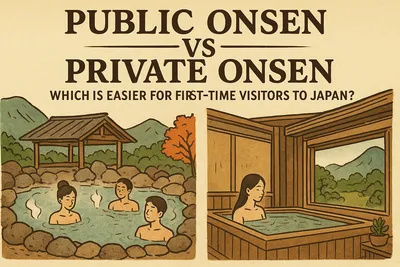
A public onsen usually means a larger shared bath, typically separated by gender. You’ll see this in ryokan, hotels, and day-use hot spring facilities.
Yes, it’s nude bathing. No swimsuits. That’s the rule in most places.
Why public onsen can be great for foreign visitors
- Value: Many public baths and day-use onsen are roughly 300–2,000 yen per person (very location- and facility-dependent).
- Scale: Bigger baths, multiple pools, sometimes saunas, sometimes outdoor baths.
- Atmosphere: It can feel very “local Japan,” especially in smaller towns.
- Convenience: In many hotels/ryokan, the public bath is included with your stay and you can come and go during set hours.
What makes public onsen stressful for first-timers
Let’s not pretend the nerves are silly. A common situation is arriving after a long day—maybe you’ve dragged a suitcase through a crowded station, your phone battery is low, and now you’re trying to remember: “Do I wash first? Where do I put my towel? Is anyone judging me?”
Good news: people are usually focused on themselves. Also, most guests won’t stare. Still, the first five minutes can feel like a lot.
Stress-Free Tip: If you want to try public onsen, go at a quieter time (often later evening or early morning, depending on the facility). Less crowd = less pressure.
Related guide: Japanese Etiquette for Tourists: What Foreign Visitors Should Know (Stress-Free Guide)
Private Onsen: The Three Types (This Is Where Booking Pages Get Tricky)
“Private onsen” sounds simple, but it can mean different things depending on the property. This is where many visitors get confused.
1) Reservable private bath (often called “private bath” or “family bath”)
This is a bath you book for a set time slot—often something like 30 to 120 minutes, depending on the facility. Your group uses it alone.
Best for: couples, families, friends, nervous first-timers, tattoo concerns (depending on the facility).
2) In-room onsen / bath in your room
This means your room has its own bath—sometimes indoor, sometimes open-air. If it’s a true onsen, it uses hot spring water (but not all “open-air baths” are automatically onsen, so check the details).
Best for: maximum privacy, bathing whenever you want, avoiding reservation stress.
3) “Private onsen” marketing language (read carefully)
Sometimes listings use “private” to mean “a small bath” or “a bath you can reserve,” but the rules may still be: request at check-in, first-come-first-served, extra fees, time limits, etc.
Tiny warning: Don’t assume “private onsen” means “in your room.” Always check whether it’s attached to your room or booked separately.
Stress-Free Tip: If you’re booking online, search the room/bath description for words like “in-room,” “attached,” “reservable,” “time limit,” and “additional fee.” If it’s still unclear, message the property before you pay.
Related guide: How to Choose a Ryokan with a Private Onsen in Japan for Your First Trip
Private Onsen vs Public Onsen: The Real-Life Comparison (For Foreign Visitors)
| Category | Public onsen | Private onsen |
|---|---|---|
| Privacy | Shared space (usually gender-separated) | Your group only (time slot or in-room) |
| Stress level (first time) | Can feel intimidating at first | Often the easiest “practice round” |
| Tattoo friendliness | Varies a lot; restrictions are common | Often easier, but still confirm |
| Cost | Often included at hotels/ryokan; day-use often ~300–2,000 yen | Private bath add-on often ~1,000–5,000+ yen per session; in-room baths raise room price |
| Flexibility | Usually no reservation | Time slots (if reservable) or anytime (if in-room) |
| Culture feel | Most “classic” shared-bath vibe | More personal retreat vibe |
1) Comfort level and culture shock
Public onsen: The biggest hurdle is being nude around strangers. Some travelers adjust quickly once they realize nobody is judging them.
Private onsen: Often easier emotionally. You can learn the flow (wash first, soak after) without feeling watched.
Stress-Free Tip: If you’re nervous, treat private onsen as your “practice round.” Sounds dramatic? Maybe. But it helps.
2) Tattoos and personal/religious reasons
Public onsen: Tattoo rules vary widely. Many facilities still restrict tattoos, and even “tattoo-friendly” places may have conditions (size, number, placement, or different rules for public vs private baths).
Private onsen: Often easier if tattoos are a concern, and it can also be more comfortable if you prefer more privacy for personal or religious reasons.
Practical tattoo workarounds (facility-dependent):
- Covering: Some places allow small tattoos if covered with a patch/tape. Others do not—so don’t assume.
- Private bath only: Some properties allow tattoos in private baths but not in public baths.
- Choose a tattoo-friendly property: Some places clearly state their policy in English. When in doubt, message them.
Stress-Free Tip: If tattoos matter for your trip, confirm directly with the property before booking. Don’t rely on assumptions or old blog posts.
Related guide: Tattoo-Friendly Onsen in Japan: Why Private Baths May Be the Easiest Option
3) Price and “is it worth it?”
Public onsen: Usually the best value. Day-use prices are often around 300–2,000 yen, and hotel/ryokan public baths are often included in your stay.
Private onsen:
- Reservable private bath: commonly an extra fee, often roughly 1,000–5,000+ yen per session (per group or per room, depending on the property).
- In-room bath: usually means a higher nightly room rate (sometimes a lot higher), but you may not pay per session.
My honest take: If your budget is tight, public onsen is hard to beat. If private onsen is the difference between “I’ll do it” and “I’ll skip it,” then private can be worth the splurge—because the best onsen is the one you actually feel comfortable using.
Related guide: Are Private Onsen Rooms in Japan Worth It? Pros, Cons, and Price Guide for First-Timers
4) Freedom and timing (and how tired you are)
Public onsen: Usually no reservation. You can often pop in for 10 minutes or soak longer.
Reservable private bath: You may need to plan around time slots. That’s fine… unless you’re jet-lagged and accidentally fall asleep.
In-room bath: Maximum freedom. Midnight soak? Early morning soak? Up to you.
Stress-Free Tip: If you hate schedules on vacation, choose either a public bath or an in-room bath. Reservable private baths are great, but they do add “one more thing to manage.”
5) The “Japan-ness” of the experience
Public onsen: This is where you may feel the cultural side more strongly—the shared space, the quiet routines, the “everyone knows what to do” vibe. Some people even enjoy small talk (though it’s often minimal).
Private onsen: More like a peaceful mini-retreat. Less cultural immersion, more personal comfort.
Stress-Free Tip: If you want the cultural experience but fear the first step, do one private session first, then try public once you feel calmer.
Reservations & Real-World Process (So You Don’t Get Surprised)
This is the part booking pages often don’t explain clearly. Here’s how it usually works in real life (with lots of exceptions, so always confirm).
Do you need to reserve a private bath in advance?
- Sometimes yes: Some properties let you reserve a time slot online before arrival (ideal if you’re anxious).
- Often at check-in: You pick a time from an in-person schedule when you arrive. Popular times (after dinner) can fill quickly.
- Sometimes first-come-first-served: You wait until it’s free, or you “claim” a slot on a board/app in the building.
Stress-Free Tip: If a private bath is the main reason you’re booking, choose a place that clearly says you can reserve (or at least guarantee access) and confirm how it works before you pay.
How to tell if day-use is possible (without guessing)
Some facilities are for overnight guests only, and some accept day-use visitors. To avoid wasted travel time, look for signs like:
- Day-use hours listed: specific entry times and last entry times
- Separate pricing for day-use: admission fee, towel rental, and any add-ons
- Closed days: many day-use facilities have a weekly maintenance day
Stress-Free Tip: If you can’t find day-use info on the official site, assume it might be guest-only and send a quick message before you go.
English support: what to expect
- Big tourist areas: more likely to have English signage and simple instructions.
- Smaller towns: still very doable, but you may rely more on visuals and routine.
- Private baths help: even if the instructions are minimal, you have time and space to figure things out calmly.
Stress-Free Tip: Save screenshots of your booking page that show bath type, fees, and reservation rules. It’s surprisingly helpful at check-in.
How to Choose Without Overthinking (A Simple Decision Tree)
Let’s make this easy, shall we?
Choose a private onsen if…
- You feel strongly uncomfortable being nude around strangers
- You have tattoos and don’t want surprise restrictions
- You’re traveling as a couple/family and want to bathe together
- You’re worried about etiquette and want a low-pressure first try
- You’re exhausted and want the simplest, calmest option
Choose a public onsen if…
- You want the classic onsen culture experience
- You want better value (especially for day-use)
- You like large baths and variety (multiple pools, outdoor baths, etc.)
- You don’t mind gender-separated bathing
Stress-Free Tip: If you’re staying at a ryokan anyway, check if it has both. Some places offer a public bath plus a reservable private bath. That combo can be ideal for first-timers.
What Actually Happens at an Onsen (So You Don’t Panic)
Many visitors worry they’ll “do it wrong.” You don’t need to be perfect. You just need to know the basics.
The usual flow (public or private)
- Enter the changing area and put your clothes in a basket/locker
- Bring a small towel (often provided). Leave big towels outside the bath area if asked
- Wash and rinse your body first at the shower stations
- Then soak in the bath
- Keep your towel out of the bath water (common rule)
Tiny warning: Swimsuits are generally not allowed in traditional public onsen. Some modern spa-style places may have separate “swimsuit zones,” but don’t assume.
Stress-Free Tip: If you feel awkward, just copy the calmest person in the room. Quietly. Respectfully. Like a travel ninja.
Accommodation Terms Explained (So Booking Pages Make Sense)
Ryokan
A ryokan is a traditional Japanese inn. It often includes meals (especially dinner and breakfast), and it may have onsen baths. Room style can be tatami with futon bedding, or a mix of Japanese and Western.
Onsen
Onsen means natural hot spring bathing. A property may have onsen water in a large shared bath, in private baths, or in-room baths (or some combination).
Public bath / public onsen
A shared bath area, usually separated by gender. Nudity is the norm.
Private onsen / private bath
A bath used by one group at a time. It might be reservable, first-come-first-served, or attached to your room.
Family bath
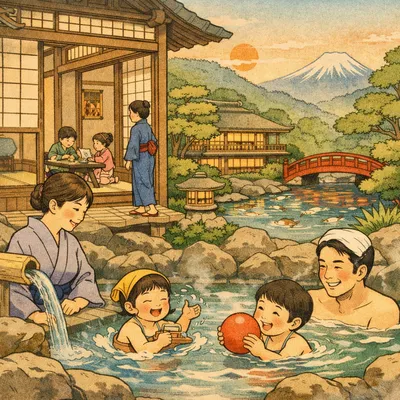
This one surprises people. In Japan, a “family bath” often means a private bath you can use as a couple, family, or small group. It does not always mean the whole property is designed specifically for families with kids.
Reserved bath
A private bath you book for a time slot. Rules vary: free or paid, reserve in advance or at check-in, time limits, etc.
Open-air bath
An open-air bath is outdoors (or semi-outdoors). It can be public or private, and it may or may not be true onsen water—check the details.
Room with private open-air bath
This usually means the bath is attached to your room and you can use it during your stay. It’s often the most convenient (and often more expensive) option.
Dinner included / room-only plan
Ryokan often sell plans with dinner and breakfast included. A room-only plan may be cheaper, but it can be inconvenient if the ryokan is far from restaurants.
Shuttle service
Some ryokan offer a shuttle from the nearest station. Times and rules vary, so check before booking—especially if you’ll arrive with luggage.
Yukata
A yukata is a casual robe often provided at ryokan. You can usually wear it around the property (and sometimes to the bath). Rules vary by place.
Stress-Free Tip: If you remember one thing, remember this: “Private” can mean “in your room” OR “reservable.” Those are very different experiences (and prices).
Cost Comparison: What You’ll Usually Pay (And When It’s Worth It)
Prices vary by region, season, and how premium the property is. But these ranges help you budget calmly.
Public onsen price range (typical)
- Day-use facilities: often around 300–2,000 yen per person
- Hotel/ryokan public baths: often included with your stay (but check if there’s a separate “hot spring tax” or facility fee)
- Extras: towel rental, sauna, or spa areas may cost extra
Private bath add-on price range (typical)
- Reservable private bath: often around 1,000–5,000+ yen per session (sometimes per group, sometimes per person)
- Longer slots / better views: often cost more
In-room private bath cost (typical)
- Higher room category: you’re usually paying a higher nightly rate rather than a per-use fee
- Best value if: you’ll soak multiple times (night + morning + after exploring)
When paying extra is the least-stress choice
- Tattoos: if public bath access is uncertain, paying for private can prevent a “surprise no” at the door.
- Couples/families: if bathing together matters, private is the simplest solution.
- Energy level: if you’re exhausted, reducing social stress can be worth more than the yen difference.
Where to Go (Simple Ways to Pick a Location)
I’m not listing specific properties here because availability, policies, and pricing can change fast. Instead, here are stress-free ways to choose an area and find the right bath style.
Near Tokyo: easiest “first onsen” areas
- Good for: short trips, first-timers, minimizing transit complexity
- Look for: ryokan/hotels that clearly state they have private reservable baths or in-room baths, plus clear access from the nearest station
Related guide: Best Onsen Areas Near Tokyo for First-Time Visitors: Hakone, Kawaguchiko, and More
Hakone vs Kawaguchiko: choosing for private baths
- Hakone: lots of accommodation choices and classic onsen-town feel; transport can involve transfers depending on where you stay
- Kawaguchiko: popular for scenery; private-bath stays can be amazing if you plan access carefully
Related guide: Hakone vs Kawaguchiko: Which Is Better for a Private Onsen Stay?
Kyoto (and other big cities): set expectations
- Reality check: true hot spring water is less common in the city center than in dedicated onsen towns
- Stress-free approach: consider staying one night in an onsen town nearby, or choose a hotel bath experience in the city without putting pressure on it being “perfect”
Common Mistakes (Totally Understandable, But Avoid These If You Can)
- Assuming “private bath” means “in-room bath” (then feeling disappointed at check-in)
- Booking a ryokan for the first night in Japan when you land late and you’re exhausted (some have early dinner times or limited check-in windows)
- Not checking tattoo rules until you’re already there
- Choosing based on a map distance only (a place can look “close” but require hills, stairs, or confusing station exits with luggage)
- Overpaying for an in-room onsen when a reservable private bath would have met your needs
- Skipping onsen entirely because you’re scared of etiquette (you can start with private!)
Stress-Free Tip: The goal is not “the most famous onsen.” It’s the onsen experience that feels doable for you.
Related guide: 10 Common Mistakes Foreigners Make in Japan (And How to Avoid Them)
Recommended Options (Pick What Fits Your Trip)
Option 1: Public onsen at your hotel/ryokan
Best for: budget-focused travelers, people who want an easy “try it once,” travelers who like flexibility.
Not ideal for: travelers with strong privacy concerns, some tattoo situations, people anxious about shared spaces.
My honest take: This is often the simplest win because you don’t need extra transport. After dinner, you just go upstairs, soak, and sleep.
Option 2: Reservable private bath (family bath)
Best for: couples, families, friend groups, first-timers who want privacy, travelers who want to bathe together.
Not ideal for: people who hate time slots or want long, repeated soaks without planning.
My honest take: This is the “middle path.” Often more affordable than an in-room onsen room, but still very comfortable.
Option 3: Room with a private open-air bath (in-room bath)
Best for: high-comfort travelers, people who want to soak multiple times a day, travelers who want zero social stress.
Not ideal for: tight budgets, travelers who won’t spend much time in the room.
My honest take: It’s often the most relaxing option—but only worth it if you’ll actually use it a lot. Otherwise, you may be paying mainly for the idea.
Booking Checklist (Before You Click “Pay”)
- Is the bath public, private, reservable, or attached to your room?
- If it’s private, is it free or paid? Is there a time limit?
- Do you need to reserve in advance, reserve at check-in, or is it first-come-first-served?
- Is it an open-air bath or indoor?
- Is it onsen water (natural hot spring) or a regular bath?
- Are tattoos allowed in public baths, private baths, both, or neither? (Confirm directly if important.)
- Are meals included? If yes, what time is dinner, and what’s the latest check-in?
- Is there a shuttle from the station? What time does it run?
- Will the location be easy with large luggage (or kids), especially after a long travel day?
- Is there English support (or clear instructions) if you’re nervous?
Stress-Free Checklist (Do This and You’ll Feel 10x Calmer)
- Decide your comfort level: public, private, or “private first, public later”
- Save screenshots of your booking details (bath type, meal plan, check-in time)
- If tattoos matter, message the property and keep the reply
- Plan onsen for a low-crowd time if you’re nervous
- Pack a small pouch for onsen basics (hair tie, skincare, contact case if needed)
- Don’t schedule a complicated onsen trip on your first night if you land late
- Bring a little cash—some local bath facilities may still be cash-focused
What to Prepare Next
You don’t need to plan everything at once. Start with the choices that remove the most stress first.
- Decide where you want your “first onsen”: hotel bath, day-use facility, or ryokan
- Confirm your arrival day plan (especially if you’ll be tired or carrying luggage)
- Make a simple budget rule: “public onsen for value, private onsen for comfort”
- Save key phrases/info in your notes app: property name, address, check-in time, bath rules
FAQ
Is a private onsen always inside my room?
No. “Private onsen” can mean an in-room bath, or a reservable private bath somewhere in the building. Always check the room details and bath description before booking.
Can couples bathe together in Japan?
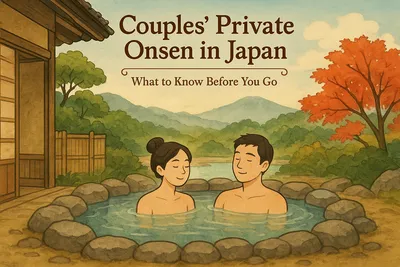
In a public onsen, baths are usually separated by gender, so couples typically bathe separately. If you want to bathe together, look for a private bath or a room with a private bath.
Are tattoos allowed in onsen?
It depends on the facility, and rules can be detailed. Some places allow tattoos, many restrict them in public baths, and some allow them only in private baths. If it matters for your trip, confirm directly with the property before booking.
Do I need to speak English or Japanese to use an onsen?
Usually no. Many places have signs or simple instructions, and the routine is fairly consistent. If you’re nervous, choosing a private bath can reduce pressure while you learn the flow.
Is public onsen “more authentic” than private onsen?
Public onsen often feels more cultural and communal, yes. But private onsen is still a very real part of onsen travel in Japan—especially at ryokan. The best choice is the one that helps you relax.
Final Thoughts
So… Private Onsen vs Public Onsen: Which Is Better for Foreign Visitors? The calm answer is: the better one is the one you’ll actually enjoy.
If public onsen feels scary right now, that’s okay. Start private. If you’re excited for the full cultural experience, try public—just go at a quieter time and remember the basic flow.
You don’t need to be perfect. You just need to be prepared. And once you are, onsen can become one of the most relaxing parts of your Japan trip—yes, even for nervous first-timers like you!