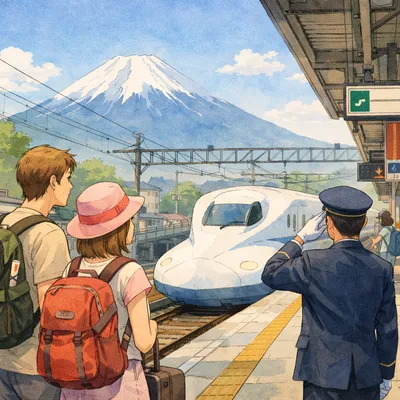
What to Do If Your Train Is Delayed or Cancelled in Japan
A delayed or cancelled train can feel confusing when you are visiting Japan for the first time, especially if you have a hotel check-in, airport transfer, or reserved Shinkansen ahead. The good news is that station staff are used to disruptions and there is usually a clear next step.
The most important thing is to check the official announcement, keep your ticket or reservation ready, and ask before taking a different train or route. Your options depend on whether the train is still running, fully cancelled, already in motion, or causing you to miss a connection.
Quick Answer
- Check the station boards, announcements, and your railway company’s official service information.
- Keep your paper ticket, IC card, rail pass, or reservation screen ready.
- Ask station staff whether you can take the next train, use an alternative route, or change your reservation.
- Do not assume that a taxi, another railway company, or an unreserved train will automatically be covered.
- If you no longer travel, ask about the refund procedure for your specific ticket.
Related guide: Staying connected makes it much easier to check live railway information. Best eSIM for Japan: What First-Time Visitors Should Know (2026).
First: Find Out What Happened to Your Train
Look for updates on electronic departure boards, platform displays, station announcements, and the railway company’s official website or app. Large stations may display information in English, but details can change quickly during bad weather, an accident, or a safety inspection.
Try to identify which situation applies to you:
- Your train is delayed but still running: You may simply need to wait, but a missed connection could require help.
- Your train is cancelled before departure: Staff may direct passengers to another train, another route, or a refund process.
- Your train stops during the journey: Remain calm and follow crew instructions. Do not leave the train unless staff tell you to do so.
- You missed a connection: Ask staff at the interchange station as soon as you arrive.
- Your Shinkansen reservation is affected by another delayed train: The answer may depend on the booking service and the railway companies involved.
What to Do Immediately at the Station
- Check the departure board. Confirm the train number, destination, platform, expected delay, and whether service is suspended.
- Save your evidence. Keep your ticket, seat reservation, booking email, app screen, or rail pass available.
- Go to a staffed gate or ticket office if needed. Look for a service counter, information desk, or station employee near the gates.
- Ask what you are allowed to do next. This is particularly important if you have a reserved seat, a limited express ticket, or an online booking.
- Check before changing transport. Do not buy a taxi, bus, or another railway ticket expecting automatic reimbursement unless staff specifically confirm it.
At a busy station, staff may direct everyone toward a particular platform or route. Follow these instructions even if your journey planner suggests a different option, as the railway company may have arranged a temporary route for affected passengers.
Useful Questions to Show Station Staff
- “Is this train still running?”
- “Can I take the next train with this ticket?”
- “Can I use an alternative route?”
- “My connection was missed because of the delay.”
- “Do I need to change my reservation?”
- “Where can I get a delay certificate?”
Showing your destination, train number, and reservation on your phone can be quicker than trying to explain a complicated itinerary.
Related guide: Learn the basics of navigating ticket gates, platforms, and transfers in advance with First Time in Japan? 15 Things to Know Before You Go (Stress-Free Tips).
Can You Take the Next Train in Japan?
Sometimes yes, but never assume. Whether you can board the next train depends on your ticket type, the railway company, the route, and the reason for disruption.
| Ticket situation | What may happen | What to do |
|---|---|---|
| Local train ticket or IC card trip | You may be directed to a later train or approved alternative route. | Check the station announcement or ask at a staffed gate before leaving the normal route. |
| Unreserved limited express or Shinkansen travel | A later service may be possible if it is operating and your ticket conditions allow it. | Ask whether your ticket remains valid and where to board. |
| Reserved-seat ticket | You may need a seat reassignment, permission to use non-reserved seating, or a reservation change. | Speak to staff before boarding another train whenever possible. |
| Online or app reservation | Rules may depend on the booking service, whether you collected a ticket, and whether the train has departed. | Check the booking service first, then ask station staff if the app cannot resolve it. |
| Rail pass | Your pass may cover an alternative train or route, but reservation rules can still apply. | Show the pass and your reservation to staff for instructions. |
For example, a local commuter train delay does not automatically mean you can board any reserved Shinkansen service. Likewise, having a reserved seat does not always mean the same seat will be available on the next train.
If You Have a Reserved Shinkansen Ticket
If your reserved train is delayed, cancelled, or missed because an earlier JR service was significantly delayed, speak to staff as soon as possible. In some cases, you may be guided to a later train or another available seat. However, arrangements differ by route, railway company, and reservation platform.
Services such as SmartEX have their own procedures for changes, cancellations, and disrupted journeys. App-based changes can be useful before departure, but once a train has departed or a ticket has been collected, staff assistance may be necessary.
Do not cancel an affected online reservation too quickly if you are still hoping to travel. First check the current disruption guidance from the booking service or ask a station employee what option applies to your booking.
If Your Train Is Cancelled Before Departure
When a train is cancelled, staff may offer one of several solutions. The available option depends on the disruption and your ticket.
- Wait for the next train on the same route.
- Take an approved alternative route.
- Change to a different service, possibly with a new seat assignment.
- Cancel the journey and request a refund where eligible.
If the station is crowded, follow platform signs and staff directions rather than rushing toward the gates. Railway employees may be managing passenger flow, especially around major Tokyo, Osaka, Kyoto, and Shinkansen stations.
If the Train Stops During Your Journey
If you are already on board, listen to the conductor and station announcements. A delay may last only a short time, or the train may later turn back, terminate at a different station, or be taken out of service.
Do not force open doors, enter restricted areas, or leave the train without instruction. If the train stops at a station and passengers are asked to transfer, take your belongings with you and follow staff toward the correct platform or exit.
If you have luggage, stay close to it during a busy transfer. If your large bags make a rapid route change difficult, ask staff whether there is a later, simpler option.
Related guide: If you are travelling with suitcases or children, this may help you plan easier station transfers: Luggage Delivery in Japan: A Stress-Free Guide for Families.
Alternative Transportation During a Japan Train Disruption
During a major suspension, a railway company may arrange approved alternative transportation. This can mean using a different rail line, another operator’s route, or occasionally another form of transport.
However, alternative transportation is not a universal right for every delayed journey. It is only available when the railway company announces it, and it may apply only to certain stations, routes, and ticket types.
Important: Ask Before Using Your IC Card
If you normally travel with an IC card, do not simply tap through a different company’s gate and assume the disruption arrangement will apply. Depending on the situation, tapping as normal may create a separate paid trip.
Go to a staffed gate and ask which route to take and how to pass through the gates. Staff may give instructions, adjust your journey, or direct you to a specific transfer point.
Do Not Assume Taxi Costs Will Be Repaid
A taxi can be useful if you have an urgent airport departure, a late hotel arrival, or no remaining train service. But railway companies do not generally promise to reimburse taxi fares just because a train was delayed or cancelled.
Before choosing a taxi, compare the likely cost with waiting for service to resume, using an officially approved alternative route, or changing your plans. Keep receipts if staff specifically tell you to use another paid form of transportation, but confirm the process first.
Related guide: If you need to switch to a taxi, see Are Taxis in Japan Expensive? A Simple Guide for Tourists (No Stress).
What If You Miss Your Connection?
A missed connection is one of the most stressful parts of a train delay, but it is usually easier to solve while you are still inside the station.
- Go to the nearest staffed gate, ticket office, or platform employee.
- Show the delayed train details and your onward ticket or reservation.
- Explain that the connection was missed because of the delay.
- Ask whether you should take the next service, change your reservation, or use a different route.
If both trains are operated by the same railway company, staff may have a straightforward solution. If the trains involve different companies, an airport service, a private railway, or a separately booked Shinkansen, the process can be more complicated.
For a flight connection, allow extra time whenever possible. A railway delay does not guarantee that an airline, airport bus company, hotel, or tour operator will waive its own rules.
If You Miss the Last Train
If a disruption causes you to miss the final train of the night, first ask staff whether any replacement service is operating. If not, you may need to use a taxi, stay near the station, or change your accommodation plans.
Related guide: For practical late-night options, read Missed the Last Train in Japan? What to Do Next (Safe, Cheap Options in Tokyo for 2026).
Japan Train Refunds: What You May Be Able to Claim
Refund rules vary by railway company, ticket type, route, purchase channel, and the exact disruption. Do not assume that every delay results in a full refund.
As a general guide, these are common situations:
- You decide not to travel because the train is cancelled: You may be eligible for a refund, often through the place where you bought the ticket or through station staff.
- Your journey is stopped partway: The unused portion of the trip may be refundable, depending on the circumstances and ticket conditions.
- A limited express or Shinkansen arrives very late: Some railway rules provide for a refund of the express surcharge after a substantial delay, often two hours or more. This does not necessarily mean the base fare is refunded.
- You used an online reservation service: The service’s own disruption and refund rules may apply, especially if you paid by card or have not yet collected a paper ticket.
For JR services, a two-hour-or-more arrival delay is commonly relevant to limited express or express surcharges, but the exact eligibility and procedure must be confirmed with the operating company. Local train fares, rail passes, seat reservations, and separate bookings can be treated differently.
Keep These Items Until the Matter Is Resolved
- Paper tickets and reservation slips
- Booking confirmation emails
- Reservation numbers and train details
- Screenshots from the railway app or website
- Receipts for replacement travel only if staff instructed you to use it
If you bought your ticket from a travel agency, a third-party platform, or an online reservation system, the refund request may need to go through that seller rather than a station counter.
What Is a Delay Certificate?
A delay certificate is a document or online record showing that a train service was delayed. It is mainly useful for commuters who need to explain lateness to a workplace or school.
For visitors, it can still be helpful if you need to document why you arrived late for a tour, hotel appointment, or meeting. However, it does not prove that you personally travelled on the train, and it does not automatically create a right to compensation or a ticket refund.
Some railway companies provide delay certificates at stations or through official websites. The document may show a delay range for the line rather than your precise arrival time.
Common Mistakes to Avoid
- Boarding any train without checking. A ticket valid for one train or seat may not be valid for another.
- Taking a different railway company’s route without asking. An approved alternative route may require special gate handling.
- Using an IC card automatically during a disruption. You could be charged separately if the alternative arrangement is not set up correctly.
- Throwing away tickets too soon. Keep them until you have completed the trip or confirmed that no refund is needed.
- Expecting a delay certificate to act as a refund receipt. It is primarily proof of a service delay, not a payment guarantee.
- Cancelling an online booking before checking the disruption policy. This can make the situation harder if a special rebooking option is available.
A Simple Checklist for Train Delays in Japan
- Check the official train status and station board.
- Keep your ticket, pass, IC card, and reservation screen ready.
- Ask whether the train is running, cancelled, or terminating early.
- Ask whether you can take the next train with your current ticket.
- Confirm any alternative route before entering another operator’s gates.
- Ask about your missed connection as soon as you arrive.
- Keep tickets and booking records if you may need a refund.
- Check the official railway company or booking service for current rules.
FAQ: Delayed and Cancelled Trains in Japan
Can I take the next train if my train is delayed in Japan?
Possibly, but it depends on your ticket, reservation, route, and the railway company’s instructions. Ask staff before boarding, especially if you have a reserved seat or limited express ticket.
Will I get a refund if my train is cancelled?
You may be eligible if you decide not to travel, but the process depends on where and how you bought the ticket. Ask staff or check the official booking service before cancelling an online reservation.
Do trains in Japan provide compensation for delays?
Not every delay leads to compensation. Some express services may refund an applicable surcharge after a major arrival delay, while other tickets may have different rules. Check with the operator for your specific journey.
Can I use another railway company if my line is suspended?
Only if an approved alternative arrangement is announced or staff instruct you to do so. Do not assume your ticket or IC card will work across another operator without guidance.
What should I do if I miss my Shinkansen because of a delayed local train?
Show your delayed journey and Shinkansen reservation to staff immediately. They can tell you whether a later train, reservation change, or booking-service procedure applies.
Should I get a delay certificate?
Get one if you need documentation for a work, school, tour, or personal appointment. It may be useful evidence of a general service disruption, but it is not automatically needed for a refund.
Japan’s rail network is usually very reliable, but disruptions do happen. When they do, you do not need to solve everything alone: check the official information, keep your ticket details ready, and ask station staff for the next approved step.
Related guide: Download useful navigation and translation tools before your trip with Japan Travel Apps You Should Download Before Your Trip (First-Timer List).