In an emergency, you don’t need perfect Japanese—you need one clear sentence that gets the right help quickly. This guide gives you short, practical “say this first” lines, plus screenshot-ready templates you can show to a station staff member, shop staff, or a passerby.
Important: If someone is in immediate danger or needs urgent medical help, contact local emergency services right away. If you’re unsure, ask a nearby staff member (station, hotel, store) to call for you.
Quick Answer: the 3 phrases to use first (and why)
Memorize these three. They work in most situations and buy you time.
| Use this first | What it does | Say it to | Next step |
|---|---|---|---|
| “Help, please.” | Gets attention without explaining details | Anyone nearby | Point to the issue (person, item, place), then use a template below |
| “Please call an ambulance.” | Signals a medical emergency clearly | Staff (station/store/hotel) or a bystander | Ask them to call 119, then show your symptoms template |
| “Please call the police.” | Signals you need police help (lost/stolen/incident) | Staff or a bystander | Ask them to call 110, then show your lost/stolen template |
Tip: If speaking feels hard, use your phone: open Notes, keep a template ready, and hand the screen to staff.
Related guide: Prep your phone before you fly with Japan Travel Apps You Should Download Before Your Trip (First-Timer List).
Japan emergency numbers (110 / 119 / 118) and when to use them
Which number should you call?
- 119: Ambulance and fire. Use for urgent medical issues, serious injuries, or fire.
- 110: Police. Use for theft, lost property reports, traffic incidents, or when you feel unsafe.
- 118: Coast Guard (marine emergencies). Use for emergencies at sea or along the coast.
What to expect when you call
- You may be asked for your location first. If you’re unsure, tell them the nearest landmark (station name, hotel name, big intersection) or hand the phone to a staff member.
- Speak slowly and keep it simple: what happened, where you are, who needs help.
- If you can’t communicate well, it’s completely okay to say: “English, please.” Then ask someone nearby to help.
Show-this templates: ask nearby people for help (copy/paste)
These are designed to be shown on your phone. Keep them short and fill in the blanks.
Template A: “Please help me” (general)
- “Please help me.”
- “I’m a tourist. I don’t speak Japanese well.”
- “Please stay with me.”
Template B: “Is there someone who speaks English?”
- “Do you speak English?”
- “Is there an English speaker here?”
- “Please use simple words / speak slowly.”
Template C: “Please call for me” (choose one)
- “Please call an ambulance (119).”
- “Please call the police (110).”
- “Please call my hotel.” (Hotel name: ____ / Phone: ____)
Related guide: Staying connected makes emergencies much easier—see Pocket Wi-Fi vs eSIM in Japan: Which One Should You Choose?.
Hospital and pharmacy emergency phrases (what to say in order)
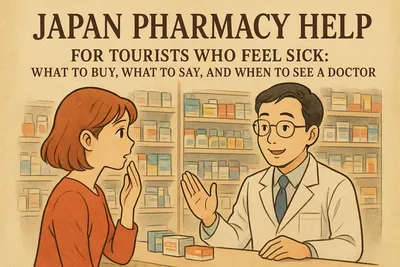
If you feel unwell, your goal is to communicate priority (urgent vs. not), main symptom, and allergies/meds. Use this order:
1) Start with urgency
- “I need a doctor.”
- “I need to go to a hospital.”
- “This is urgent.” / “This is not urgent, but I need help.”
2) Describe the symptom (keep it simple)
- “I have a fever.”
- “I have strong pain here.” (Point to the spot.)
- “I feel dizzy / nauseous.”
- “I have trouble breathing.”
- “I fainted.” / “I fell.”
3) Safety info: allergies, medicines, conditions
- “I have allergies.” (Allergy: ____)
- “I’m taking this medicine.” (Show the package or a photo.)
- “I have a medical condition.” (Condition: ____)
4) Payment/insurance basics (simple and honest)
- “I have travel insurance.”
- “I will pay by card.” / “Cash only?”
- “Please write it down.” (Helpful for fees, directions, and instructions.)
Related guide: For non-urgent needs, pharmacies and drugstores can help—see Japan Drugstore Essentials for Tourists (2026): What to Buy, When You’ll Need It, and How to Shop Tax-Free.
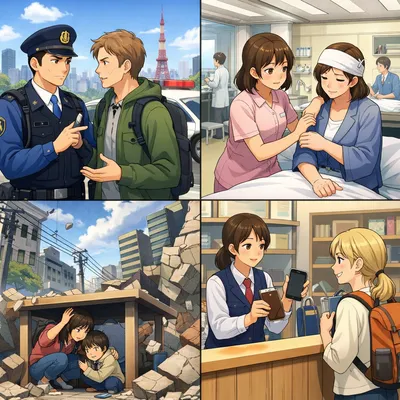
Police, lost items, and theft: phrases that get you to the right counter
In Japan, lost items are often handled efficiently—especially if you report quickly and can describe the item clearly.
Lost item (train, station, shop, hotel)
- “I lost something.”
- “I think I left it on the train / in a taxi / in this store.”
- “Where is the lost and found?”
- “It looks like this.” (Show a photo.)
Passport or wallet missing (priority)
- “My passport is missing.”
- “My wallet is missing.”
- “I need a police report.”
- “Please tell me the nearest police station.”
If you suspect theft (stay calm, focus on next steps)
- “My bag was taken.”
- “My phone was taken.”
- “I want to report this.”
- “This is where it happened.” (Point on a map.)
Accidents and transport problems: what to say to staff
In stations and on trains, the fastest path is usually: find uniformed staff, show a simple line, then follow directions.
Traffic or street incident
- “There has been an accident.”
- “Someone is injured.”
- “Please call an ambulance / police.”
- “I need help getting to the hospital.”
Train station help (lost, sick, or overwhelmed)
- “Please help me. I’m lost.”
- “I feel sick. Please help.”
- “Please show me on the map.”
Related guide: If your issue is late at night rather than an emergency, see Missed the Last Train in Japan? What to Do Next (Safe, Cheap Options in Tokyo for 2026).
Disasters in Japan: simple phrases for evacuation and updates
Japan is well-prepared for natural events, and staff announcements are common. Your goal is to understand where to go and how to confirm safety.
Evacuation and safety
- “Where is the evacuation area?”
- “Is it safe here?”
- “Which way should I go?”
- “I’m staying at this hotel.” (Hotel name: ____)
Information and communication
- “Please show me the latest information.”
- “Is the train running?”
- “I need Wi‑Fi / internet.”
Related guide: A few general prep steps make everything smoother—see First Time in Japan? 15 Things to Know Before You Go (Stress-Free Tips).
Smartphone “screenshot list”: the shortest phrases that work
If you only save one image, save this list.
- Help, please.
- Please call an ambulance (119).
- Please call the police (110).
- I’m a tourist. I don’t speak Japanese well.
- Where am I? Please show me on the map.
- I need a hospital.
- I have allergies. (____)
- I lost my passport.
- Please write it down.
Common mistakes (and the calmer alternative)
- Mistake: Trying to explain everything at once.
Do instead: Say one priority line (“call an ambulance/police”), then show a template. - Mistake: Calling the wrong number because you’re flustered.
Do instead: Remember: 119 = medical/fire, 110 = police, 118 = coast. - Mistake: Not knowing your location.
Do instead: Open your map and show the blue dot, or ask staff to help identify the nearest station/landmark. - Mistake: Assuming everyone can speak English.
Do instead: Use simple English, speak slowly, and rely on written templates.
Emergency readiness checklist (2 minutes before you go out)
- Save your hotel name, address, and phone number in your phone (and offline if possible).
- Screenshot the “screenshot list” above.
- Keep a photo of your passport and travel insurance details (store securely).
- Turn on location services for maps.
- Carry a small card with allergies/medical conditions if relevant.
Related guide: If you need a reliable way to get back to your hotel (especially late), read Are Taxis in Japan Expensive? A Simple Guide for Tourists (No Stress).
FAQ
Can I use English when calling 110 or 119?
Sometimes yes, but it varies by area and operator. If communication is difficult, ask a nearby staff member to call and speak for you, and show your phone templates.
What’s the fastest way to get help in a station or shopping area?
Go to uniformed staff (station staff, security, information counter) or a nearby hotel front desk. Start with “Please help me” and “Please call an ambulance/police,” then show your written message.
Should I go to a pharmacy first or a hospital?
For mild issues, a pharmacy or drugstore may be enough. For severe symptoms or anything that feels urgent, seek medical care immediately and consider calling 119. When in doubt, ask your hotel to help you decide based on current local options.
What if I’m hard of hearing or speaking is difficult?
Use the show-this templates, point to your map location, and use your phone’s text or translation tools. In many places, staff will try to communicate using writing and simple gestures.
What should I do if I lose my phone?
Go to your hotel or the nearest station staff and ask them to help you contact the police (110) and your mobile provider. If you have important numbers written down (hotel, travel companion), you’ll recover faster.