You step out of a station in Japan, look left, look right… and nothing matches what you expected. The “right” exit is apparently not the right exit. Your phone is spinning. Your suitcase suddenly feels twice as heavy. Yep—this is where many first-time visitors get stuck.
Don’t worry. Getting lost in Japan is common, and it’s not a personal failure. Japan has amazing public transport, but stations can be huge, exits can be confusing, and addresses don’t always work the way you’re used to. The good news? In many cases, you won’t be truly “stuck.” Map apps work well, signage often includes English in cities, and there are plenty of safe places to pause and reset.
This guide is here to help you do one thing: get calm first, then get un-lost—without needing perfect Japanese or superhero navigation skills. You don’t need to be perfect. You just need to be prepared.
Quick Answer

If you get lost in Japan, stop walking, move to a bright, busy spot, and check your exact location on Google Maps.
Then confirm the nearest station and the correct exit number, or show your destination screenshot to station staff or a hotel/visitor information counter.
No internet? Use an offline map you downloaded before your trip, or head to a konbini (convenience store) or station where help is easy to find.
Who This Guide Is For
This is for you if you’re:
- A first-time visitor to Japan who worries about getting turned around
- Not confident speaking Japanese
- Traveling with kids, parents, or anyone who gets tired easily
- Carrying luggage and dreading crowded stations
- Nervous about “doing something wrong” while asking for help
- Trying to avoid that spiral of stress when plans change
First: Do the One Thing Most People Skip (Stop Walking)
Here’s the thing. When you feel lost, your brain wants to “fix it” by walking faster. That usually makes it worse.
Stop moving for 30 seconds. Take a breath. Look around. Check your phone calmly. This tiny pause saves you a lot of time.
Move to a safe “reset spot”
If you’re on a quiet street or you feel flustered, walk to somewhere obvious and easy:
- A station entrance
- A konbini (convenience store)
- A hotel lobby
- A department store entrance
- A busy intersection with clear signs
This isn’t about Japan being unsafe. It’s just basic travel sanity. Bright and busy places make it easier to ask for help and re-orient yourself.
Stress-Free Tip: If you’re traveling with someone, agree on a “pause rule.” If either of you says “Stop,” you both stop and check the map together. Sounds dramatic? Maybe. But it helps.
Use Landmarks Like a Local (Yes, Even in Big Cities)
Many first-time visitors try to navigate purely by street names. In Japan, that can feel weird because street names aren’t always the main way people navigate.
Instead, use landmarks. Big ones. Easy ones.
Good landmarks to look for
- Train stations and station signs
- Rivers, bridges, and major roads
- Department stores and malls
- Towers and tall buildings
- Famous temples/shrines or parks
- Konbini chains (they’re everywhere for a reason)
If you can identify just one landmark, Google Maps becomes much easier to trust. You’ll think, “Okay, I’m near the river,” instead of “I’m somewhere in the universe.”
Stress-Free Tip: When you open your map, rotate your body until the map direction matches what you see in real life. It helps your brain click back into place.
Google Maps in Japan: What Works (and What Can Trip You Up)
In many areas of Japan, Google Maps works very well, and English labels have increased over time. So getting lost usually isn’t a “game over” situation.
But there are a few classic traps. Let’s make them less scary.
Do this when your blue dot is acting weird
Sometimes your location jumps around, especially near tall buildings or underground spaces.
- Step outside if you’re underground
- Wait 10–20 seconds before deciding the app is “wrong”
- Use the compass feature and re-center your location
- Compare with a landmark (station name, big road, river)
Walking routes vs. station reality
A common situation: Google Maps says “5 minutes,” but you’re inside a station that feels like an airport.
Stations can have multiple floors, long corridors, and many exits. So your real time may be longer than the walking estimate—especially with luggage.
Stress-Free Tip: If you’re dragging a suitcase, treat “5 minutes” as “10 minutes.” Your future self will thank you.
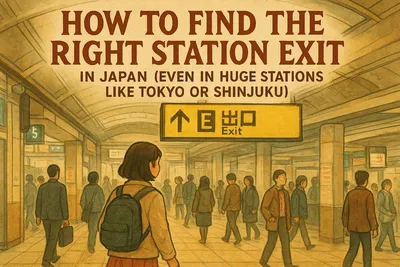
The Secret Weapon: Exit Numbers (Yes, They Matter)
Let’s be honest. Many visitors think, “I just need the station name.” In Japan, that’s only half the battle.
Exit numbers (or exit names) can be the difference between a 2-minute walk and a 20-minute detour.
What to do if you’re at the wrong exit
This happens constantly. You’re not the only one.
- Don’t try to “walk around the station” outside unless you’re sure
- Go back inside and follow signs for the correct exit
- If you’re exhausted, ask staff instead of guessing
What to screenshot before you go out
Before you leave your hotel (or before you land in Japan), it’s often recommended that you save:
- Your hotel name (English and Japanese if available)
- The hotel address (English and Japanese if available)
- Nearest station name
- Exit number (or exit name)
When you’re lost, showing a screenshot is faster than trying to pronounce anything perfectly.
Stress-Free Tip: Make a simple album on your phone called “Japan Addresses.” Put your hotel, first-night restaurant, and key sights in there.
If You Get Lost Inside a Station (It’s More Common Than Outside)
Big stations can feel like mini-cities. Multiple lines. Multiple companies. Multiple levels. And crowds that move like a school of fish.
If you’re lost inside a station, your goal is not “find the perfect route.” Your goal is find one clear piece of information.
Step-by-step: un-lost yourself in a station
- Find a station map board (usually near gates or main corridors)
- Confirm the line name and direction (often shown as the final destination)
- Check the platform number
- Check the train type (local/rapid/express). This varies by line
- If you’re unsure, stop and ask before tapping your ticket/IC card again
Many stations also have clear color-coded signage. Follow the colors and line symbols, not just the English text.
Who to ask inside a station
- Station staff at the ticket gate
- Information counters (where available)
- Staff near platforms (often wearing uniforms and gloves)
Showing your phone screen with the destination station name is usually enough.
Stress-Free Tip: If you feel rushed by the crowd, step to the side first. Then check your phone. Standing still in the middle of a flow of commuters is where stress multiplies.
If You’re Lost on a Bus (The “Is This the Right One?” Moment)
Buses are great, but they can feel less obvious than trains. The good news is you can make it simple.
Match these three things
Before boarding, compare:
- The bus number (if shown)
- The destination shown on the bus display
- The route shown in Google Maps
If something doesn’t match, don’t force it. Wait for the next one or ask the driver with your phone screen ready.
Stress-Free Tip: If you’re not sure, it’s often safer to confirm before you board than to panic after the doors close.
No Internet? You Still Have Options (And You’re Not Doomed)
This is a big fear: “What if I can’t connect?” Totally understandable.
Many travelers recommend downloading an offline map app (such as Maps.me) ahead of time if you’re not sure you’ll have data. That way, you still have a usable map even without service.
What to do in the moment if you have no signal
- Go to a station or konbini and try connecting again
- Use any offline maps you downloaded
- Use a paper map from your hotel or tourist information center
- Ask for help and show a saved screenshot of your destination
Tiny warning: Public Wi-Fi availability varies by area and can change. Don’t rely on it as your only plan. Check the latest official info before you go.
Stress-Free Tip: Save one “anchor point” offline: your hotel location pinned on a map, plus the nearest station name. That alone can rescue a lot of situations.
How to Ask for Help Without Feeling Awkward
Worried about bothering people? You’re not alone. But in many tourist areas, people are used to travelers needing directions.
The trick is to make it easy for the other person to help you.
Best people to ask (easy mode)
- Station staff
- Hotel front desk staff
- Tourist information counters
- Staff at department stores
- Konbini staff (if it’s not busy)
What to do when you ask
- Start with a polite attention-getter (like “Excuse me”)
- Say “I’m lost” (simple is fine)
- Show your phone screen with the place name and map pin
- Ask one clear question: “Which way?” or “Which exit?”
Simple Japanese words that can help (romanized only)
You don’t need perfect pronunciation. You just need something recognizable.
- Sumimasen (soo-mee-mah-sen): Excuse me / sorry
- Michi ni mayoimashita (mee-chee nee mah-yoi-mah-shee-tah): I’m lost
- Koko wa doko desu ka (koh-koh wah doh-koh dess kah): Where am I?
- [Place] wa doko desu ka: Where is [place]?
- [Place] ni ikitai desu: I want to go to [place]
- Aruite ikemasu ka: Can I walk there?
- Ichiban chikai [thing] wa doko desu ka: Where is the nearest [station/ATM/etc.]?
Stress-Free Tip: If speaking feels stressful, just smile, say “Sumimasen,” and show the map. That’s often the smoothest method.
When You’re Too Tired to Navigate: Use the “Support Triangle”
Some days, you’re fine. Other days, the crowds, the heat, and the jet lag hit all at once. That’s when getting lost feels personal.
Try this simple approach: Apps + People + Places.
Apps
Use Google Maps first in many cases. If you prepared offline maps, switch to those when needed.
People
Ask staff, not random passersby if you’re overwhelmed. Staff are paid to help. That’s comforting, isn’t it?
Places
Use tourist information centers, hotels, and stations as your “base.” Many hotels can also mark your location on a map at check-in, which is a surprisingly helpful habit.
Stress-Free Tip: If you’re staying at a hotel, pick up a free local map if they have one. Paper maps can be a “last boss” tool when your phone battery is low.
Optional Help: Volunteer Guides and Free City Maps
If you’re the kind of traveler who feels anxious navigating alone, you’re not “bad at travel.” You just prefer support. That’s valid.
Free city maps (paper)
In some cities, tourist information centers and hotels provide free maps. These often include small streets and local landmarks that can be easier to discuss with someone face-to-face.
Availability varies, so treat it as a bonus, not a guarantee.
Volunteer guide services (Tokyo example)
In Tokyo, some travelers mention services like “Tokyo Free Guides,” where local volunteers may guide you for free while you cover their transport and meal costs. Details and availability can change, so check the latest official information before you go.
Stress-Free Tip: If you book any guide service, confirm meeting points carefully. Choose a station exit with a clear number and a visible landmark nearby.
When “Getting Lost” Can Actually Be Nice (And When It’s Not)
Some travel media likes to say, “Getting lost is part of the adventure.” And honestly… sometimes it is.
You might wander into a quiet shopping street, find a tiny bakery, and think, “How did I end up here?” in a good way.
But please don’t force the adventure
If it’s late, you’re alone, your battery is low, or you’re exhausted, this is not the moment to improvise.
In those moments, do the practical thing:
- Go back to a station
- Ask staff
- Use a taxi if needed
- Return to your hotel and reset
Stress-Free Tip: If you remember one thing, remember this: getting un-lost is easier when you act early. Don’t wait until you’re frustrated.
Common Mistakes (Totally Understandable, But Try to Avoid These)
Let’s keep this gentle. These mistakes happen because you’re human, and Japan can be a lot on day one.
- Walking faster to “fix it” instead of pausing and checking your location
- Exiting a station without confirming the exit number, then trying to walk around outside
- Letting your phone battery hit 5% while using maps all day
- Assuming every train goes to the same place (rapid/express can skip stops)
- Trying to ask a long question instead of showing a screenshot and asking one simple thing
- Dragging large luggage through rush hour crowds (it’s stressful for you and everyone else)
Stress-Free Tip: Make your “first day” lighter than you think you need. Jet lag plus navigation is a sneaky combo.
Recommended Options (Only If They Fit Your Travel Style)
Internet option (eSIM, SIM, or pocket Wi-Fi)
Best for:
Travelers who want reliable maps, translations, and booking access on the go.
Not ideal for:
People who dislike managing tech, or those who are happy navigating with printed info and hotel support.
My honest take:
If getting lost is a major anxiety trigger for you, having stable internet can make Japan feel dramatically easier. Options and prices change often, so compare plans and check the latest official details before you buy.
Offline maps (download-before-you-go apps)
Best for:
Travelers who worry about signal issues, or who want a backup plan.
Not ideal for:
Anyone who won’t remember to download maps in advance (no judgment—this is common).
My honest take:
An offline map is like an umbrella. You may not use it, but you’ll be glad it exists when you need it.
Luggage delivery (takkyubin)
Best for:
People moving between cities, families, or anyone who hates hauling bags through stations.
Not ideal for:
Very short trips where you can pack light and move easily.
My honest take:
Large stations are much less stressful without a suitcase. Delivery rules, timing, and fees vary by company and location, so confirm details with your hotel or the provider.
Stress-Free Checklist
- Save your hotel name and address on your phone (English and Japanese if available)
- Save the nearest station name and exit number
- Pin your hotel and top 3 places in Google Maps
- Download an offline map as a backup (if you’re unsure about internet)
- Screenshot key reservations and addresses
- Carry a small portable charger (maps drain batteries fast)
- When lost: stop walking, move to a bright busy spot, then re-check your location
- Ask staff and show your screen instead of explaining everything with words
- Avoid navigating big stations with luggage during rush hour if you can
FAQ
Is it safe to ask strangers for help in Japan?
In many areas, yes, and many people will try to help. If you feel nervous, ask station staff, hotel staff, or an information counter for the easiest experience.
What if I can’t speak Japanese at all?
You can still do fine. Use simple English, gestures, and show your phone screen with the destination. Learning one word like “Sumimasen” can help, but it’s not required.
Why do I keep ending up far away from my destination after leaving the station?
It’s often an exit issue. Large stations have many exits, and the “wrong” one can put you on the opposite side. Try to confirm the exit number before you go out.
What should I do if my phone has no signal or dies?
Go to a station, hotel, or konbini to reset and ask for help. Offline maps and saved screenshots are great backups if you prepared them.
Should I take a taxi if I’m lost?
If it’s late, you’re exhausted, or you’re carrying heavy luggage, a taxi can be a practical choice. Just show the driver your destination address on your phone.
Final Thoughts
Getting lost in Japan can feel intense in the moment, especially on your first trip. But it’s usually solvable with a calm pause, a good map check, and one helpful human.
Prepare a few screenshots. Learn one or two simple phrases if you like. Know that exit numbers matter. And give yourself permission to ask for help.
You don’t need perfect navigation. You just need a small plan for when things go slightly off-script. And once you have that, Japan becomes much easier, doesn’t it?