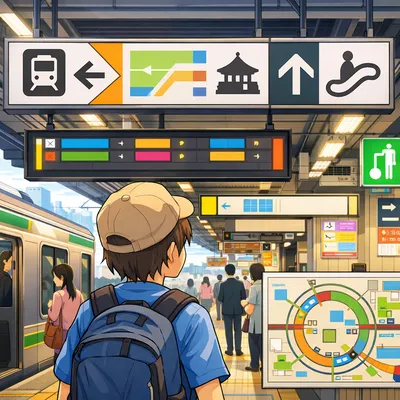
Japan’s stations are clean, efficient, and (sometimes) enormous. The good news: you don’t need to “understand the whole station” to get out correctly. If you can match your destination to an exit name/number and then follow a few consistent sign types, you’ll be fine—even in Tokyo or Shinjuku.
This guide gives you a calm, repeatable method: what to do before you arrive, what to do inside the station, and what to do if you feel stuck.
Quick Answer: The simplest way to find the right exit
- On your phone: Search your destination (hotel, museum, meeting point) and confirm the recommended exit (name or number) and which side of the station it’s on.
- In the station: Follow signs for Exit and your exit name/number (not the destination first).
- At the last decision point: Use the big yellow/white “Exit information” boards to confirm you’re taking the correct exit for your destination.
Key idea: In big stations, “Exit 3” (or “West Exit”) is more reliable than “Hotel Name,” because the exit signage stays consistent even if nearby businesses change.
Understand station exits in Japan (so the signs make sense)
- Exits can be named or numbered: For example, “West Exit,” “Central Exit,” or “Exit A3.” Many stations have both systems depending on the operator and area.
- There may be multiple levels: The “best” exit might be on street level, in an underground mall, or connected to a bus terminal.
- One station can have multiple ticket gate areas: If you exit through the “wrong” gate area, you may still be able to reach your exit—but it can add a lot of walking.
Stress-free rule: Aim for the closest exit to your destination, not “any exit.” In Japan, one wrong exit can put you on the opposite side of a huge station complex.
Related guide: How to Read Train Station Signs in Japan (Without Panicking).
Smartphone method: Find the correct station exit in 3 steps (real-world workflow)
Step 1: Search “Station name + your destination” (not just the station)
Instead of searching only for the station, search for where you’re actually going (your hotel, a landmark, a restaurant). This increases the chance your map app will suggest the most convenient exit.
- Example searches: “Shinjuku Station to [Hotel Name]” or just “[Hotel Name]” and then tap Directions.
- Look for mentions of an exit name (like West/Central) or an exit number (like A1, A6, 3, 8).
Step 2: Confirm the exit on the route preview before you arrive
Before your train pulls in (or while you’re still on the platform), open the route details and look for:
- Exit name/number (your primary target)
- Street name or major landmark near the exit (your backup target)
- Walking time after exiting (this helps you choose between similar exits)
Practical tip: Take a screenshot of the route details with the exit name/number. Underground areas can be slow for data, and you’ll feel calmer with a saved reference.
Step 3: In-station, match your phone’s exit to station signage
Once inside the station, stop trying to “follow the blue dot” through corridors. Instead:
- First, find signs that say Exit.
- Then look for your exit number/name on those signs.
- Only after you’re near the exit, switch back to your phone for the final street-level walk.
Related guide: Japan Travel Apps You Should Download Before Your Trip (First-Timer List).
Use station maps the “Japanese way”: Find the yellow exit information boards
In many stations you’ll see large boards (often yellow/white) that list:
- Exit numbers/names
- Nearby landmarks (hotels, department stores, famous streets, bus stops)
- Which direction to walk to reach each exit
How to use them fast:
- Find your destination (or a nearby landmark you recognize).
- Note the exit name/number next to it.
- Follow the station signs for that exit.
If you can’t find your exact destination on the board, look for something stable nearby: a major road, a well-known department store, a park, or a bus terminal.
Instant sign-reading: A simple visual filter when your brain is overloaded
If you feel overwhelmed, don’t try to read everything. Use this priority order:
| Look for | Why it helps | What to do |
|---|---|---|
| Exit number / letter | Most precise target (especially in subway stations) | Follow only signs that include your exact code (e.g., A3) |
| Exit name (West/East/Central) | Common in big JR stations | Commit to one direction and avoid “detours” through shops |
| Major landmark | Often listed on exit boards and overhead signs | Use it as a confirmation you’re on the right path |
| Line color / station code | Helps you relocate yourself if you got turned around | Backtrack to a clear sign cluster and restart from there |
Micro-strategy that works: Every time you see an overhead sign, ask only one question: “Does this sign contain my exit number/name?” If not, keep walking until you find one that does.
Big-station rules: Tokyo, Shinjuku, Osaka, and other mega hubs
Rule 1: Decide “ground exit vs underground exit” on purpose
In huge stations, you can often reach your destination either via:
- Ground-level exits: easier for orientation (you can see buildings), but more street crossings and sometimes longer walks.
- Underground exits/passages: great in rain/heat and can be faster, but easier to lose your sense of direction.
If you have luggage, strollers, or mobility concerns, underground routes may involve more stairs unless you plan for elevators.
Related guide: Japan Station Staircases With a Suitcase: Elevator-Finding Hacks and Luggage Tips for Stress-Free Travel.
Rule 2: When there are “too many exits,” pick the one that reduces complexity
If Google Maps suggests an exit deep inside a maze and you’re feeling unsure, it’s okay to choose a slightly less optimal exit that is:
- Clearly signed from your current area
- Connected to a major street
- Near a well-known landmark
You might walk an extra 5–10 minutes above ground, but you’ll avoid 20 minutes of confusing corridors.
Rule 3: If exits are numbered “1–5” only, use the station “side” logic
Some stations have only a few exits and rely more on “North/South/East/West” or “Central.” If you can’t find the exact number:
- First lock onto the correct side (East vs West, etc.).
- Then choose the exit on that side that matches your destination’s nearest major road/landmark.
Rule 4: Avoid last-second lane changes near ticket gates
In mega stations, the final split happens near gate areas and escalators. If you’re not 100% sure, pause near a wall, check your screenshot, and then continue. Rushing is what creates wrong turns.
If you can’t find the exit: the calm recovery plan (60 seconds)
1) Reset at a “sign cluster”
Walk to the nearest area with multiple overhead signs (often near escalators, wide corridors, or ticket gates). Don’t keep wandering through shops.
2) Look for “Exit” first, then your number/name
If you only remember one thing, remember this: Exit → number/name → follow arrows.
3) Ask station staff using the exit number (fastest method)
Station staff are used to this question. The quickest way is to show the exit on your phone or say the exit number/name clearly.
- Useful phrase: “Which way to Exit [number/name]?”
- Backup phrase: “I’m going to [destination]. Which exit is best?”
If you have the exit code, lead with that. It’s usually the fastest for staff to answer with a simple point and direction.
Related guide: First Time in Japan? 15 Things to Know Before You Go (Stress-Free Tips).
Common mistakes (and the easy fixes)
- Mistake: Following the blue dot through underground corridors.
Fix: Use your phone to identify the exit, then follow station signs to reach it. - Mistake: Exiting from the first “Exit” sign you see.
Fix: Confirm the exit number/name before committing. - Mistake: Assuming “West Exit” is always best because your hotel is west of the station.
Fix: In big stations, underground passages can flip your sense of direction—use the recommended exit from your map app or the exit information board. - Mistake: Realizing too late you’re on the wrong side and trying to force a shortcut through shops.
Fix: Backtrack to the last clear sign cluster and restart. It’s faster than improvising.
Mini checklist: What to do before you arrive at a big station
- Save your destination address and pin it in your map app.
- Screenshot the route details that show the exit name/number.
- If you have luggage, plan for elevators and extra time.
- Make sure you have data coverage (or offline access) for navigation.
Related guide: Pocket Wi-Fi vs eSIM in Japan: Which One Should You Choose?.
FAQ: Finding station exits in Japan
Does Google Maps always show the correct exit number in Japan?
Often, yes—especially in major cities—but not always. Station layouts change, and different exits can be similarly convenient. Use Google Maps as your starting point, then confirm with the station’s exit information board or signage. For anything critical (appointments, tours), allow extra time and check current information.
What if there are multiple exits with the same “side” (like several West exits)?
That’s normal in large stations. Look for a more specific label: a number, a sub-name, or a nearby landmark listed on the exit information board. If you’re unsure, choose the exit that places you on a major road near your destination and walk the rest above ground.
I exited and I’m on the wrong side of the station. Do I have to go back in?
Not necessarily. Sometimes it’s faster to walk around above ground. Check your map: if walking around is under 10–15 minutes and straightforward, it may be less stressful than re-entering a complex station.
Will I need cash to exit the station?
Usually, no. You can exit using your ticket or an IC card. If you’re using an IC card, make sure it has enough balance before you tap out.
Related guide: How to Use IC Cards in Japan: Suica, PASMO, and Other Travel Cards Explained (Stress-Free Guide).
Bottom line
To find the right station exit in Japan, focus on one calm process: identify the exit (phone) → follow exit signage (station) → confirm at the exit board (final check). You don’t need to “master” the station—just match your destination to the correct exit name/number, and the rest becomes surprisingly manageable.