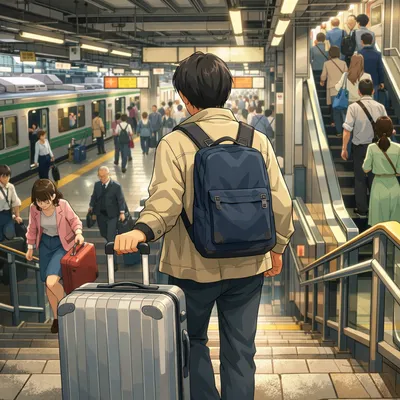
Dragging a big suitcase through a Japanese station can feel like a surprise workout—especially when you turn a corner and see stairs. The good news: you usually have options, and with a few “micro-hacks” you can avoid most staircases altogether (or handle them safely when you can’t).
Quick Answer: What to Do When You See Station Stairs With Luggage
- Pause and look for elevator signs (often near accessible routes, ticket gates, or a different exit).
- Use exit numbers to your advantage: choose an exit that clearly shows an elevator on the station map.
- If you must use stairs, switch to “two-hand carry” mode and go slowly—don’t try to roll a heavy suitcase down steps.
- If it’s a long transfer day, consider luggage delivery or store bags in a locker and come back later.
Stress-free rule: In Japan, the “best” route is often the one with fewer steps, not the one with fewer minutes.
Why Station Staircases Feel So Common in Japan (and Why It’s Not Your Fault)
Many stations have multiple levels, older sections, and long underground corridors. Elevators and escalators exist, but they may be located at specific exits or at one end of the platform. That’s why you can walk into a station, see only stairs, and still be just a minute away from an elevator—if you know how to look.
Plan for this: even if your hotel is “near the station,” the closest exit to your hotel might be stairs-only, while the elevator exit is slightly farther.
Station “Elevator vs Stairs” Success: 3 Simple Rules
Rule 1: Use exit numbers to choose the elevator route
Many stations post maps that show exits by number/letter. The elevator is often marked on those maps, and it’s frequently tied to a specific exit.
- Before you walk out: look for the station map near the ticket gates or on the platform level.
- Pick the exit with an elevator icon, even if it’s not the closest exit to your destination.
- When meeting someone: agree on an exit number that has an elevator, not just “the main exit.”
If you’re navigating to a place (hotel, attraction), try searching directions to a specific exit rather than the station name alone. That small change often prevents the “surprise staircase” at the end.
Rule 2: In small stations, start by checking near ticket gates and platform ends
Smaller stations may have fewer signs, but elevators (if present) are commonly placed in predictable spots:
- Near the main ticket gates (especially newer gates)
- At one end of the platform (sometimes only one end has an elevator)
- Near the accessible restroom (not always, but often in the same “accessible route” zone)
If you don’t see an elevator after a quick scan, it may be faster to ask at the station office than to keep guessing.
Rule 3: Treat escalators as “optional,” not guaranteed
Escalators can be one-direction only (up or down), located far away, or crowded. If your suitcase is heavy or you’re traveling with kids, prioritize elevators when possible. Escalators are fine for manageable bags, but don’t feel like you have to use them.
Related guide: Make navigation easier with the right tools: Japan Travel Apps You Should Download Before Your Trip (First-Timer List).
Micro-Techniques: How to Handle Stairs Safely With Different Luggage Types
If you can’t avoid stairs, use a method that matches your bag style. The goal is stability, not speed.
| Luggage type | Best staircase approach | What to avoid |
|---|---|---|
| 4-wheel spinner suitcase | Carry it with two hands (top handle + side handle). Keep it close to your body. | Trying to roll it down steps. Spinners can twist and pull your wrist. |
| 2-wheel roller suitcase | For short stairs, “bump” it one step at a time only if it’s light. Otherwise, two-hand carry. | Letting it slide or dragging fast; it can jump and hit steps hard. |
| Backpack | Tighten straps, wear it high, keep hands free for railings. | Loose straps catching on people or railings in crowded stairwells. |
| Two bags (suitcase + tote) | Put the tote on your shoulder cross-body style or inside the suitcase handle area before stairs. | One bag in each hand—this reduces balance and makes you slower. |
Stair posture that reduces strain (and awkward moments)
- Face forward and keep the suitcase close to your legs.
- Use railings when you can (especially going down).
- Take breaks at landings. It’s normal, and nobody will mind.
- If you’re traveling as a pair: one person takes the suitcase, the other takes the second bag.
How to Ask for the Elevator (Simple, Polite, and Effective)
If you feel stuck, asking is often the fastest solution. Station staff are used to this question.
- Show your phone map and point to your exit or destination.
- Use clear keywords: “elevator” and the exit number/letter you’re aiming for.
- Don’t worry if you’re redirected through a longer corridor—accessible routes can be indirect but much easier with luggage.
When It’s Smarter to Avoid Stations With Luggage
Sometimes the best “staircase strategy” is not bringing the suitcase into the station at all.
Option 1: Use luggage delivery for hotel-to-hotel moves
If you’re changing cities (or even neighborhoods) and you have a large suitcase, delivery can turn a stressful transfer day into a simple daypack commute. You travel with a small bag, and your main luggage meets you later.
Best for: multi-city trips, families, heavy suitcases, rainy days, or long subway transfers.
Watch-outs: delivery is not always same-day; confirm cut-off times and arrival windows with your hotel or the service provider.
Related guide: Step-by-step help: Luggage Delivery in Japan: A Stress-Free Guide for Families.
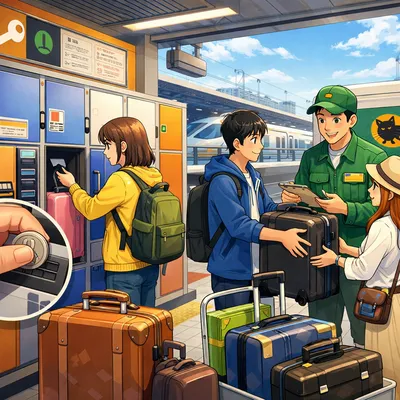
Option 2: Use station lockers for “half-day freedom”
If you arrive early or have hours before check-in, lockers can save you from hauling bags through multiple lines and staircases.
Best for: sightseeing between check-out and check-in, day trips, short stopovers.
- Look near major ticket gates and main corridors.
- Have a backup plan: popular stations can run out of large lockers at peak times.
- Keep essentials with you (passport, medications, valuables, one change of clothes).
Option 3: Consider a taxi for the “last mile”
If your hotel is close but the route involves multiple stair-heavy subway exits, a short taxi ride can be a practical choice—especially with two suitcases or after a long flight.
Related guide: Are Taxis in Japan Expensive? A Simple Guide for Tourists (No Stress).
Pack So You Can Handle Stairs: How to Get Down to “One Main Bag”
The easiest staircase is the one you don’t have to climb with two bags. For many first-time visitors, the real win is reducing what you carry day-to-day.
Use hotel amenities to cut liquids and duplicates
Many hotels provide basics like shampoo and body wash. If you’re comfortable using what’s provided, you can often skip full-size bottles and bring only a small “just in case” option.
Tip: If you have strong preferences or sensitive skin, bring your own—but consider travel-size containers rather than full bottles.
Do laundry once and pack fewer outfits
A single laundry day can cut your clothing volume dramatically. Many hotels have laundry machines, or you can use a nearby laundromat. Plan for a simple mid-trip wash and pack lighter from day one.
Compression bags: helpful, but don’t overdo it
Compression bags can reduce bulk, but they can also make your suitcase heavier and harder to lift on stairs. Use them to save space, then keep your overall weight realistic for carrying.
Related guide: More first-timer planning tips (including what to bring): First Time in Japan? 15 Things to Know Before You Go (Stress-Free Tips).
Station Strategy: Choose Routes That Minimize Transfers (Not Just Time)
With luggage, each transfer is a chance to meet stairs. When comparing routes, prioritize:
- Fewer transfers (even if it’s slightly slower)
- Major stations (more elevators, clearer signage)
- Straighter routes (less platform switching)
If you’re taking the bullet train, plan your station arrival with extra time so you’re not rushing through corridors with a suitcase.
Related guide: How to Use the Shinkansen in Japan for the First Time.
Common Mistakes (That Cause 90% of Luggage Stress in Stations)
- Following the shortest route blindly and ending at a stairs-only exit.
- Assuming every entrance has an elevator (often only certain exits do).
- Trying to roll a heavy spinner suitcase down stairs instead of carrying it carefully.
- Overpacking “just in case” items and then struggling all trip.
- Not budgeting time: rushing makes everything feel harder and less safe.
Checklist: A Staircase-Proof Station Plan (Before You Leave the Hotel)
- Choose a route with fewer transfers.
- Identify an exit number/letter that shows an elevator on the station map.
- Pack a small day bag with essentials so your suitcase can be stored or delivered if needed.
- Keep one hand free when possible (phone away while on stairs).
- Have a backup option: locker, taxi, or delivery.
FAQ: Japan Station Staircases and Luggage
Are elevators common in Japan stations?
In many medium and large stations, yes. But the elevator may be located at specific exits or one end of the platform. In smaller or older stations, elevators may be limited or absent.
Is it rude to bring a suitcase on trains and subways?
It’s generally fine if you’re considerate: keep bags out of walkways, avoid blocking doors, and try to travel outside peak rush hours when possible.
What if my route has multiple stair-only transfers?
If you’re facing repeated stairs (especially with heavy luggage), that’s a strong sign to switch strategies: use luggage delivery, take a taxi for part of the trip, or store your bag in a locker and return later.
Should I choose a 2-wheel or 4-wheel suitcase for Japan?
Both work. Four-wheel spinners are great on flat station floors, but can be awkward on stairs. Two-wheel rollers handle rougher surfaces a bit better. The bigger factor is weight: a lighter suitcase is easier no matter the wheels.
Final Reassurance: You Don’t Need to “Power Through” Stairs
Japan’s stations are navigable with luggage—you just need a plan that favors elevators, smarter exits, and lighter day-to-day carrying. If you treat stairs as a last resort (not the default), your travel days get noticeably calmer.
Related guide: Choosing a convenient base can reduce transfers (and stairs): Where to Stay in Tokyo for Your First Trip to Japan (Stress-Free Areas).