You land in Japan. You’re excited. You’re also holding a suitcase that suddenly feels twice as heavy as it did at home.
What this guide covers: This article is about moving through Japanese stations with luggage: stairs, elevators, crowds, exits, and stress points. If you want to skip this problem as much as possible, read Luggage Delivery in Japan: A Stress-Free Guide for Families.
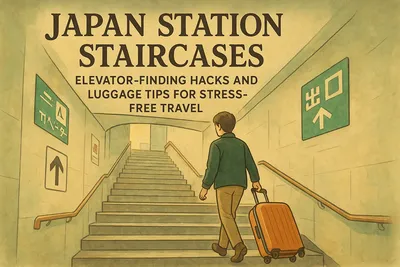
Then you walk into a train station and spot it: stairs. More stairs. And somehow… even more stairs.
And the hardest part isn’t just the weight. It’s that little voice in your head going, “Am I blocking people? Am I doing this wrong? Is everyone judging my suitcase choices?” Don’t worry. You’re not the only one. This is where many first-time visitors get stuck.
This guide is here to make that whole situation feel calmer. You’ll learn why Japan station stairs luggage stress happens, how to avoid the worst parts, and what to prepare so you don’t end up doing the “20kg suitcase + staircase” workout on day one.
Quick note: Train station layouts, elevator locations, luggage services, and rules can change over time. Use this as a calm starting point, and check the latest official information (railway/airport/hotel) before you rely on anything important.
Quick Answer

Japan station stairs luggage stress usually comes from three things happening at once: lots of stairs, heavy luggage, and fast-moving crowds.
The good news is that you can reduce most of the stress with a simple strategy: pack lighter (or split bags), avoid rush hour, choose routes with fewer transfers, and use luggage delivery when it makes sense.
You don’t need to be perfect. You just need a plan for the “stairs moment.”
Who This Guide Is For
- First-time visitors to Japan who feel nervous about stations and transfers
- Travelers who don’t speak Japanese and worry about asking for help
- Families with kids (because one hand is always busy, right?)
- Anyone traveling with big suitcases, multiple bags, or shopping plans
- People who get overwhelmed by crowds and want a calmer pace
- Travelers choosing hotels and trying to avoid “luggage misery commutes”
Why Japan Stations Can Feel So Hard With Luggage
Here’s the thing. Japan’s train system is excellent. Clean, frequent, and usually on time.
But station design can be… a little intense when you’re carrying luggage.
It’s not “no elevators.” It’s “the elevator is not where you need it.”
Many stations do have elevators and escalators. The problem is that they’re often not on the most direct route.
You might need to walk to a different end of the platform. Or exit through a specific gate. Or take an elevator that brings you close-ish, but not actually where you’re going.
So yes, elevators may exist. But they can feel like a scavenger hunt when your phone battery is low and your suitcase is judging you.
Stress-Free Tip: When you have luggage, assume you’ll need an extra 10–20 minutes in big stations. “Time cushion” is your secret weapon.
The real stress is physical + social pressure
Many first-time visitors expect the heavy lifting part. What surprises them is the mental load.
You’re trying to move quickly. You’re trying not to block anyone. You’re trying to read signs. And you’re trying to not look lost (even though you are a little lost).
That’s how you get tired faster than you expected.
Stress-Free Tip: Give yourself permission to step aside. Find a wall. Park your suitcase. Check your route calmly. You’re allowed to pause.
Before You Even Fly: Your Luggage Strategy (This Matters More Than You Think)
Let’s be honest. Your suitcase size can decide your entire station experience.
Not in a dramatic way. In a “why is my life stairs now?” way.
Think “size and handling,” not just “how much can I fit?”
Many travelers later say the same thing: a huge suitcase sounded smart… until they met station stairs and crowded platforms.
In many cases, two smaller suitcases (or one medium + backpacks) are easier than one extra-large suitcase that’s hard to lift, hard to steer, and hard to squeeze through ticket gates.
A simple rule that helps
- One person = one main bag you can lift up a short flight of stairs if you have to
- Keep a small day bag for essentials (passport, charger, medication, water)
- If you’re shopping, plan for a foldable extra bag or use delivery later
Stress-Free Tip: If you remember one thing, remember this: You don’t want to be “strong.” You want to be “mobile.”
The Two Biggest Stress Reducers: Avoid Rush Hour + Reduce Transfers
This is where many visitors accidentally make things harder.
They choose the “fastest” route on a map… and it includes three transfers, two stair-heavy connections, and one packed commuter train.
Rush hour can turn “fine” into “nope”
During commuter times, trains and platforms can get crowded. With a suitcase, that crowd feels even tighter.
You may find yourself worrying about where to stand, how to keep your bag out of the way, and whether you’re blocking the flow.
My honest take: If you can shift your travel time even a little, it’s often worth it. A slower, calmer trip can feel “faster” because you’re not constantly stressed.
Stress-Free Tip: If you must travel at a busy time, aim for one transfer max when you have big luggage.
Fewer transfers usually beats “shortest travel time”
Each transfer is a chance to meet stairs, crowds, and confusing corridors.
A route with fewer transfers often means fewer “where is the elevator?” moments.
Stress-Free Tip: When comparing routes, choose the one with fewer transfers even if it takes a bit longer. Your legs will forgive you. Your mood will too.
How to Find Elevators Without Feeling Lost (Even If You Don’t Speak Japanese)
I know, it sounds confusing. “There’s an elevator somewhere” is not helpful when you’re standing in front of stairs.
But you can make this easier with a few practical habits.
Use station signs like a checklist
In many stations, signage includes icons for elevators and escalators. The tricky part is that the elevator may be closer to a different car position on the platform.
- Look for the elevator icon and follow it even if it feels like a detour
- If you’re on a platform, walk toward the elevator before you exit the train area
- If you see multiple exits, choose the one that looks most accessible (not always the “closest”)
Stress-Free Tip: If you’re unsure, follow the elevator icon first, then figure out the best exit second. Elevators are harder to “fix later” than exits.
Plan your “exit number” only when it truly helps
You may see short videos online saying things like “Use Exit X for the elevator route.” Sometimes that’s genuinely helpful.
Tiny warning: Station layouts and construction can change, and different lines inside the “same station name” can have different exits. Use those tips as hints, not promises.
Stress-Free Tip: If you’re relying on a specific exit for accessibility, double-check with a current map from the railway operator or station information before you go.
What if you need to ask for help?
Good news: you don’t need perfect Japanese.
Keep it simple. You can show your phone map and say:
- “Elevator?”
- “Which way for elevator?”
- “No stairs, please.”
Station staff are often used to these questions. And pointing at the elevator icon on a sign works surprisingly well.
Stress-Free Tip: Save a note on your phone that says “elevator” and your destination station name in English. You can show it quickly without stress.
When You’re Tired: Choose the “Easy Mode” Route
A common situation is arriving after a long flight, with jet lag, and still needing to reach your hotel.
This is not the moment to prove you’re a public transport hero.
Consider an “arrival day hotel” that is simply easy
Many first-time visitors pick a hotel because it looks central on a map. Then they discover the station is huge, crowded, and full of stairs and long corridors.
Sometimes the best first-night choice is a hotel that is:
- Close to a station with simple navigation
- Easy to reach with fewer transfers
- Not necessarily the “coolest neighborhood,” but calm and convenient
Stress-Free Tip: “Near the station” is only stress-free if the station is easy for your luggage situation.
Luggage Delivery in Japan: The “Exit Button” for Station Stairs Stress
Want the most powerful solution to Japan station stairs luggage stress?
It’s not stronger arms. It’s sending your suitcase ahead.
What is luggage forwarding?
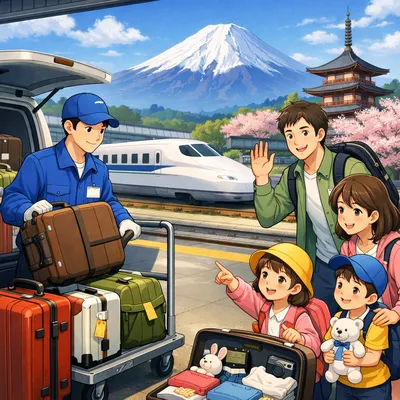
In Japan, luggage delivery services (often called takkyubin) can send suitcases between hotels, and sometimes from airports or stations to hotels.
Delivery time is often next day, and sometimes 24–48 hours is mentioned depending on distance, time of day, and service conditions. Exact timing varies, so check the latest details when you book or ship.
How to use it without getting stressed
- Pack a 1–2 day “survival kit” in your backpack (clothes, toiletries, chargers)
- Ship your big suitcase hotel-to-hotel when changing cities
- Ask your hotel front desk if they can help arrange it (many can, but not all)
Tiny warning: Delivery cut-off times and accepted luggage types can vary. Confirm at the counter or with your hotel before you rely on same-day or next-morning arrival.
Stress-Free Tip: If you’re moving cities, shipping your suitcase can turn a “stair marathon day” into a normal travel day. Sounds dramatic? Maybe. But it helps.
Small Station Habits That Reduce Stress Fast
These are tiny changes. But they add up.
1) Stand to the side when checking your phone
In busy stations, stopping in the middle of the walkway is the classic “oops” moment.
Just move to the side, park your suitcase, and breathe.
Stress-Free Tip: Make it a habit: Stop → side → check → go.
2) Use escalators carefully (and only if you feel stable)
Escalators can be convenient, but a heavy suitcase can be awkward to lift on and off.
If you feel unsteady, it’s okay to take the elevator or even a longer route.
Stress-Free Tip: Safety beats speed. Always.
3) Keep your hands free
If you’re juggling shopping bags, coffee, umbrella, and your suitcase handle… you’re going to have a bad time.
Use a backpack or crossbody bag for essentials and keep one hand free for balance.
Stress-Free Tip: If you’re buying lots of things, consider doing it near the end of your trip or plan a delivery day.
Common Mistakes (Totally Understandable, But Avoid These If You Can)
- Choosing the biggest suitcase “just in case” and then struggling on stairs and transfers
- Assuming major stations are automatically easy (big can mean confusing)
- Picking the fastest route without noticing it includes multiple transfers and long stair connections
- Traveling with big luggage during commuter rush and feeling stressed the whole time
- Not packing a small overnight kit when using luggage delivery (next-day delivery is common)
- Booking a hotel that looks close on the map but requires long underground walks or lots of stairs from the platform
Recommended Options (Choose What Fits You)
Luggage forwarding (takkyubin)
Best for: Travelers changing cities, anyone with large suitcases, families, travelers who get overwhelmed in stations.
Not ideal for: People who need their suitcase immediately on arrival, or travelers doing very last-minute hotel changes.
My honest take: If stairs stress is your main worry, this is often the biggest “stress-to-relief” upgrade. Just pack a small overnight kit and confirm delivery timing before you ship.
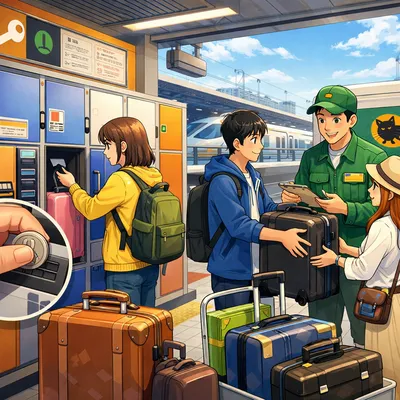
Hotel luggage storage (before check-in / after check-out)
Best for: People arriving early, day-trippers, anyone who wants to explore without dragging bags.
Not ideal for: Travelers staying at places with limited staff hours or strict storage rules (varies by property).
My honest take: This is a simple win. Ask your hotel in advance if storage is available and what the hours are.
A “less famous but easier” hotel location
Best for: First-time visitors who want calm navigation, travelers with luggage, anyone arriving late or tired.
Not ideal for: Travelers who strongly prioritize nightlife right outside the hotel, or who don’t mind complex stations.
My honest take: Famous stations are not automatically convenient. Sometimes a smaller station with a straightforward exit is the real luxury.
Stress-Free Checklist (Do This Before and During Your Trip)
- Choose a suitcase size you can lift up a short flight of stairs if needed
- Set a “one person, one main bag” rule (when possible)
- Pack a small day bag with essentials and keep one hand free
- Plan routes with fewer transfers when moving with luggage
- Avoid commuter rush times when you can (especially with big suitcases)
- Budget extra time in large stations for elevator hunting
- Consider luggage forwarding when changing cities; pack a 1–2 day kit
- Save your hotel name and address in your phone so you can show it if needed
- When you need to check your phone, step to the side and park your suitcase
What to Prepare Next
You don’t need to plan everything at once. Start with the parts that remove the most stress first.
- Decide your luggage plan: carry, store, or forward (and when)
- Choose hotels with “easy access” in mind, not just famous station names
- Download offline maps and make sure you have a charging plan
- Write down your first route from the airport to your hotel (simple version)
FAQ
Do Japan train stations always have elevators?
Not always. Many do, but older or smaller stations may have limited elevator access, or the elevator may be far from the most convenient route. If accessibility is essential for you, check current station information from the railway operator.
Is it rude to bring a suitcase on Japanese trains?
It’s generally allowed, and plenty of travelers do it. The stress usually comes from crowds and space, not from “breaking a rule.” Try to avoid peak commuter times and keep your suitcase close to you.
What’s the easiest way to reduce Japan station stairs luggage stress?
In many cases: pack lighter, reduce transfers, and avoid rush hour. If you want the biggest change, consider luggage forwarding so you’re not carrying your suitcase through stations at all.
How fast is luggage forwarding in Japan?
Many services deliver the next day, and 24–48 hours is often mentioned depending on distance and conditions. Timing can vary, so confirm the latest details when you ship your bag.
Should I choose a hotel “near a big station” for convenience?
Sometimes yes, sometimes no. Big stations can be convenient but also confusing and stair-heavy. For first-time visitors with luggage, a simpler station can feel much more relaxing even if it’s slightly less central.
Final Thoughts
Japan station stairs luggage stress is real. And it’s common. So if you’re worried, that doesn’t mean you’re unprepared. It means you’re thinking ahead.
The best approach is simple: reduce what you carry, reduce how often you transfer, and give yourself time. And if you want the calmest option, send the suitcase ahead and travel light for a day.
You don’t need to be perfect. You just need to be prepared. Once you are, Japan’s stations get a lot less scary—and your trip gets a lot more fun.