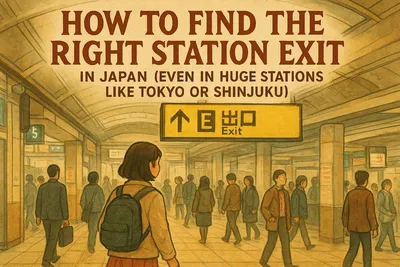
You step into a Japanese train station. It’s clean. It’s bright. It’s… huge. And suddenly there are signs everywhere, people walking like they’re on a mission, and you’re holding your suitcase thinking, “Okay. Which way is the actual train?”
What this guide covers: This article is about reading station signs, exits, platform numbers, line colors, and station numbers. If your main worry is moving a suitcase through stairs or crowds, read Japan Station Stairs Luggage Stress. If you want to avoid carrying large bags at all, read Luggage Delivery in Japan.
Don’t worry. You’re not the only one. This is where many first-time visitors get stuck. Not because Japan is “impossible”… but because Japanese stations give you a lot of information at once.
Here’s the good news: you don’t need to read everything. If you learn to spot just five things on station signs—line, platform, destination, car position, and exit—you can move through most stations calmly, even if you don’t speak the language.
Quick note: Station layouts, sign designs, and services can vary by company and station, and updates happen over time. Use this guide as a calm starting point, and check the latest official information (or station maps) when something feels different on the day.
Quick Answer: The 5 Things to Look For

To understand how to read train station signs in Japan, focus on these five items:
1) Line (name + color + station number system)
2) Platform (which track/platform number to go to)
3) Destination (where the train is heading)
4) Car position (where to stand on the platform for your door/car)
5) Exit (which side of the station you should leave from)
If you can confirm these five, you’re usually fine—even in big stations, even on low sleep, even with a suitcase.
Related guide: If you want your route app to feel clearer (and less overwhelming), see How to Use Google Maps in Japan: Simple Tips for First-Time Visitors.
How to “Scan” a Station Sign in 5 Seconds (A Simple Visual Process)
If signs feel like a wall of information, use this quick scan order. You’re not trying to absorb everything—just the parts that decide where you walk next.
- Arrow first: Which direction is the sign sending you?
- Line identifier: Look for the line name and line color (often shown as a colored bar or colored circle).
- Platform number: Confirm the platform number (especially in big stations).
- Destination / direction: Check the “bound for” station name on the display board or platform sign.
- Small details last: Car position, transfers, elevator icons, exit numbers/letters.
Stress-Free Tip: When you’re moving, only ask one question at a time: “Is this the right line?” then “Is this the right platform?” then “Is this train going the right direction?”
Who This Guide Is For
This guide is for you if you’re:
- A first-time visitor to Japan who worries about getting lost in stations
- Not confident in the local language (or you’re not reading characters at all)
- Traveling with kids, big luggage, or both (brave soul!)
- Nervous about making mistakes and accidentally going the wrong way
- Trying to reduce stress and avoid “station meltdown moments”
Related guide: If you’re building your overall first-trip plan, start here: First Time in Japan? 15 Things to Know Before You Go (Stress-Free Tips).
Step 1: Find the Line (Name + Color + Station Number)
Let’s be honest. The hardest part is often not the train. It’s figuring out which line you’re supposed to be on.
In many Japanese stations, the main navigation system is built around:
- Line name (like a major rail line or a subway line)
- Line color (very important and often consistent)
- Station numbers (a letter/number code system designed to help even if you don’t read the local script)
Major stations usually have multilingual signs (often English, Chinese, and Korean), and the design is increasingly language-independent: color + code + arrows.
What station numbers are (and why they’re your best friend)
Many rail companies use a station numbering system. You’ll see a letter(s) + number style code on signs and maps.
This is incredibly helpful when you’re tired and everything looks like “just more signs.” Instead of trying to read unfamiliar characters, you can match the code from your route app to the signs in the station.
Stress-Free Tip: Before you enter the station, screenshot your route and circle (mentally) the line color and station number/code. When your phone battery drops to 8%, you’ll feel like a genius.
Know the Operator Differences (Rail vs Subway vs Private Lines)
One reason stations feel confusing: you may be in the same building, but using different operators. Signs can look slightly different depending on who runs that part of the station.
- Main rail (often JR): You’ll often see a consistent brand style across big stations, with clear line names, platform numbers, and transfer guidance.
- Subways: Strong use of line colors and station codes. You may see more “underground mall” style corridors between lines.
- Private railways: Super common in big cities. They can have their own colors, logos, and gate areas—sometimes right next to each other.
Stress-Free Tip: If you see two gate areas close together, don’t assume they’re interchangeable. First confirm the operator/line name, then follow the arrows to the correct gates.
What to do when line colors don’t match your app perfectly
Most of the time, colors match nicely. But occasionally you’ll see different shades, multiple lines with similar colors, or an app that emphasizes a different color system.
- Use line name + station code as your “tie-breaker.”
- Look for the next major station in your route and match it on the sign.
- If you’re still unsure, pause near the gate area and check the platform guide board.
Step 2: Spot the “Gate” Area First (Where Everything Branches)
A common situation is walking into a station and immediately looking for the platform… and getting pulled into the wrong corridor.
Instead, aim for the station’s “decision point”: the ticket gate area. This is where you’ll usually find the clearest cluster of signs for:
- which lines are inside
- where transfers are
- which platforms serve which directions
Once you’re at the gate area, you can slow down for 10 seconds and confirm your plan.
Stress-Free Tip: If you feel lost, don’t keep walking faster (we all do it!). Stop near a wall, out of the flow, and re-check: line color + platform number.
Step 3: Confirm the Platform Number (This Is Not Optional)
In Japan, platforms are usually numbered clearly. You’ll see signs pointing to “Platform 1,” “Platform 2,” and so on.
Here’s the thing: two trains on the same line can leave from different platforms. And sometimes the same platform serves trains going in different directions.
So your goal is not “find the line.” Your goal is:
Find the correct platform number for your train direction.
What to do when the station has multiple levels
Some stations send you up stairs, down escalators, through a corridor, and then—surprise—another set of stairs. It can feel like a maze, especially with luggage.
Tiny warning: “Near the station” on a hotel map doesn’t always mean “easy.” A hotel can be 300 meters away but require crossing a massive station with multiple floors.
Stress-Free Tip: If you’re traveling with a suitcase, prioritize routes that show elevator icons (when available) and give yourself extra time in big stations.
Related guide: If you’re choosing a Tokyo base and want easier station walks, see Where to Stay in Tokyo for Your First Trip to Japan (Stress-Free Areas).
Step 4: Read the Destination Display (Where Is This Train Actually Going?)
Okay, you found the platform. Nice! Now you want to confirm the train is going the right way.
On signs and electronic boards, you’ll see a destination or direction indicator. In Japan, direction is often shown as “bound for ____.” It’s basically the station’s way of saying:
“This train is headed in that direction.”
Many first-time visitors worry they’ll accidentally ride a train going the opposite way. That fear is very normal.
A quick, practical way to confirm direction
- Check the platform display for the final destination (or a major station along the route)
- Compare it with your navigation app route
- If it matches, you’re good
If you remember one thing, remember this: platform number + destination is the safest combo.
Stress-Free Tip: If the destination name is unfamiliar, look for a major hub station listed on your route. Displays often rotate through multiple stops or “bound for” info.
Step 5: Use Platform Floor Markings (They Tell You Where to Stand)
This part is surprisingly satisfying once you know it.
On many Japanese platforms, the floor has markings showing:
- where doors will stop
- where to line up
- sometimes which car number you’re near
You may see shapes like circles or triangles, plus numbers. These markings help organize boarding so it’s faster and safer (and yes, it’s also why the boarding process looks so calm).
Why car position matters (especially with luggage or transfers)
Car position is not just a “nice detail.” It can save you a lot of walking.
For example:
- If you have a transfer at a huge station, standing in the right car can put you closer to the transfer stairs/escalator.
- If you’re carrying a suitcase, choosing a less crowded boarding spot can reduce stress.
Stress-Free Tip: If your app shows a “recommended car” or “best car,” use it when you can. If not, don’t overthink it. Just line up neatly and get on the correct train.
Step 6: Exit Signs Can Make or Break Your Day
You arrived! And then you leave the station… from the wrong side… and suddenly your hotel is “only a 6-minute walk” that turns into 18 minutes with traffic lights and confusion.
Yep. It happens.
Exit signs matter because big stations often have many exits. The exit you choose decides which neighborhood side you pop out into.
How to choose the right exit without reading everything
- If you have a hotel booking, check if it mentions a specific exit (many do).
- If you’re going to a landmark, look for it listed on exit boards near the gates.
- When in doubt, choose the exit that matches the direction your map shows—but confirm once you’re outside.
Stress-Free Tip: Save your hotel name and address in your notes app. Even better: keep a screenshot of the hotel map pin and the nearest exit name.
Related guide: For choosing a base with easier transit and fewer “wrong exit” moments, see How to Choose the Best Area to Stay in Japan Without Regret (First-Timer Friendly).
Station Name Weirdness: How to Match What You See to What’s in Your App
Sometimes the hardest part isn’t the arrows—it’s realizing the station name on a sign doesn’t look like what you expected.
- Same station, multiple lines: A station can have several line names attached to it. Your app may emphasize the line name more than the station name (or the other way around).
- Similar-looking names: In dense city areas, multiple stations can have similar names. Always double-check the station code if available.
- Different romanization styles: Occasionally you’ll see slightly different spellings across maps, older signs, or nearby area maps. If the spelling looks close, confirm using the line color, station code, and neighboring stations on the line map.
Stress-Free Tip: If you’re unsure whether a sign matches your app, look for a line map panel and confirm the two stations before/after your target. That context is often clearer than the station name alone.
Useful Station Words (Romanized) You’ll See Again and Again
You don’t need to memorize the local language. But a few station terms show up so often that recognizing them can calm your brain down fast.
- exit: the way out of the station (often shown with an arrow and an exit number/letter)
- ticket gates: the entry/exit gates you tap through
- transfer: changing lines
- platform: where you board
Stress-Free Tip: If you only focus on two ideas: platform and exit. Those two solve most “where do I go now?” moments.
What About Special Signs Like Women-Only Cars?
On some lines (especially during certain times), you may see signs for women-only cars and priority seating.
These are common, and they’re usually clearly marked on platform signs and sometimes on the train itself.
Tiny warning: Rules and times can vary by line and region. If you’re unsure, step back, look for the nearest sign, and follow what it says on the day.
Stress-Free Tip: If you’re traveling as a couple or group and you’re confused about a women-only car marking, just move to a different boarding position. Easy fix, no drama.
Trouble-Mode Signs: Delays, Service Changes, and Last Train Info
Most trips are smooth. But it’s smart to recognize the “something changed” signals—especially in big cities where a small delay can affect connections.
How to handle delay or service change boards
- Look for the platform number first: Sometimes the train is still coming—just later.
- Check the next departure time: Electronic boards usually show updated times.
- Confirm destination again: In disruptions, some trains may terminate early or change service pattern.
- Use your app for a second opinion: If the station board and your app disagree, trust what you see in-station and ask staff if needed.
Last train: what to do if it’s getting late
- Don’t guess—check the final departures on the platform board or your route app.
- If you’re unsure about a transfer, consider taking a slightly earlier train so you have buffer time.
- If you’re traveling with luggage, the “easiest route” may matter more than the fastest route late at night.
Stress-Free Tip: When things feel messy, shrink your task: get to the right platform, then confirm the destination on the next train. One decision at a time.
Related guide: For a smoother arrival day (when you’re tired and signs feel extra loud), see What to Do After Landing in Japan: A Simple Arrival Guide for First-Time Visitors.
Common Mistakes (Totally Understandable, But Let’s Avoid Them)
First-time station mistakes are basically a Japan travel rite of passage. But you can skip a few of the classic ones, yes?
- Following the crowd instead of following the platform number (crowds are not always going to your train!)
- Checking only the line name and ignoring the destination direction
- Assuming “Exit” is just one exit at large stations (it’s often many)
- Not using floor markings and then scrambling when the train arrives
- Choosing a hotel “near a famous station” without thinking about how complex that station is with luggage
Stress-Free Tip: When you feel rushed, use the 5-check system: line → platform → destination → car position → exit. It’s like a mini checklist for your brain.
Recommended Options (If You Want This to Feel Even Easier)
Offline maps / saved screenshots
Best for: travelers with low phone battery anxiety, or anyone who doesn’t want to rely on signal underground.
Not ideal for: people who prefer live updates only (delays and platform changes won’t show on a screenshot).
My honest take: A few screenshots can prevent the “my phone is dying and I’m trapped in a station” feeling. It’s small effort, big calm.
An IC card (like Suica or Pasmo)
Best for: anyone taking multiple trains/subways and wanting smoother gate entry.
Not ideal for: travelers doing very limited local transit (though it can still be convenient).
My honest take: It doesn’t teach you signs, but it removes ticket-machine stress. Less friction = more brain space to read signs calmly.
Related guide: If you want the simplest tap-and-go setup, see How to Use IC Cards in Japan: Suica, PASMO, and Other Travel Cards Explained (Stress-Free Guide).
Luggage delivery (takkyubin)
Best for: travelers with large suitcases, families, and anyone arriving after a long flight.
Not ideal for: short stays where you need your bag immediately, or very last-minute changes.
My honest take: If station navigation is your biggest fear, sending luggage ahead can make stations feel 50% easier. Confirm timing and availability with your hotel before relying on it.
Related guide: If you want to try it, here’s the step-by-step: Luggage Delivery in Japan: A Stress-Free Guide for Families.
Stress-Free Checklist: Before You Enter a Big Station
- Screenshot your route and make sure you can see the line color and platform number
- Save your hotel name and address in your notes app
- Decide your priority: fastest route or easiest route (they’re not always the same)
- Give yourself extra time if you have a suitcase or kids (stations are big, and that’s normal)
- When you reach the gate area, pause and confirm: line + platform + destination
- On the platform, look down: follow the floor markings and line up
- Before exiting, check if your destination mentions a specific exit
What to Prepare Next
You don’t need to plan everything at once. Start with the things that remove the most stress first.
- Decide how you’ll handle internet access (so you can check routes calmly)
- Make a simple arrival plan for your first station transfer (airport to hotel)
- Consider whether you want to use luggage delivery on travel days
- Choose hotels based on ease of access, not just “famous station nearby”
Related guide: For a calm, practical setup before you land, see Japan Travel Apps You Should Download Before Your Trip (First-Timer List).
FAQ
Are train station signs in Japan in English?
In many major stations, yes—English (and other languages) is common. Smaller stations may have less English, which is why line colors, station numbers, symbols, and platform numbers are so helpful.
What should I look at first when I feel lost?
Look for the line color/name and the platform number. Then confirm the destination direction on the electronic display.
What do the floor markings on the platform mean?
They show where the train doors will stop and where you should line up. Sometimes they also indicate car numbers or boarding positions for specific services.
Why are there so many exits in Japanese stations?
Large stations connect to multiple neighborhoods and buildings. Picking the right exit can save you time and walking—especially with luggage.
Do I need to learn Japanese to use trains in Japan?
No. Most travelers get around using a mix of English signage, colors, station numbers, symbols, and route apps. Learning a few common station concepts (platform, exit, transfer) helps—but it’s not required.
Final Thoughts
Japanese stations can look intense at first. Lots of signs. Lots of people. Lots of arrows pointing in ways that feel suspiciously confident.
But you don’t need to be perfect. You just need a simple system. Focus on line, platform, destination, car position, and exit, and you’ll feel calmer fast.
Sounds dramatic? Maybe. But it helps. And once you get it right a couple of times, you’ll start walking through stations like you belong there—which is a very fun moment, isn’t it!