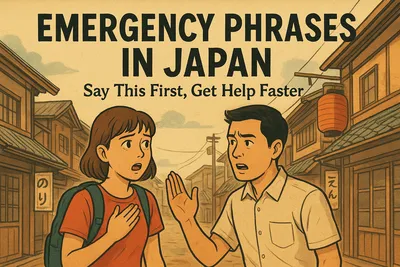
You’re in Japan. It’s your first trip. You’re tired after a long flight. And suddenly… something goes wrong. Your phone is missing. You feel sick. Or the ground starts shaking.
Let’s be honest: emergencies feel extra scary when you don’t speak Japanese, you don’t know the system, and you’re standing in a huge station with a suitcase and 3% battery.
Don’t worry. Japan is generally very organized about help. The trick is knowing the first door to knock on—and the two phone numbers that matter most. This guide walks you through police, hospitals, earthquakes, and lost items in a calm, practical way.
Quick note: Local services, hospital rules, translation support, and disaster tools can change. Use this guide as a calm starting point, and check the latest official information (especially for hotlines, apps, and medical services) before you rely on anything important.
Quick Answer (Save This)

If you remember one thing, remember this: 110 = police and 119 = ambulance/fire.
For “help but not life-threatening,” start with a koban (small local police box), a station staff member, or your hotel front desk.
For earthquakes, your first job is simple: protect your head, avoid falling objects, and if you’re near the coast after strong shaking, move to higher ground because of tsunami risk.
Who This Guide Is For
This guide is for you if you’re:
- A first-time visitor to Japan who feels nervous about emergencies
- Not confident in Japanese (or you’re worried you’ll freeze up)
- Traveling with kids, parents, or anyone who might need medical help
- Worried about getting lost at stations, losing items, or handling earthquakes
- The type of traveler who wants a plan before things get stressful
The Two Emergency Numbers in Japan (110 and 119)
This is where many first-time visitors get stuck. Because in some countries, there’s one number for everything. In Japan, there are two.
110: Police
Call 110 for police help. This includes theft, accidents, trouble, and also reporting lost items (especially important for passports and credit cards).
It’s also the number you use if you need to make an official police report for insurance or replacement documents.
Stress-Free Tip: Save “110 (Police)” in your phone notes now. When you’re stressed, your brain becomes… creatively unhelpful.
119: Ambulance and Fire
Call 119 for an ambulance or fire services. Use it for serious illness, major injury, breathing trouble, loss of consciousness, or a fire.
If it feels urgent and you’re not sure, it’s better to call than to wait and hope it magically gets better, right?
Stress-Free Tip: If you can, tell the operator your location first (hotel name, station name, a nearby big building). Location matters more than perfect wording.
The “First Door” Rule: Koban, Station Staff, or Hotel Front Desk
Here’s the thing: Japan has a very practical “help network.” You usually don’t start by hunting for the perfect office. You start with the nearest human whose job includes helping people.
Koban (Police Box): Your Local Help Desk
A koban is a small neighborhood police box. And it’s surprisingly useful.
You can ask for:
- Directions (yes, really)
- Help with lost items and filing a report
- Advice on what to do next if something went wrong
Many travelers feel awkward walking in. Don’t. This is exactly what it’s for.
Stress-Free Tip: If you’re lost and your phone is dying, a koban can be faster than trying to “solve Tokyo” with 2% battery.
Station Staff: Best for Lost Items and “Where Am I?” Moments
A common situation is losing something on a train or in a station. In that case, station staff are often your fastest starting point.
They can guide you to the station’s lost-and-found counter or tell you what information you need to provide.
Stress-Free Tip: If you realize you left something on a train, go to staff immediately. Waiting “until later” is how items go on a little adventure without you.
Hotel Front Desk: Best for Medical Help and Translation Support
If you feel sick, need a clinic, or need help explaining something, your hotel front desk can be a lifesaver.
They may be able to:
- Call a taxi or ambulance
- Suggest a nearby clinic or hospital
- Help communicate in Japanese (this varies by property)
Stress-Free Tip: Keep your hotel name, address, and phone number saved offline. If your phone is lost, you still want to know where “home base” is.
Medical Emergencies: How to Decide What to Do
Medical stress hits differently abroad, doesn’t it? Especially when you’re jet-lagged and everything feels louder than usual.
When to Call 119 (Ambulance)
Call 119 if the situation seems serious. For example:
- Trouble breathing
- Severe bleeding
- Chest pain
- Loss of consciousness
- Signs of stroke (sudden weakness, speech trouble)
- Major injury from an accident
You do not need to “earn” an ambulance by being perfect at Japanese. Safety first.
Stress-Free Tip: If you’re with someone who’s ill, assign tiny jobs: one person calls, one person finds the address, one person meets help outside.
When to Go Yourself (Clinic, Taxi, or Walk-In)
If you can walk, talk, and the condition feels mild to moderate, you may be advised to go to a clinic or hospital yourself (often by taxi or public transit).
This can be a calmer option for things like:
- Minor fever or cold symptoms
- Small cuts that may need cleaning
- Stomach trouble that’s uncomfortable but stable
- Sprains where you can still move
Tiny warning: Some clinics have limited hours, and not all places can support English smoothly. If you’re unsure, ask your hotel to help you choose where to go.
Stress-Free Tip: Take a photo of your travel insurance details and store it in a cloud account you can access from any device.
Tokyo-specific help: “Himawari” Medical Information Service
If you’re in Tokyo, there is a medical information service called Himawari that can help you find a medical facility (including multilingual support options).
Because contact methods and support languages can change, check the latest official details before you rely on it.
Stress-Free Tip: Write down your key health info in simple English on your phone notes: allergies, medications, conditions, and emergency contact.
Earthquakes in Japan: What to Do (Without Panicking)
Earthquakes are one of those “I knew Japan has them, but I didn’t think about it” topics. Totally normal.
The good news: the basic actions are simple. And you don’t need Japanese to do them.
If You’re Indoors
Your first priority is protecting your head. Then avoid things that fall.
- Get under a sturdy table if possible
- Move away from windows, shelves, and hanging objects
- Stay put until shaking stops, then check for hazards
Stress-Free Tip: In hotels, quickly note where the emergency exit is when you arrive. It’s a 10-second habit that can pay off later.
If You’re Outdoors
Outside, the danger is often above you.
- Protect your head
- Move away from buildings, signs, and anything that could fall
- Head to a wider open area if you can
Stress-Free Tip: If you’re in a busy area, don’t sprint. Move steadily. Crowds + panic is a bad combo.
Tsunami Risk: If You’re Near the Coast or a River
This part is important. If you feel strong shaking near the coast (or even near a river that connects to the sea), be ready to move.
General guidance is to evacuate to higher ground if there is a tsunami warning or if the shaking is strong enough to make you worry.
Tiny warning: Don’t go “watch the waves.” It sounds obvious, but curiosity makes smart people do weird things.
Stress-Free Tip: When you arrive in a coastal town, quickly check where “higher ground” is on the map. You don’t need a perfect plan. Just a direction.
Disaster Alerts: Safety Tips and NERV Apps
Traveler guides often recommend disaster alert apps like Safety Tips and NERV to receive earthquake and emergency notifications.
These tools can be very helpful, especially if you don’t understand local announcements.
Because features can change, download in advance and check the latest official app information before your trip.
Stress-Free Tip: Turn on notifications, but also set a calm rule for yourself: read the alert, take action, then stop doom-scrolling.
If Mobile Data Fails: 00000JAPAN Wi‑Fi
In some major disasters, you may see a free public Wi‑Fi network called 00000JAPAN mentioned as a way to get online when normal networks are stressed.
Availability and conditions can vary, so treat it as a backup option, not your main plan.
Stress-Free Tip: Decide one meeting point with your travel buddy (like “hotel lobby”) in case messages don’t go through.
Lost Items in Japan: The Fastest Way to Get Your Stuff Back
Japan is one of the better places in the world to lose something. I know, that’s a strange compliment. But lost-and-found systems are taken seriously.
Still, speed and details matter.
Step 1: Think “Where Did I Lose It?”
Lost items are handled based on location.
- If you lost it in a station or on a train, start with station staff and the railway’s lost-and-found process
- If you lost it in a shop or restaurant, ask that facility first
- If you lost it on the street, go to the nearest koban
Stress-Free Tip: The sooner you report, the easier it is for staff to trace the likely route your item took.
Step 2: Prepare the Details (This Helps a Lot)
When you report a lost item, you’ll usually be asked for specifics. The more you can provide, the better your chances.
- Where you think you lost it (station name, shop name, area)
- Time and date (even an estimate is helpful)
- Train line and direction if relevant
- What it looks like (color, size, brand, case)
- What’s inside (for wallets: cards, ID type—don’t share PINs)
This sounds picky, but it’s actually good news. It means the system is organized enough to match items properly.
Stress-Free Tip: Take a quick photo of your passport photo page and your main cards (front only) before your trip. Store it securely. If something is lost, you’ll have the details.
What If You Lost Your Passport or Credit Card?
This is the “okay, deep breath” category.
In many cases, you’ll want to do these steps quickly:
- Report it to the police (often needed for documentation)
- Contact your card issuer to freeze/cancel the card
- Contact your embassy/consulate for passport replacement guidance
- Contact your travel insurance provider if applicable
Stress-Free Tip: Keep your passport in a safe place and carry a different ID day-to-day if you can. And don’t store every card in the same wallet. One loss shouldn’t wipe you out.
Traveler Support You Can Use: JNTO Japan Visitor Hotline
If you’re not sure where to start, Japan also has traveler-focused support. One widely cited resource is the JNTO Japan Visitor Hotline, which is described as a 24-hour support line for visitors.
Because phone numbers and service details can change, check the latest official JNTO information before you travel, and save it somewhere accessible offline.
Stress-Free Tip: Put key help info in two places: your phone notes and a small paper card in your wallet. Redundancy is calming.
Common Mistakes (Totally Understandable, But Avoid These If You Can)
Mixing up 110 and 119
It happens. Your brain is juggling maps, tickets, and “where is the exit.”
Fix: Think: 110 = police, 119 = ambulance/fire. Save it now.
Waiting too long to report a lost item
Many travelers do the “maybe it’ll turn up later” thing. Sometimes it does. Sometimes it doesn’t.
Fix: Ask station staff or a shop immediately, then go to a koban if needed.
Trying to handle medical issues alone when you’re exhausted
Jet lag plus illness is a nasty combo. And big stations are not the place to “power through.”
Fix: Use your hotel front desk as your helper. That’s part of what you’re paying for.
Not thinking about tsunami risk in coastal areas
Earthquake = shaking. Tsunami = water later. That delay can create confusion.
Fix: If you’re near the coast and the shaking is strong, be ready to move to higher ground and follow official warnings.
Recommended Options (Simple Prep That Reduces Panic Later)
Disaster alert apps (Safety Tips, NERV)
Best for: Travelers who want clear alerts and extra reassurance during earthquakes or severe weather.
Not ideal for: Anyone who gets anxious from constant notifications (you may need to tweak settings).
My honest take: Downloading one app before you fly is a low-effort, high-comfort move. Just make sure you check the latest official app details and keep your phone charged.
A small power bank
Best for: Everyone. Seriously.
Not ideal for: Only if you already carry one and it actually works.
My honest take: In emergencies, your phone is your map, translator, and contact list. A power bank is not “extra.” It’s peace of mind.
Travel insurance (especially with medical coverage)
Best for: Travelers who want to avoid huge surprise costs and want support when things go wrong.
Not ideal for: People who already have strong coverage through another policy (but check what it actually covers).
My honest take: Policies vary a lot. Don’t buy based on vibes. Check medical coverage, exclusions, and how to contact them from Japan.
Stress-Free Checklist (Do This Before You Go)
- Save 110 (Police) and 119 (Ambulance/Fire) in your phone notes
- Save your hotel name, address, and phone number offline
- Download a disaster alert app (and enable notifications)
- Carry a power bank and charging cable in your day bag
- Take secure photos of passport info and key cards (front only)
- Know your “first door”: koban, station staff, or hotel front desk
- If you’ll visit coastal areas, quickly identify higher ground on arrival
What to Prepare Next
You don’t need to plan everything at once. Start with the parts that reduce the most stress first.
- Decide your internet plan (so you can call, map, and translate when needed)
- Set up a simple “lost wallet” backup (separate one card and some cash)
- Learn a basic station routine: find staff first, then solve the problem
- Make sure your accommodation choice is practical for your first night (easy access beats “cool neighborhood” when you’re exhausted)
FAQ
What are the emergency numbers in Japan?
110 is for police. 119 is for ambulance and fire services.
What is a koban in Japan, and can tourists use it?
A koban is a small local police box. Tourists can absolutely use it for directions, lost item reports, and help with minor troubles.
If I don’t speak Japanese, can I still call 110 or 119?
Yes. Call if you need to. Try to share your location clearly and use simple words. If you can, ask a nearby staff member or your hotel to help communicate.
What should I do first if I lose something on a train?
Go to station staff immediately. Tell them the line, direction, time, and what the item looks like. Acting fast helps.
What should I do during an earthquake in Japan?
Protect your head, avoid falling objects, and wait for shaking to stop. If you’re near the coast after strong shaking, be ready to move to higher ground and follow official tsunami warnings.
Final Thoughts
Emergencies are scary anywhere. In a new country, they can feel twice as big. But you’re not powerless in Japan.
Remember the basics: 110 for police, 119 for ambulance/fire, and when you’re unsure, start with a koban, station staff, or your hotel front desk.
You don’t need to be perfect. You just need to be prepared. And honestly? That tiny bit of prep can make Japan feel a whole lot more stress-free.