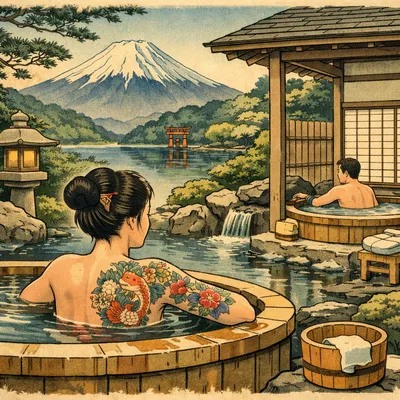
You’re planning your Japan trip. You’re excited. And then you open a ryokan booking page and see words like “Private Onsen,” “Family Bath,” and “Open-Air Bath Room.”
What this guide covers: This article explains the difference between private onsen, family bath, and open-air bath rooms. If you are choosing a ryokan, read How to Choose a Ryokan with a Private Onsen. If you are deciding whether the upgrade is worth it, read Are Private Onsen Rooms in Japan Worth It?.
They all sound like “a bath just for you,” right? But the details can be wildly different. And that’s where many first-time visitors get stuck.
A common situation is this: you land after a long flight, drag your suitcase to your ryokan, and you’re dreaming of a calm soak… only to realize your “private bath” is actually a 40-minute time slot that needs booking at the front desk. Surprise!
Don’t worry. Once you know the system, it gets much easier. This guide explains the real difference, what to check before paying, and how to choose the least stressful option for you.
Quick note: Ryokan policies, bath rules, tattoo policies, child rules, pricing, reservation methods, and time limits can change by property and season. Use this guide as a calm starting point, and always check the latest official information before booking anything important. If something matters to you (tattoos, mixed-gender use, dinner timing), confirm directly with the ryokan or hotel before booking.
Quick Answer: The Difference in One Minute

Private onsen usually means a bath you can use only with your group, but often by time slot (like 40–60 minutes).
Family bath is usually the same idea as a private onsen, just marketed as easier for families. Couples can often use it too.
Open-air bath room usually means a room with its own outdoor bath attached, so you can soak whenever you want during your stay.
If you remember one thing, remember this: “Private” can mean “reserved time,” not “attached to your room.”
3 Options Compared (Privacy, Cost, Booking, Stress Level)
If you’re skimming, this is the section to save.
| Type (what booking sites may call it) | Where it is | How you use it | Typical cost (rough guide) | Best for | Common stress point |
|---|---|---|---|---|---|
| Private onsen / private bath / reserved bath | Shared bath area (not in your room) | Reserve a time slot (often 30–60 min) | Often free to 5,000+ yen per session depending on property and plan | Privacy without paying for an upgraded room | Time slots sell out / you feel “on the clock” |
| Family bath | Shared bath area (not in your room) | Same as above: reserve or first-come-first-served | Often similar to private baths: free to 5,000+ yen per session | Kids, couples, or anyone who wants to bathe together privately | Assuming it’s unlimited / assuming it’s automatically tattoo-friendly |
| Open-air bath room (room with private open-air bath) | Attached to your guest room | Use anytime during your stay | Usually included in the room price (higher nightly rate rather than a per-use fee) | Maximum privacy, flexible timing, easiest for first-timers | Higher cost; “open-air” may be semi-open, not a wide-open view |
Stress-Free Tip: If a listing only says “private bath available,” assume it’s a shared facility you reserve by time slot until proven otherwise.
Related guide: Private Onsen vs Public Onsen: Which Is Better for Foreign Visitors?
Who This Guide Is For
This guide is for you if you’re a first-time visitor to Japan and any of these sound familiar:
- You don’t speak English and you’re nervous about bath rules.
- You want a private soak (with your partner, kids, or friends) and you don’t want surprises.
- You’re comparing ryokan and hotel options and the bath terms all look the same.
- You’re worried about tattoos, nudity rules, or using the bath separately by gender.
- You want a relaxing experience, not a “why is this so complicated?” moment.
First, the Big Idea: “Private” Can Mean Three Different Setups
Let’s be honest. The English labels on booking sites can be a little… creative.
In Japan, your “private bath” experience usually falls into one of these categories:
- A reservable private bath (shared facility, reserved by time slot).
- A room with a private bath (attached to your room, any time).
- A public bath (shared with other guests, usually separated by gender).
Same dream. Different reality. And different stress level, too.
Stress-Free Tip: Before you book, look for the words “reservation,” “time limit,” “first-come-first-served,” or “in-room.” Those four words basically decide your whole bath experience.
Private Onsen in Japan: What It Usually Means (And What It Often Doesn’t)
In many cases, “Private Onsen” means you can reserve a bath that is not in your room.
It’s usually located in the ryokan’s common bath area. You book a time slot. You use it. Then you leave so the next guests can use it.
How a typical private onsen time slot works
Many properties use a system like:
- Reserve at check-in (sometimes earlier, depending on the ryokan).
- Use it for a set time (often 30 to 60 minutes, sometimes longer).
- Pay a fee or use a “one free use” perk included in your plan.
Typical pricing (rough guide): You may see anything from free (included for guests) to roughly 1,000–5,000+ yen per session. Some places price it per group, some per room, and some bundle it into specific plans. Always confirm the current details on the official listing.
I know, it sounds confusing. But it’s basically a meeting room booking… except you’re booking a bath. That’s it!
What’s great about a reservable private onsen?
- You can bathe with your partner or family without using the public bath.
- It’s often cheaper than booking a room with a private open-air bath.
- It can be less intimidating if you’re nervous about public bathing rules.
What can be stressful about it?
- You may only get one slot per night, or limited availability.
- You might have to book quickly after arriving (popular times go fast).
- You’re on the clock. Relaxing… but with a timer in the back of your mind.
Tiny warning: If you arrive late (delayed train, wrong station exit, hungry kids, low phone battery… it happens), you may miss the best time slots. If private bathing is your top priority, consider a room with a private bath instead.
Stress-Free Tip: If you want a reservable private onsen, choose a ryokan with a check-in time that matches your arrival reality. Not your “perfect day” fantasy.
Related guide: How to Choose a Ryokan with a Private Onsen in Japan for Your First Trip
Family Bath in Japan: Yes, Couples Often Use It Too
This one surprises a lot of first-timers.
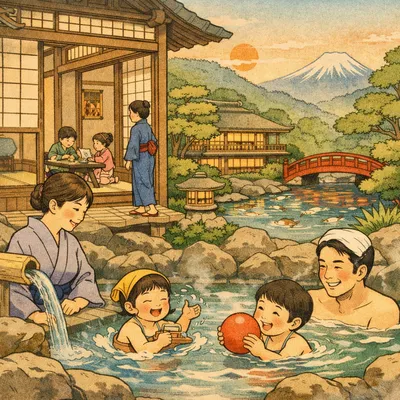
A “Family Bath” in Japan often means a private bath you can use together. It does not always mean the whole property is designed specifically for families with children.
So yes, Mr. and Ms. “We don’t have kids” can often use it. Totally normal.
Why it’s called a “family bath”
Many facilities use the label because the bath is:
- Easy for a parent and child to use together.
- Sometimes equipped with family-friendly features (like a wider washing area).
- Designed for small groups rather than solo use.
But the naming is not standardized. One property may call it “family bath,” another may call the same thing “private bath,” “reserved bath,” or “private onsen.”
When a “family bath” is a great choice
- You’re traveling with kids who are too young to bathe separately by gender.
- You’re traveling with an older parent who needs assistance.
- You want privacy, but you don’t need 24/7 access.
What to watch for
Family baths are often booked like private onsen (time slots). Some are first-come-first-served. Some are paid. Some are free. Yep. It’s a “check the details” situation.
Stress-Free Tip: If the booking page only says “family bath available,” assume nothing. Look for the key details: Is it free or paid? and How do you reserve it?
Related guide: Family-Friendly Ryokan in Japan: What to Check Before Booking (Without Regrets)
Open-Air Bath Rooms: The “Attached to Your Room” Upgrade
An “Open-Air Bath Room” usually means a room with its own outdoor bath attached. In ryokan terms, this is a room with a private open-air bath.
This is the option that feels the most straightforward for many first-time visitors. Because the “reservation system” is simple: you already reserved it when you booked the room.
Why it’s so appealing (especially when you’re tired)
Picture this. You’ve been navigating a huge station, carrying luggage, and trying not to block commuters. You finally reach your room.
Now imagine you can soak without leaving your room, without booking a slot, and without worrying about anyone seeing you. Sounds dramatic? Maybe. But it helps.
Important reality check: “Open-air” doesn’t always mean “fully open”
Some baths are truly outdoors. Some are semi-open (partly covered). Some feel more like a balcony bath with privacy screens.
All can be lovely. But if you’re expecting a wide-open mountain view, make sure the room description and photos match that expectation.
Cost and value (the honest version)
Rooms with private open-air baths are often more expensive than standard rooms. How much more depends on the property, season, view, and meal plan.
One simple way to think about the price: a reservable private bath is often a per-use fee (or included perk), while an open-air bath room is usually a higher nightly room rate because the bath is part of the room itself.
My honest take: If your biggest stress is public bath nerves (tattoos, modesty, etiquette worries, traveling with kids), paying extra for an in-room bath can be worth it. If you’re fine with a time slot system, reservable private baths can be a smarter budget choice.
Stress-Free Tip: If you’re booking this for comfort, not luxury, prioritize “attached bath” over “fancy view.” A simple in-room bath can reduce more stress than a beautiful bath you’re too nervous to use.
Related guide: Are Private Onsen Rooms in Japan Worth It? Pros, Cons, and Price Guide for First-Timers
Wait… Is an Open-Air Bath Always an Onsen?
Here’s the thing. “Onsen” and “open-air bath” are not the same word in Japan.
Onsen (hot spring) = the water
Onsen means the water meets official hot spring criteria (temperature and/or mineral content). So “onsen” is about the source and properties of the water.
Open-air bath = the location
An open-air bath means the bath is outdoors (or semi-outdoors). It’s about the bathing environment and vibe.
So what does that mean for you?
You can have:
- An open-air bath that uses real hot spring water.
- An open-air bath that uses heated tap water (still relaxing, just not “onsen” water).
- An indoor bath that uses real hot spring water.
This is why some listings feel confusing. The words describe different things.
Stress-Free Tip: If hot spring water matters to you, look for wording like “hot spring water used” or “onsen in the bath.” If it’s unclear, confirm directly with the property before booking.
Private Bath vs Public Onsen: Which One Is Less Stressful for First-Timers?
This is a personal comfort question, and you’re not the only one asking it.
Public onsen can be wonderful (but it can feel intense at first)
Public baths in ryokan are usually separated by gender. You bathe nude. You follow a simple routine: wash first, then soak.
Many travelers end up loving it. But if you’re nervous about etiquette or body confidence, it can feel like a lot on day one.
Private options reduce “new experience overload”
A reservable private bath or an in-room bath can remove several stress points at once:
- No worrying about other guests watching your etiquette.
- No need to split up by gender.
- Easier for families, couples, and people who want more privacy.
My honest take: If you’re curious about the public onsen experience, a nice strategy is: try the private bath first, then decide if you want to try the public bath later. You don’t need to be perfect. You just need to be prepared.
Stress-Free Tip: If your ryokan has both private and public baths, ask the front desk (in simple English) what time the public bath is quietest. Early afternoon and late evening can be calmer in many places, but it depends on the property.
How Reservation Rules Usually Work (And How to Avoid the “Sold Out Time Slots” Surprise)
Reservation systems vary. But there are a few common patterns you’ll see.
Pattern 1: Reserve at check-in
You arrive, you choose a time, you get a key or sign. Simple. But popular slots can disappear fast.
How to avoid disappointment:
- Arrive as close to check-in opening time as your day allows (even 30–60 minutes earlier can help).
- Book the bath slot first, then handle dinner timing and everything else.
- If you’ll arrive late, email ahead and ask if they can hold a slot (some can, many can’t—but it’s worth asking).
Pattern 2: First-come-first-served (no bookings)
There may be a sign outside the bath. If it’s free, you go in and lock the door.
This sounds easy. But if the ryokan is busy, you might be waiting in your room at 9:30pm like, “Is it my turn yet?”
How to make it smoother:
- Use it earlier (late afternoon) if you can, before the post-dinner rush.
- Ask the front desk when it’s usually quiet.
- If you have kids, plan around bedtime rather than hoping for a late slot.
Pattern 3: Pre-booking required
Some properties let you reserve in advance by email or through the booking process. This is great for planners and nervous travelers.
How to actually get the time you want:
- Book earlier than you think for peak seasons and weekends.
- If the bath time is your top priority, choose a property that clearly states “advance reservation available” (vague listings often mean you can’t pre-book).
- If you don’t see instructions, assume you may need to contact the property directly.
Tiny warning: If you’re relying on a private bath to avoid public bathing completely, do not assume you’ll get multiple slots at perfect times. Check the rules before you pay.
Stress-Free Tip: When you arrive, book your private bath time first, then deal with dinner timing, yukata sizing, and everything else. This one small move can make the whole evening feel smoother.
Mixed-Gender Bathing: What’s Allowed Where?
Let’s make this simple, because this topic makes people nervous.
Public baths (shared onsen) are usually separated by gender
This is the standard setup in most ryokan and bathhouses.
Private baths often allow couples and families together
In many cases, a reservable private bath or in-room bath can be used by couples and families together, because it’s a private space.
But rules can exist (especially for day-use private baths)
Some facilities may limit mixed-gender use to family members, or have other rules. It depends on the facility.
Stress-Free Tip: If mixed-gender use matters for your group, don’t guess. Confirm directly with the ryokan or facility before booking.
Tattoos: The Question Everyone Is Afraid to Ask
You’re not the only one, okay?
Tattoo rules vary a lot by facility. Some allow tattoos in private baths but not public baths. Some allow small tattoos with covers. Some allow all tattoos. Some allow none.
There is no single rule that applies everywhere.
Tiny warning: Do not assume “private bath available” automatically means “tattoos OK.” It often helps, but it’s not a guarantee.
Stress-Free Tip: If you have tattoos and want a low-stress stay, consider booking a room with a private bath and still confirm the policy directly with the property before booking.
Related guide: Tattoo-Friendly Onsen in Japan: Why Private Baths May Be the Easiest Option
Kids and Family Travel: The Quiet Details That Matter
With kids, the bath type matters. But the “small logistics” matter just as much.
What can make a family bath easier
- A washing area with enough space (kids wiggle, you know?).
- Less walking from your room (because wet kids + long hallways = chaos).
- Flexible timing (because bedtime is not negotiable).
What can make an open-air bath room easier
- You can bathe around your child’s schedule, not the ryokan’s schedule.
- You can keep towels and pajamas nearby.
- No pressure if your child suddenly decides baths are “scary.”
My honest take: For families, a room with a private bath can be a sanity-saver. But if budget matters, a reservable family bath can be a great middle option—just confirm the time rules.
Stress-Free Tip: If you’re traveling with kids, avoid a remote ryokan for your first night in Japan. After a long flight, even a “simple transfer” can feel like a boss level.
Location and Luggage: “Near the Station” Isn’t Always Stress-Free
This is not talked about enough.
Many first-time visitors book a ryokan that looks close to the station on a map. Then they arrive and discover the route includes stairs, a long uphill walk, or a confusing station with multiple exits.
And now you’re doing that… with a suitcase.
What to look for instead of “close”
- Is there a shuttle from the station?
- Is the walk flat and simple?
- Is check-in early enough that you’re not rushing?
- Can you use luggage delivery so you travel light?
Stress-Free Tip: If you’re doing one special ryokan night, consider sending your suitcase ahead and traveling with a small overnight bag. Your future self will thank you at the station.
Related guide: Luggage Delivery in Japan: A Stress-Free Guide for Families
Accommodation Terms Explained (Without the Headache)
Here are the terms you’ll see most often, explained in plain English.
Ryokan
A traditional Japanese inn. Often includes dinner and breakfast plans. Rooms may have futons instead of beds (or sometimes both).
Onsen
A hot spring. It refers to the water meeting hot spring criteria, not the bath style.
Private onsen / private bath
Often means a bath you can use privately, but it may be reservable by time slot and located in a shared area.
Family bath
Usually a type of private bath meant for small groups. Couples can often use it too.
Reserved bath
Another way to say “private bath you reserve.” Same concept as a time-slot private bath in many cases.
Public onsen (large communal bath)
A shared bath for guests. Usually separated by gender. You wash first, then soak.
Open-air bath
A bath that is outdoors (or semi-outdoors). It may or may not use real hot spring water.
Room with private open-air bath
A room with an attached outdoor bath. Usually the most private and the most flexible.
Dinner included / meal plan
Many ryokan stays are sold with dinner and breakfast. Dinner often starts at specific times, so check the schedule before booking.
Room-only plan
No meals included. This can be less stressful if you want flexibility, but some ryokan areas have limited restaurants at night.
Shuttle service
A pick-up/drop-off service from the nearest station. Times and booking methods vary, so check the property’s latest info.
Yukata
A casual robe provided by many ryokan. It’s normal to wear it around the property.
Stress-Free Tip: If a booking page is vague, search the room type name on the property’s official site too. Booking platforms sometimes simplify details that matter (like time limits).
Common Mistakes (Totally Understandable, But Let’s Avoid Them)
Mistake 1: Assuming “private onsen” means “in your room”
This is the big one. Many people book expecting an in-room bath and get a reservable slot instead.
Stress-Free Tip: Look for wording like “in-room bath,” “attached,” or “private bath in guest room” if that’s what you want.
Mistake 2: Booking a ryokan without checking dinner timing
Many ryokan dinners have a start time window. If your train is delayed and you arrive late, you may miss it or feel rushed.
Stress-Free Tip: If you’re arriving from a big city the same day, choose a ryokan with a check-in time you can realistically make.
Mistake 3: Choosing a place “near a famous station” without thinking about the station itself
Big stations can be confusing. “Near” can still mean a long walk through crowds or multiple levels.
Stress-Free Tip: Simple access beats famous location when you’re tired and carrying luggage.
Related guide: Where to Stay in Tokyo for Your First Trip to Japan (Stress-Free Areas)
Mistake 4: Assuming tattoo rules are the same everywhere
They’re not. Even within the same area, policies can differ.
Stress-Free Tip: If tattoos matter for your trip, confirm directly with the ryokan or hotel before booking.
Mistake 5: Overpaying for luxury when what you wanted was privacy
Some travelers book the most expensive room because they think it’s the only way to bathe privately.
Stress-Free Tip: A reservable private bath can be enough. Decide whether you want “private sometimes” or “private anytime.”
Recommended Options (Pick the One That Matches Your Stress Level)
Option 1: Room with a private open-air bath
Best for: Travelers who want maximum privacy, flexible timing, and the simplest experience (especially couples and families).
Not ideal for: Tight budgets or travelers who don’t care about privacy and are happy using the public bath.
My honest take: This is often the easiest “no confusion” option. You pay more, but you remove the reservation race and the time limit stress.
Option 2: Reservable private bath (private onsen / family bath / reserved bath)
Best for: Travelers who want privacy but don’t need it 24/7, and want a more budget-friendly compromise.
Not ideal for: Late arrivals, travelers with unpredictable schedules, or anyone who will stress about time slots.
My honest take: Great value if you understand the rules. The stress comes from assuming it’s unlimited.
Option 3: Public onsen (plus learning the basics)
Best for: Travelers who want the classic ryokan experience and don’t mind shared bathing.
Not ideal for: People who feel very uncomfortable with nudity rules, or travelers with tattoo concerns unless confirmed.
My honest take: It can be the highlight of your trip. But you don’t have to force it on night one. Start where you feel comfortable.
Option 4: Luggage delivery for ryokan nights
Best for: Anyone doing an onsen town stay, especially with stairs, transfers, or kids.
Not ideal for: Very last-minute plans where delivery timing won’t work.
My honest take: This can reduce more stress than upgrading your room. Traveling light makes everything easier—stations, buses, and check-in.
Booking Checklist (Read This Before You Pay)
- Is the bath private, shared, reserved, or attached to your room?
- If it’s private, is it time-slot based? How many minutes per session?
- Is the private bath free or paid? Is one free use included in your plan?
- How do you reserve it: at check-in, in advance, or first-come-first-served?
- Can couples/families use it together? Any mixed-gender restrictions?
- Does the bath use real hot spring water, or is it a regular bath? (If that matters to you.)
- What are the latest tattoo rules? Confirm directly with the property if needed.
- Are children allowed? Any age rules for certain bath types? Confirm before booking.
- Is dinner included? If yes, what is the latest dinner start time?
- What is the latest check-in time?
- Is there a station shuttle? If yes, what are the latest times and booking steps?
- Will large luggage be easy to manage from the station to the property?
Stress-Free Checklist (So You Actually Enjoy the Bath)
- Screenshot or save your room plan details (especially the bath description) before travel.
- Arrive with enough time to book a private bath slot if needed.
- Pack a small bag for your ryokan night if you’re sending luggage ahead.
- Bring a small coin pouch or some cash (some onsen towns and small services can be cash-based).
- Learn the two core onsen rules: wash first, and towels do not go in the bath.
- If you’re nervous, start with a private bath first, then decide about the public bath later.
- Confirm anything important (tattoos, mixed-gender rules, children) directly with the property before booking.
What to Prepare Next
You don’t need to plan everything at once. Start with the choices that reduce stress the fastest.
- Decide if you want “private anytime” (in-room bath) or “private sometimes” (reservable bath).
- Plan how you’ll reach the ryokan with luggage (shuttle, taxi, or luggage delivery).
- Check dinner and check-in times and make sure they match your travel day.
- Prepare a simple message template for questions (tattoos, family bath reservation, meal timing).
FAQ
Is a “family bath” only for families with children?
Usually no. In Japan, “family bath” often means a private bath for a small group. Couples can often use it too, but rules can vary, so check the property details.
Does “private onsen” always mean I can use it whenever I want?
Often it does not. Many “private onsen” options are reservable baths with time slots (like 40–60 minutes). A room with a private bath is the more flexible “anytime” option.
What’s the difference between “open-air bath” and “onsen”?
“Onsen” refers to hot spring water. “Open-air bath” refers to an outdoor bath style. An open-air bath may or may not use real hot spring water.
If I have tattoos, should I only book a room with a private bath?
A private bath can reduce stress, but tattoo policies still vary. If tattoos are a concern, confirm directly with the ryokan or hotel before booking.
What’s the easiest option for nervous first-time visitors?
Many first-timers find a room with a private bath the simplest because there’s no time-slot race and you can go at your own pace. If that’s out of budget, a reservable private bath is the next best option—just confirm how reservations work.
Final Thoughts
If Japan bath terms feel confusing, you’re not doing anything wrong. The same setup can be labeled three different ways on different booking sites.
The calm way to book is simple: decide whether you want private anytime (attached to your room) or private sometimes (reserved time slot), then confirm the reservation method and fees before you pay.
Related Guides for a Smoother Japan Trip
Related guide: Hakone vs Kawaguchiko: Which Is Better for a Private Onsen Stay?
Related guide: How to Get from the Airport to Your Hotel in Japan Without Stress (First-Timer Guide)
Related guide: Japan Travel Apps You Should Download Before Your Trip (First-Timer List)