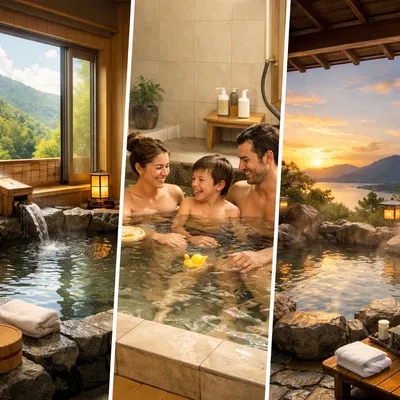
Seeing “Family Bath” on a hotel or ryokan listing can feel like a relief—until you realize it might mean several different things. In Japan, the phrase is often used loosely in English. This guide explains what it usually means, what it doesn’t guarantee, and the exact details to confirm so you can book with confidence.
Quick Answer: What a “Family Bath” Usually Means
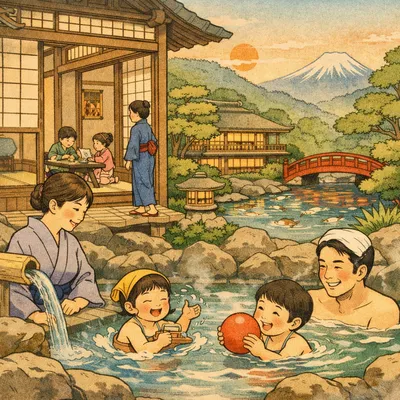
In most Japan accommodations and hot spring facilities, a “family bath” typically means a private bath you can use exclusively for a set time (often 30–60 minutes). It’s commonly chosen by families with kids, couples, and anyone who prefers privacy.
However, “family bath” does not automatically mean:
- Everyone in your family can bathe together (some places limit mixed-gender bathing by age).
- It’s included in the room rate (it may cost extra).
- It’s a hot spring (it could be heated tap water).
- It’s available whenever you want (it may require a reservation or have limited slots).
Bottom line: Treat “family bath” as a starting point, then confirm the details before booking.
Family Bath vs Private Bath vs Private Onsen: Simple Meaning Guide
English terms vary by booking site and property. Here’s a practical way to interpret them.
| Term you may see | What it usually implies | What to confirm |
|---|---|---|
| Family bath | A private bath intended for one group at a time | Reservation method, time limit, extra fee, age rules |
| Private bath | Same idea as family bath; not necessarily for families only | Whether it’s shared (time-slot) or in-room |
| Private onsen | A private bath using hot spring water (sometimes) | Is it truly hot spring water? Any extra rules? |
| In-room bath | A bath inside your guest room (not shared) | Is it a normal bathroom tub or an onsen-style bath? |
| Open-air bath in room | A private outdoor-style tub attached to your room | Privacy level, temperature control, cleaning schedule |
| Private bathing room (day-use) | A rentable private bath at a facility you don’t stay at | Hours, booking method, what’s provided (towels, toiletries) |
Tip: If the listing mentions “time slots,” “reservation,” or “available for an additional fee,” it’s usually a shared private bath (private per session, not private all day).
Related guide: Not sure which style fits you? Private Onsen vs Public Onsen: Which Is Better for Foreign Visitors?.
What a “Family Bath” Is NOT (Common Misunderstandings)
- Not a kids-only service: Many properties label it “family” simply because it’s private—not because it’s designed for children.
- Not guaranteed to be large: Some private baths are compact. You may fit, but it might feel tight for 4+ people.
- Not a promise of mixed-gender bathing: Rules can change depending on the child’s age.
- Not always the same as an “onsen”: Some are regular heated baths. The listing should clarify water type, but if it doesn’t, ask.
Before You Book: 5 Things to Confirm (This Prevents 90% of Surprises)
1) Is it private by time slot, or private because it’s in your room?
- Time-slot private bath: You book a 30–60 minute session (sometimes longer). Great for families, but you need to plan around availability.
- In-room bath: Available anytime, no time limit. Usually the easiest option with young kids.
2) Do you need a reservation—and when?
Common systems include:
- Reserve in advance (online or by email): best for peak seasons.
- Reserve at check-in: you choose an available slot when you arrive.
- First-come, first-served: you may need to wait or try again later.
If bathing together is a must for your family, prioritize places that allow advance reservations or have in-room baths.
3) What is the total cost?
A family bath may be:
- Included in some room plans (especially higher-priced rooms).
- An extra fee per session (common at many ryokan and onsen facilities).
- Charged per person at some day-use facilities.
Because pricing changes, confirm the current fee on the official site or your booking page.
4) Are there age, gender, or group-size rules?
Rules vary a lot, so don’t assume. Confirm:
- Maximum number of people allowed in one session.
- Mixed-gender bathing limits for children (some places set an age guideline).
- Whether a parent must accompany children (often yes).
5) Tattoos, swimwear, and diapers: what’s allowed?
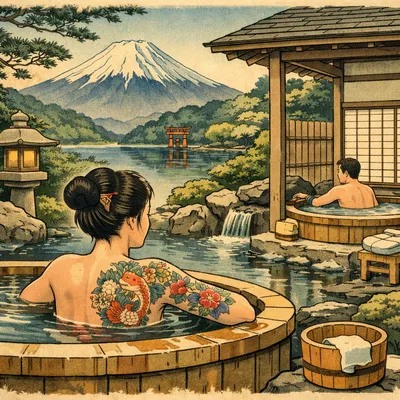
- Tattoos: Private baths are often easier, but policies still vary. Confirm in advance.
- Swimwear: Most traditional baths do not allow it, even in private. Some modern “spa” facilities do—check the rules.
- Diapers: Many places restrict entry for children who aren’t toilet-trained, or require a swim diaper and specific bathing steps. Confirm before you arrive.
Related guide: If tattoos are a concern, start here: Tattoo-Friendly Onsen in Japan: Why Private Baths May Be the Easiest Option.
Which Option Fits Your Family? (Fast Decision Guide)
If you’re traveling with a baby
- Best fit: in-room bath or a property with advance-reservable private baths
- Confirm: diaper/toilet-training rules, temperature control, where you can rinse, and whether baby amenities exist
If you have toddlers or preschoolers
- Best fit: time-slot private bath (less stress than public baths)
- Confirm: session length (you’ll want enough time), slip-resistant flooring, and whether you can bring a child bath chair (some provide them)
If you’re traveling with older kids/teens
- Best fit: either separate public baths (often simplest) or two private sessions
- Confirm: age guidelines for mixed-gender bathing and whether your family prefers privacy or flexibility
If it’s a three-generation trip
- Best fit: a ryokan with multiple private baths or an in-room bath plus public bath options
- Confirm: stairs, walking distance from room to bath, and whether the private bath has a step/ledge that’s hard to enter
Related guide: For booking a property that truly works for families, see Family-Friendly Ryokan in Japan: What to Check Before Booking (Without Regrets).
What Happens Inside a Family Bath (So You Don’t Feel Awkward)
Most private bathing rooms follow a similar flow:
- Changing area: You undress and store clothes (often with baskets or lockers).
- Washing area: You sit and wash thoroughly before entering the tub. This is the most important step.
- Soaking tub: You soak quietly. Keep towels out of the water unless the facility says otherwise.
- Dry and dress: Dry off in the washing area if needed to avoid dripping everywhere.
Private baths are calmer than public baths, but the etiquette basics are the same.
Related guide: If you want a full, beginner-friendly walkthrough, read Private Onsen vs Public Onsen: Which Is Better for Foreign Visitors?.
How to Read Facility Rules (Even When the English Is Vague)
Some listings use short, unclear phrases. Here’s how to interpret common wording on booking pages:
- “Reservation required” → You must book a time; don’t assume you can use it spontaneously.
- “Additional fee applies” → It’s not included in your room plan.
- “Limited availability” → There may be only 1–3 private baths for the whole property.
- “Not a hot spring” or “heated water” → It’s a private bath, but not onsen water.
- “May not be available during peak hours” → You might not get your preferred time (often evenings).
If anything is unclear, message the property with three short questions: How to reserve? How long per session? Any child restrictions?
Common Mistakes First-Time Visitors Make
- Booking based on the English label alone: “Family bath” can mean different setups. Always check time limits and reservation rules.
- Assuming it’s included: Many private baths cost extra, even at nice ryokan.
- Not planning around peak times: Early evening slots can fill fast. Reserve as soon as you can.
- Arriving without a simple plan: With a 45-minute slot, it helps to wash first, then soak, then rinse quickly.
- Expecting lots of space: If your group is 4–5 people, confirm the maximum capacity.
Booking Checklist (Copy/Paste for Your Notes)
- Is it in-room or time-slot private?
- How do we reserve: in advance, at check-in, or first-come?
- Session length: ______ minutes
- Fee: included / extra (¥____ per session or per person)
- Max people per session: ______
- Any child rules (toilet training, age guidelines, accompaniment): ______
- Tattoo policy: allowed / not allowed / ask
- Swimwear policy: allowed / not allowed / ask
- Towels provided: yes / no (if no, bring or rent)
Related guide: For general booking “gotchas” that matter in Japan, read Japan Hotel Guide for First-Time Visitors: What to Know Before Booking.
FAQ: Family Baths in Japan
Can our whole family bathe together in a family bath?
Often yes, because it’s private for your group. But some places have age guidelines for mixed-gender bathing or a maximum number of users per session. Check the property rules before you book.
Do we need to be staying overnight to use a family bath?
Not always. Some day-use hot spring facilities rent private bathing rooms. Ryokan private baths are typically for guests, but policies vary by property.
Is a family bath always an onsen?
No. Some are hot spring water, others are regular heated water. If the water type matters to you, confirm on the official listing.
Are private family baths easier with tattoos?
They can be, because you’re not sharing with strangers. But tattoo rules still vary, so confirm directly with the property.
What should we bring?
Many places provide soap and shampoo. Towels may be provided in your room, at the bath area, or available to rent. If you’re traveling with kids, a small bag with water, hair ties, and a change of clothes can help—especially if your time slot is short.
Related guide: For more practical planning with children, see Japan Travel with Kids: Simple Tips for a Smoother Family Trip.
Final Takeaway
In Japan, “family bath” usually means a private bathing option—but the details (reservation, cost, rules, and whether it’s truly a hot spring) depend on the property. Confirm the five key points before you book, and you’ll avoid the most common surprises while keeping the experience calm and enjoyable for everyone.