You booked a ryokan, and now you’re thinking: “Okay… but what actually happens at dinner?” Totally normal.
What this guide covers: This article focuses on ryokan dinner: timing, courses, etiquette, and what first-time visitors should expect. For private bath or room selection, use Private Onsen, Family Bath, and Open-Air Bath Rooms or How to Choose a Ryokan with a Private Onsen.
A lot of first-time guests picture a simple restaurant meal. Then they see words like “kaiseki,” “in-room dining,” or “set start times,” and it starts to feel like there are secret rules.
Most of the time, there aren’t. Ryokan dinner is usually just a carefully paced, multi-course meal where the staff guides the flow and you get to slow down for the night—often after a check-in, a soak in the bath, and finally sitting down when you’re already a little sleepy in the best way.
Below is what to expect, what tends to be strict (timing), what’s usually flexible (your pace, within reason), and the small things worth confirming so you don’t feel rushed or awkward.
Quick note: Meal styles, serving locations, start times, allergy accommodations, and house rules vary a lot by property and plan. Use this as a calm starting point, and confirm directly with the ryokan before booking (or before arrival) if dinner details matter for your comfort.
What a Ryokan Dinner Usually Is

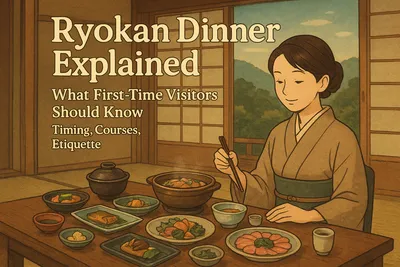
At many ryokan, dinner is a multi-course Japanese meal, often described as kaiseki-style (or kaiseki-inspired).
You typically don’t order from a menu. Dishes arrive in a planned sequence, and staff bring each course at the right time.
Dinner is commonly included in your plan and served either in your room or in a shared dining space. Your main job is simple: show up on time and relax.
Who This Is Helpful For
This is for you if:
- You’re staying at a ryokan for the first time and feel unsure about dinner etiquette
- You don’t speak Japanese and worry you’ll misunderstand the schedule
- You’re confused by “dinner included” vs “room-only” plans
- You’re traveling with kids, food allergies, or picky eaters and want fewer surprises
- You want the ryokan experience, but you also want it to feel easy, not intimidating
What “Kaiseki” Can Look Like (Without Getting Too Technical)
Most ryokan dinners are a course-style meal with small plates, seasonal ingredients, and a calm pace. Some are very traditional and formal; others are simpler but still follow a “courses arrive in order” style.
What dishes might you see?
This varies by region, season, and plan, but a typical flow often includes:
- Small starters (a few bites to begin)
- A soup course
- Sashimi (raw fish) or another fresh seafood course
- Grilled or simmered items
- A hot dish at your table (sometimes cooked on a small burner)
- Rice, soup, and pickles toward the end
- Dessert or fruit
You might not recognize everything. That’s normal. And you’re not being tested.
Stress-Free Tip: If you’re nervous about unfamiliar food, remember: you’re allowed to leave something uneaten. Being relaxed and polite matters more than finishing every bite.
How Dinner Time Usually Works (Step by Step)
1) You’ll be given a dinner start time
Many ryokan have a set start time, or a small window of start times you choose at check-in.
This is where people get surprised. It’s usually not like a hotel buffet where you drift in whenever you feel like it. The kitchen and staff plan the pacing carefully.
Tiny warning: If you arrive late, the ryokan may shorten the meal, skip courses, or in some cases not be able to serve dinner at all. It depends on the property. If you think you’ll be late (missed train, slow bus, rainy taxi line), contact them as early as possible.
2) You’ll go to the dining spot (your room or a dining area)
If dinner is in-room, staff may set up a low table and place settings, then bring dishes in stages.
If dinner is in a dining room, you’ll be shown to your seat. It’s usually quiet, organized, and unhurried.
Either way, you generally won’t be left guessing. Staff will guide you.
Stress-Free Tip: At check-in, take a quick photo of the dinner time written on your plan or key envelope (if provided). After a bath and a change into yukata, it’s easy to forget the exact time.
3) Some dishes may already be set out
Often, a few starters are waiting when you sit down. Then the rest arrives gradually.
The pacing is part of the experience—hot dishes stay hot, delicate items arrive at the right moment, and you’re encouraged to slow down.
4) Courses arrive one by one (or in small groups)
Staff may bring the next course when you’re ready, or on a gentle schedule.
If something is meant to be cooked at the table, they may light the burner or show you what to do. If there’s a language gap, many places use simple English, gestures, or a printed menu.
Stress-Free Tip: If you’re unsure whether to start cooking something, wait a moment and watch. Or ask a simple “Now?” with a smile. That’s often enough.
5) Dinner takes time
Ryokan dinner is not designed to be quick. It’s an evening activity.
Many travelers find it takes around 1.5–2 hours, sometimes more, depending on the number of courses and the property’s style.
If you arrive late in the day, you’ll feel this immediately: check in, drop your bags, maybe squeeze in a bath, and then dinner starts. It helps to keep the evening loose.
Stress-Free Tip: A simple ryokan rhythm that works for many people: arrive → check in → bath → dinner → bath → sleep.
Room Dining vs Dining Hall: Which Feels Easier?
Both can be great. The “easier” one is the one that matches how you like to spend your evening.
In-room dining
Good for: privacy, couples, families with small kids, travelers who feel shy about etiquette.
What can surprise you: staff will enter your room multiple times to serve courses, and your room becomes “dinner mode” for a while.
Practical note: If you have a lot of luggage, the room can feel tight once the table is set.
Stress-Free Tip: Before dinner starts, clear a little floor space and tuck bags to the side. It makes the whole setup feel calmer.
Dining hall / dining room
Good for: travelers who prefer a clear “restaurant space,” people who don’t want staff coming into the room, and anyone who likes a slightly more structured flow.
What can surprise you: it’s quiet—more “soft voices” than lively chatter.
Stress-Free Tip: If you’re worried about volume, aim for “library voice.” You don’t need to be perfect—just considerate.
What to Wear to Ryokan Dinner
Many ryokan allow you to wear the yukata (the casual robe provided by the ryokan) to dinner. Some even expect it.
But not all. A few more formal places may prefer regular clothes in the dining area, or they may have specific rules.
My honest take: If the ryokan provides a yukata and doesn’t say otherwise, it’s often safe to assume yukata is acceptable. But if you want to avoid even a moment of uncertainty, check the ryokan’s dinner instructions (your booking page, in-room guide, or ask at check-in).
Stress-Free Tip: If you’re unsure, a simple option is: yukata + neat hair + clean socks (especially if you’ll be walking through hallways).
Etiquette: What Actually Matters (No Panic Needed)
You don’t need to memorize formal rules to enjoy a ryokan meal. Most of the “etiquette” is just being considerate in a quiet space.
The basics that matter most
- Be on time (the big one)
- Speak quietly in shared dining spaces
- Wait a moment before touching table-cooked items, in case staff is about to explain
- Try a little of each dish if you can (but don’t force it)
- Be kind and grateful—a smile goes a long way
Chopsticks stress?
If you’re not confident with chopsticks, many ryokan can provide a fork if you ask. Some may already set one if you requested it in advance.
Stress-Free Tip: If you remember one thing, remember this: being calm and polite is more important than perfect technique.
Food Allergies, Dietary Needs, and Picky Eating (The Honest Reality)
Ryokan meals are usually planned ahead. That’s part of what makes them special—and also why last-minute changes can be difficult.
If you have allergies
Tell the ryokan before booking or immediately after booking. The earlier, the better.
Some properties can accommodate certain allergies. Some cannot. And some can only accommodate with limitations.
Because this is safety-related, don’t rely on assumptions. Confirm directly with the ryokan before booking.
If you don’t eat raw fish
A lot of travelers worry about sashimi. You’re not the only one.
Some ryokan can substitute. Some may not. Sometimes they can adjust one course but not the whole meal. If this matters to you, ask early.
If you’re traveling with kids
Kid meals vary widely. Some ryokan offer a child-friendly set. Others serve a smaller version of the adult meal. Some require you to book a “child with meals” option.
Check your plan details carefully.
Stress-Free Tip: If your child is in a “plain rice and bread only” phase, consider booking a plan without dinner, or staying somewhere with nearby food options. A ryokan dinner can be wonderful, but it isn’t always the easiest fit for every family.
Understanding “Dinner Included” Plans (So You Don’t Book the Wrong One)
This is a common first-timer issue: you book a beautiful ryokan, then realize dinner isn’t included—or dinner is included, but only if you check in by a certain time.
Common plan types you may see
- Dinner + breakfast included: the classic ryokan experience
- Breakfast only: lighter commitment, easier if you arrive late
- Room-only: no meals; good if you want flexibility or have dietary concerns
Tiny warning: Some ryokan are in quiet areas with limited restaurants nearby, especially at night. If you book room-only, check what food options exist around the ryokan (and the latest opening hours) before you arrive.
Stress-Free Tip: If you’re arriving after a long flight and a complicated train ride, a first-night ryokan in a remote area can feel like a lot. Many travelers find it easier to schedule the ryokan for later in the trip.
Accommodation Terms Explained (So Booking Pages Make Sense)
These words show up a lot when you book a ryokan stay. Here’s the simple version.
Ryokan
A traditional Japanese-style inn. Often includes tatami rooms, bedding on the floor (futon), baths (sometimes onsen), and meal plans.
Onsen
A hot spring bath using naturally heated spring water. Not every “big bath” is onsen—some are just heated water. If the water type matters to you, check the ryokan’s official description.
Private onsen
This phrase can mean different things. It might mean a bath attached to your room, or a reservable private bath you book for a time slot. Always confirm what “private” means for that property.
Family bath / reserved bath
Often a private bath that couples, families, or small groups can use together. It does not always mean the ryokan is designed specifically for families with kids.
Room with private open-air bath
A guest room with its own outdoor-style bath (open-air). Usually very private and convenient, but often more expensive. Details vary, so check the room description carefully.
Yukata
A casual robe provided by many ryokan. Often worn around the property and sometimes to dinner, depending on the ryokan’s rules.
Common Mistakes (Easy to Make)
- Booking a ryokan without checking the meal plan (then realizing dinner isn’t included)
- Assuming dinner is flexible like a restaurant (start times can be strict)
- Arriving too late for dinner because train transfers or bus schedules took longer than expected
- Not telling the ryokan about allergies early (some changes can’t be made last minute)
- Overplanning the evening (ryokan dinner is slow on purpose)
- Assuming “private bath” means “in your room” (it may be reservable instead)
Stress-Free Tip: When you book, treat dinner like a reservation you can’t casually move. Build your travel day around it, especially if you’re coming in by train with luggage and you’re not sure how long the last transfer will take.
Recommended Options (Choose What Makes Dinner Feel Easier)
Option: Dinner + breakfast included plan
Best for: first-time ryokan guests who want the “full experience” without hunting for food.
Not ideal for: travelers with complex dietary restrictions or very late arrival times.
My honest take: If your goal is to understand what a ryokan stay feels like, this plan usually delivers. Just make sure your arrival time matches the dinner schedule.
Option: Breakfast-only plan
Best for: travelers who want a ryokan stay but prefer flexible evenings.
Not ideal for: remote areas where dinner options nearby are limited.
My honest take: This can be a good “training wheels” option. You still get a Japanese-style morning meal, without the pressure of a timed multi-course dinner.
Option: Room-only plan (no meals)
Best for: picky eaters, travelers with allergies who prefer full control, or people doing a short ryokan stay.
Not ideal for: travelers who chose the ryokan specifically for the food experience.
My honest take: It can be the least stressful choice for some people. Just confirm food availability around the ryokan before you commit.
Before You Book: What to Confirm (5-Minute Check)
- Is dinner included in your plan, or is it breakfast-only / room-only?
- Where is dinner served: in-room or dining area?
- What is the latest check-in time if you have dinner included?
- Do you need to choose a dinner start time at check-in?
- Can the ryokan accommodate allergies or specific dietary needs? (Confirm directly before booking.)
- If you don’t eat certain foods (raw fish, beef, etc.), can they substitute?
- Are you allowed to wear yukata to dinner?
- If the ryokan is remote, what are the nearby dinner options if you book without dinner?
A Calm Way to Think About It
Ryokan dinner can sound formal on paper. In real life, it’s usually gentler than people expect.
You show up on time. You sit down. Dishes arrive. You taste new things. You take a few photos. If you don’t understand a dish, you use your phone to translate the menu card, shrug, and try a bite anyway.
You don’t need perfect manners or perfect chopstick skills. A little preparation—mainly around timing and food needs—goes a long way, and then you can let the ryokan handle the details.